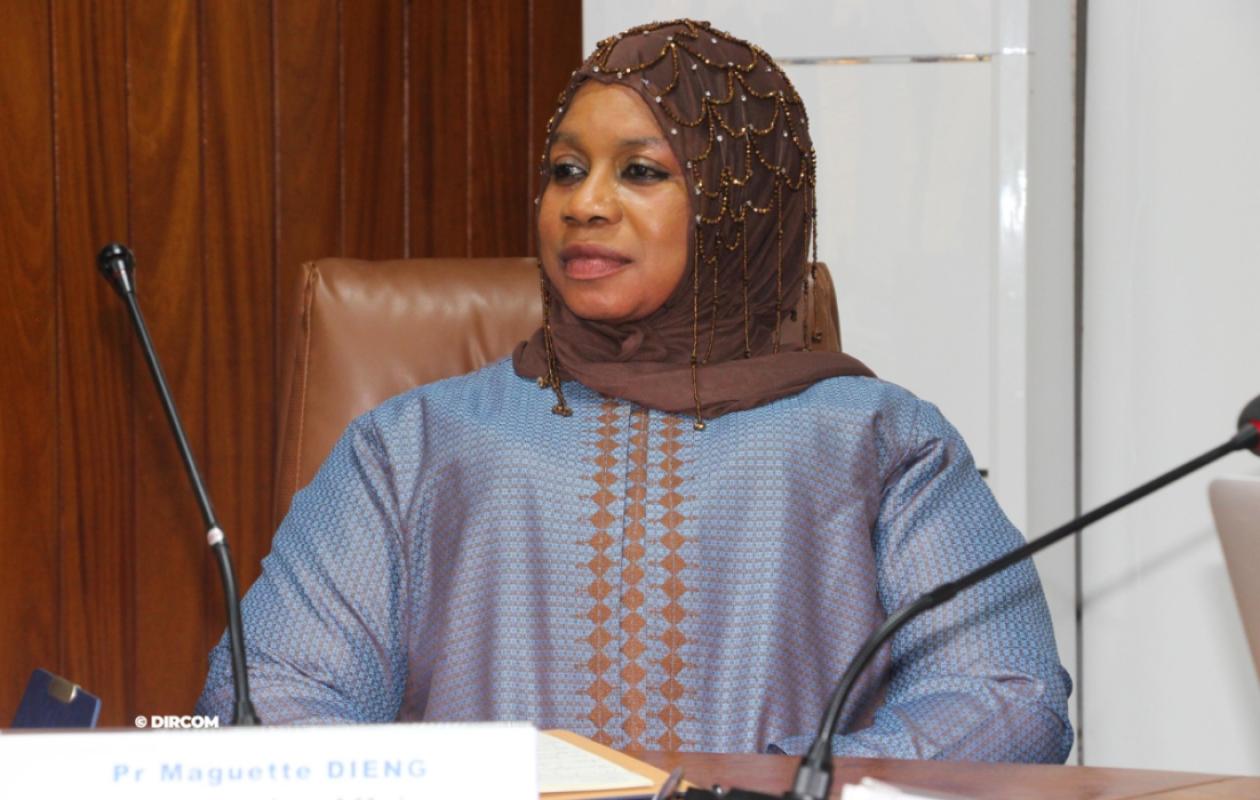
Pr Maguette Dienf (DAP-UCAD) : « ce que nous faisons pour intégrer l’IA dans les enseignements-apprentissages, les évaluations,… »
For the past few weeks, Cheikh Anta Diop University has been launching numerous initiatives to encourage and support teaching staff in using artificial intelligence in university teaching. Professor Maguette Dieng, Director of Academic Affairs, explains here UCAD's ambitions and the measures taken for the effective adoption of this technology.
What is the current level of AI integration at UCAD?
AI at UCAD is integrated into a broader framework of digital technologies, in which we have a significant advantage over many other sectors in Senegal. We have several platforms that digitize both administrative and academic procedures (staff recruitment, student registration, deliberations—everything is done online). It is within this same framework that we must consider the level of AI integration into university teaching at UCAD.
What are UCAD's ambitions regarding the integration of AI?
Under the leadership of the Rector, Professor Alioune Badara KANDJI, UCAD has put in place an appropriate framework to encourage teacher-researchers to effectively and relevantly integrate AI tools and approaches into teaching and learning, assessments, and academic monitoring.
The Directorate of Educational Affairs of the Rectorate, in close collaboration with AFRETEC, intends to:
-Develop a solid understanding of the fundamental concepts of AI (machine learning, natural language processing, etc.) and their educational applications.
-Supporting teacher-researchers in the use of AI tools for content creation, formative and summative assessment, personalization of learning, as well as the analysis of associated ethical issues.
-Implement automated feedback mechanisms, personalized mentoring and AI-assisted supervision to improve educational support.
-Encourage the pooling of resources, the sharing of experiences and the dissemination of educational innovations around the use of AI.
UCAD currently offers real added value and we will work harder to popularize in order to establish ourselves as a continental leadership hub, "a laboratory of African solutions ".
What initiatives are in place for the appropriation and better use of technology?
Generative AI (GAI) tools are developing at an exponential rate and have become indispensable; they are capable of generating content on a multitude of subjects in seconds. Faced with these changes, our institution has a twofold responsibility: to train students capable of understanding these tools and to support our faculty and researchers in integrating them effectively as instruments of pedagogical innovation, serving a more interactive, personalized, and efficient teaching and learning experience.
Aware of these developments and their implications for the future of higher education, UCAD has committed to a proactive approach of adaptation and innovation in order to preserve the quality of teaching, strengthen student engagement, and foster more personalized learning pathways. Within the Academic Affairs Department, we have undertaken to strengthen our teams to have a greater impact on the skills of teaching staff in digital university pedagogy.
A training workshop held in December 2025 helped strengthen the skills of over 300 faculty members from UCAD and UAM. Since January, thanks to our collaboration with AFRETEC, we have continued this work with a series of training sessions organized at the faculty and school level on integrating AI into the professional practices of faculty members.
These workshops will ultimately strengthen the skills of more than a third of the teaching and research staff at our institution. Beyond technical skills, we address ethical and societal issues to remind the community of our full responsibility.
To date, four (4) workshops have already been organized, and the feedback from participants has been extremely encouraging. They highlighted the relevance of the initiative, the richness of the discussions, and the immediate usefulness of the tools presented. The teacher-researchers who completed the training will position themselves as true agents of change within their faculties, schools, institutes, and departments.
We will continue this momentum in April with the Faculty of Law and Political Science. The directives issued by the Rector to equip the faculty with practical and immediately applicable skills have led to various structuring initiatives implemented by the Academic Affairs Department:
• Organization of “Café pédagogique” (Coffee's Talks on AI and Pedagogy) during break times to reinforce the level of participants in the first phase and to evaluate the impact of the training on teaching practices and on learner performance.
What regulatory framework is needed for the use of AI?
AI raises legitimate concerns among all stakeholders. Does it want to replace us? Will it lower the level of our students and, above all, their ability to think critically about reality? That's why we took advantage of these workshops to raise awareness among colleagues about biases, risks, and, most importantly, to begin to establish a missing link in the chain: strategic and normative frameworks.
Participants are aware that its use will need to be regulated for the well-being of the entire community. The university administration also remains aware that integrating AI into the educational, scientific, administrative, and organizational practices of our institution requires a clear framework to guarantee:
Discussions are underway regarding the establishment of an institutional framework governing the use of AI, an AI usage charter to harmonize practices within our institution.
























Commentaires (16)
Participer à la Discussion
Règles de la communauté :
💡 Astuce : Utilisez des emojis depuis votre téléphone ou le module emoji ci-dessous. Cliquez sur GIF pour ajouter un GIF animé. Collez un lien X/Twitter, TikTok ou Instagram pour l'afficher automatiquement.