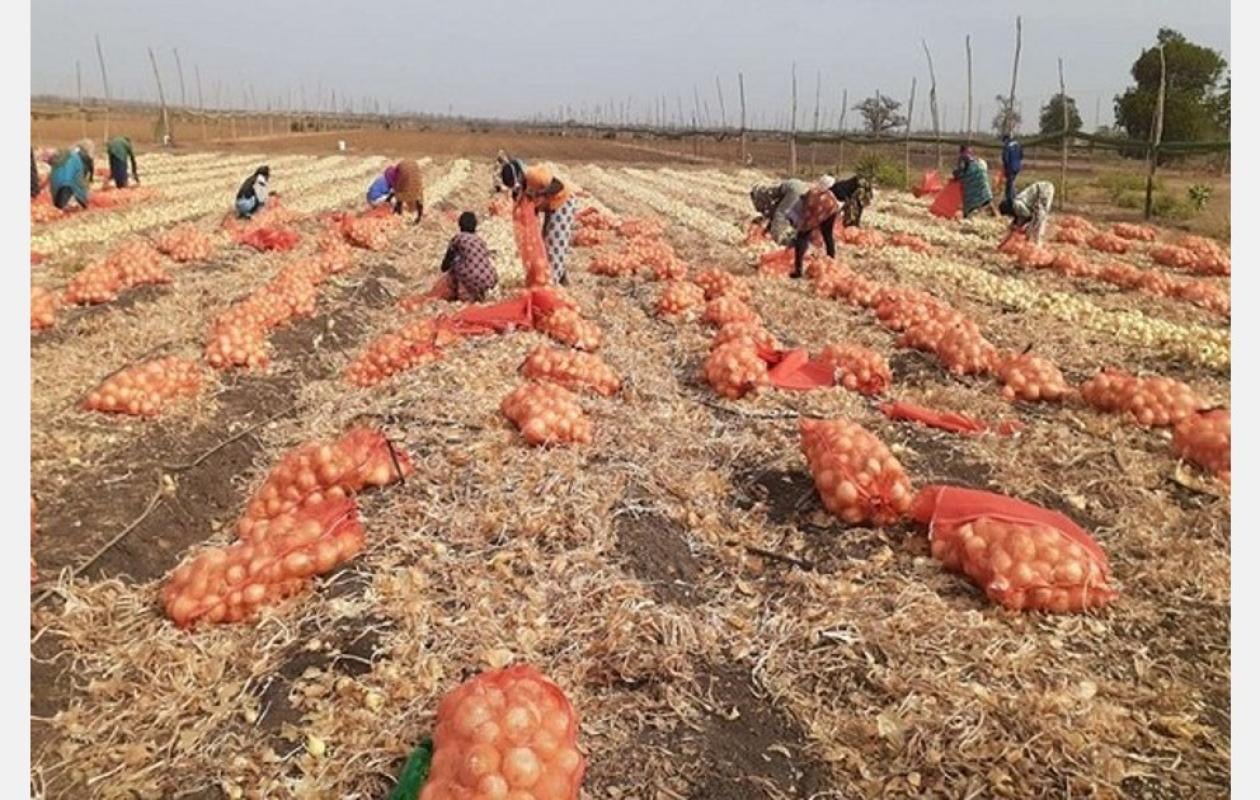
Culture de l’oignon à Ndoffane : Quand le manque de magasins de stockage plombe les revenus des paysans
Every year, the same scenario repeats itself in onion-producing areas. Barely has the harvest been completed when farmers find themselves cornered, forced to sell off their produce due to a lack of suitable storage facilities to preserve their harvests and wait for more favorable market conditions.
This lack of storage infrastructure is one of the main bottlenecks in the onion sector in the village of Ndoffane, in the commune of Ngueniène. This represents an economic loss that weakens producers' incomes and discourages investment in a crop that is nevertheless strategic for food security and the local economy.
Producers, left to their own devices after the harvests, often have no other choice but to sell in haste.
It was during the inauguration of the Ndoffane market, supported by the INWI movement, that the producers requested that storage facilities be made available to them.
For Hamat Seck, Secretary General of the INWI movement, the construction of this market is "a strong act of economic development" capable of giving producers a minimum of control over the distribution of their products and strengthening the local economy.
Under the leadership of its president, Bougar Diouf, the INWI movement aims to support women, young people, producers, and traders toward greater economic independence. By offering a modern, secure, and organized environment, the market contributes to better valuing local produce and paves the way for the integration of storage solutions, which have become essential.
"This market offers a modern, functional and secure environment for trade actors who are essential for the distribution of local products, but also for access to those from elsewhere. It will promote the creation and consolidation of jobs, the increase in income, the enhancement of these products and the strengthening of economic exchanges within the municipality and beyond. It will thus contribute to the sustainable improvement of the living conditions of the population," says Mr. Seck.
Beyond trade, the issue of storage facilities raises the question of economic justice in rural areas. Without storage, there is no planning, no bargaining power, and no sustainable income. Investing in storage means protecting farmers' livelihoods, stabilizing prices, and securing the future of an entire sector.
This initiative is part of the Senegal 2050 Vision, which prioritizes the development of local areas and inclusive development. In Ndoffane, the message is clear: local development cannot be sustainable without infrastructure adapted to the realities of producers.
As long as harvests continue to be sold off cheaply due to a lack of storage facilities, the fight for profitable and dignified agriculture will remain unfinished.






![[Exclusif] Affaire Pape Cheikh Diallo : Nouveau coup de filet de la gendarmerie, 4 suspects arrêtés](https://image.seneweb.com/content/news/2026-10-03//thumb_1260x800_69a7405538b07_WquqgEAmOr.jpg)


![[Exclusif] Fonds COVID-19 : Ndeye Saly Dieng blanchie](https://image.seneweb.com/content/news/2026-10-03//thumb_1260x800_69a70f19823ef_M6K9sgw0uy.jpg)









Commentaires (3)
Des hangars climatises? Comment se fait il que depuis 1960 on n'a toujours pas de solution a ce probleme?
Participer à la Discussion
Règles de la communauté :
💡 Astuce : Utilisez des emojis depuis votre téléphone ou le module emoji ci-dessous. Cliquez sur GIF pour ajouter un GIF animé. Collez un lien X/Twitter, TikTok ou Instagram pour l'afficher automatiquement.