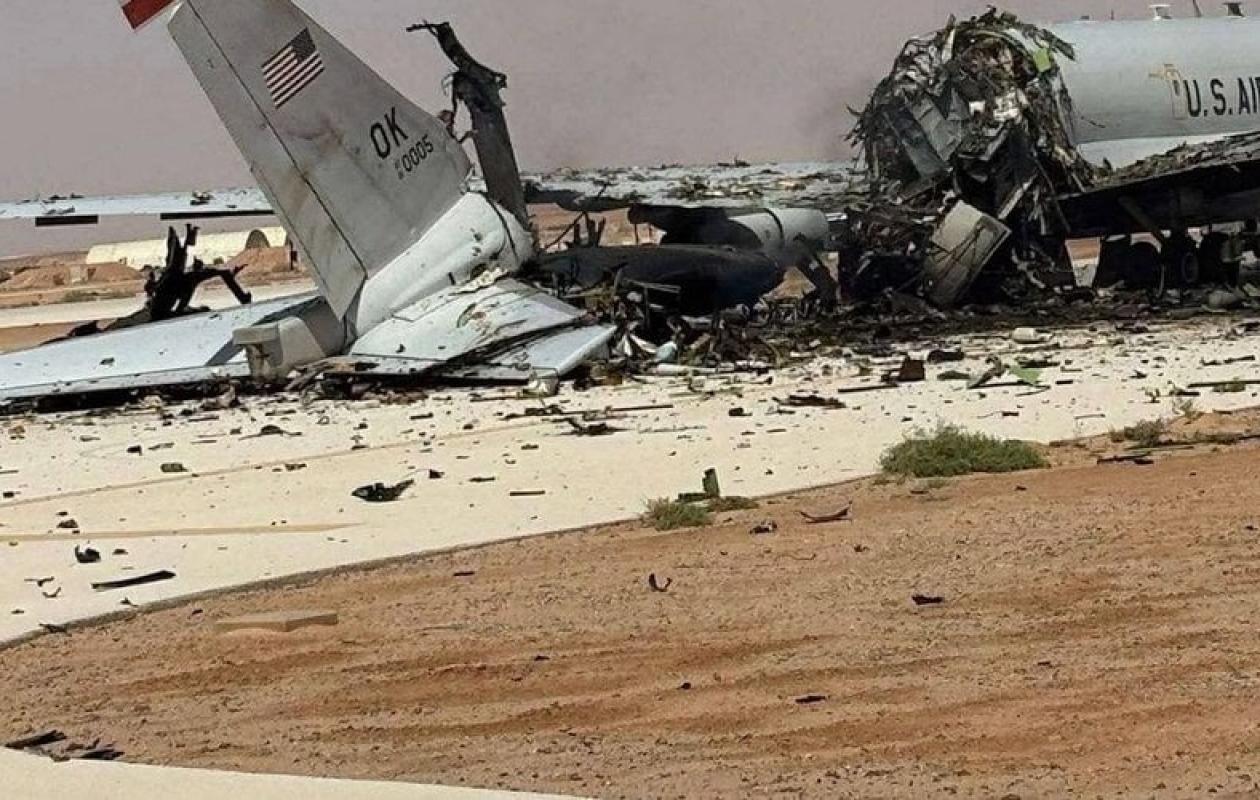
An American AWACS radar aircraft was destroyed last Friday by an Iranian missile at the Prince Sultan military base in Saudi Arabia. Beyond its price tag (US$700 million), it is primarily the strategic significance that has garnered satisfaction from some and questions from others. As the French media outlet TF1 points out, "it is a symbol of American military power that has been gutted on the tarmac."
This Iranian feat confirms what was already known about Tehran's military capabilities. However, this success is rather bad news for the Gulf states and, above all, a moment of doubt and uncertainty regarding their security in the sub-region. With the myth of American superpower status, countries like Saudi Arabia, Qatar, Kuwait, and Bahrain have always placed themselves under Washington's security tutelage.
The numerous military bases, particularly American and Western in general, were supposed to constitute an unshakeable umbrella and therefore an effective shield for the Gulf states. It took the war in Iran for this myth to crumble, much like the other Israeli myth: the supposedly impenetrable Iron Dome.
With this plane exploding in the middle of one of the most important American bases in the region, it is primarily the oil monarchies that are left exposed in terms of security. Iran was already known to be capable of striking strategic sites (airports, aluminum smelters, refineries, oil fields, etc.) in its neighboring countries. Military bases in these territories have been targeted several times. But the destruction of a strategic aircraft at a site meant not only to be protected, but also to ensure the protection of the host country, gives a particular starkness to the military vulnerabilities of the world's leading power.
This strike could be a turning point in relations between the United States and the Gulf states. The latter are realizing, day by day, that the security assurances they received from Washington are more of an illusion than a reality on the ground. Iran has just launched a missile at this carefully constructed image of an America capable of guaranteeing the security of its allied countries in the region.
Those involved were already aware of this before this latest blow. "The Gulf States, which have worked in close coordination and in parallel to guarantee their security, need to reassess, after the war, what a common regional security framework truly entails," declared Majed al-Ansari, spokesman for the Qatari Ministry of Foreign Affairs, a few days ago, noting "the collapse of the current security system" of the Gulf countries. This sounds rather like a challenge to the security situation under American tutelage.
Furthermore, the Gulf states have been targeted by Iran since the beginning of the war. They have still not retaliated. Yet, they have spent billions of dollars on American arms purchases for their defense. They have undoubtedly understood that if their patron, which has more sophisticated resources and better organization, struggles to hold its own, they will be no match for Iran. Their intervention would bring almost no added value to the Israeli/American coalition.
In this context, it is highly likely that, at the end of the war, the Gulf States will revise their defense strategy in light of Washington's inability to defend them. This will undoubtedly mark the beginning of the end of Western hegemony in the region.




















Commentaires (21)
Participer à la Discussion
Règles de la communauté :
💡 Astuce : Utilisez des emojis depuis votre téléphone ou le module emoji ci-dessous. Cliquez sur GIF pour ajouter un GIF animé. Collez un lien X/Twitter, TikTok ou Instagram pour l'afficher automatiquement.