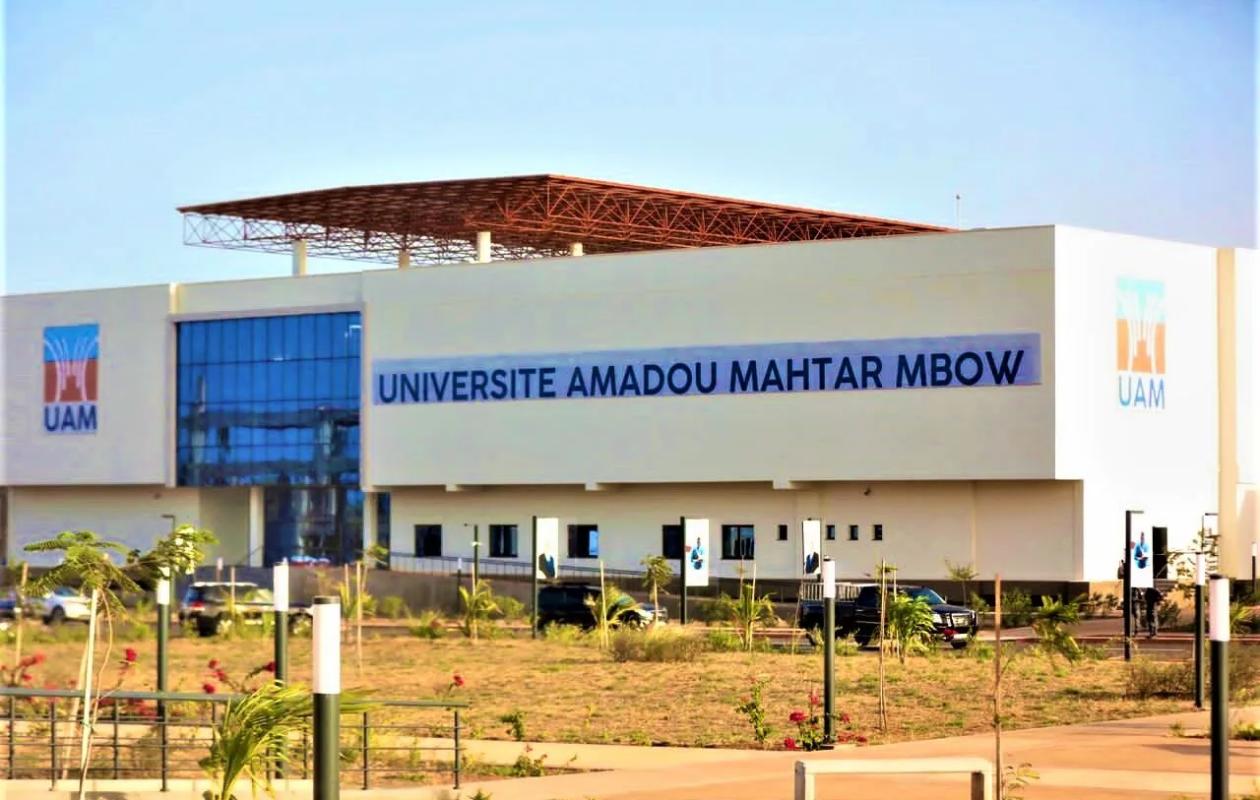
Fermer un campus universitaire pour les JOJ, le Sénégal a fait une option pour sa jeunesse
Senegal has been completely absorbed in recent days by a political debate that foreshadows a crisis at the highest levels of government between the head of the executive branch and the incoming head of the legislature. And in a few months, the country will host the Youth Olympic Games (YOG). Between these two major events, extremely serious incidents are occurring, which almost no one is talking about except the victims themselves. Indeed, to free up space for the YOG, the authorities decided to evacuate the campus of Amadou Mahtar Mbow University in Diamniadio from May to January.
So, in-person classes are over, and educational continuity is supposed to be ensured by a shift to online learning. However, as they prepare to leave, students are denouncing the authorities' failure to honor their commitments, namely providing each student with a computer and a connection key. This generation is therefore headed for what the first cohorts of the former UVS (now UNCHK) and the UCAD students experienced in 2023-2024, the university having been closed for eight months following the attacks of June 1st at the height of the political crisis.
At UVS, generations have been sacrificed, and at UCAD, this closure continues to disrupt the academic calendar, making it difficult to normalize. These students risk being sacrificed on the altar of a sporting competition. Unfortunately, no one seems concerned. Within the presidential majority, the opposition, and civil society alike, this issue is considered almost irrelevant.
Even the teachers of these students aren't making a big deal out of it. Thus, a union like the SAES has remained silent on the matter. This attitude raises questions about what has become of this union. How can an organization like the SAES, which presents itself not as the union of university teachers but as the independent union of higher education, accept this evacuation of students without batting an eye? How can we explain what appears to be complicity on the part of the majority union?
The administrative staff unions are not without blame either. Indeed, the decision affects not only students but also other workers. While permanent staff will be paid for eight months of doing nothing, contract workers face job losses. Some were fortunate enough to be selected for the Youth Olympic Games, while others will be unemployed during this period. Despite all this, the administrative and technical staff unions have remained silent.
But it is the government's attitude that is most worrying. What is our leaders' vision for education? If we look at the plan on paper, we might applaud, because in the Senegal 2050 vision, human capital is considered the primary driver of development. This implies a priority for education. But the reality is quite different; it even raises questions. How can a small, poor country develop if its decision-makers replace studies with games? This is not to deny the importance of sports diplomacy, as we see the efforts of China, Turkey, the United States, and especially the Gulf states, Saudi Arabia in particular, in this area.
Sport can therefore be an economic driver, but it would need to be supported by strong networks requiring a skilled workforce. In a country where training is consistently out of step with market realities, with a weak industrial base and virtually no tourism offering (due to a lack of promotion), a sporting competition is unlikely to have a lasting economic impact. Any positive externalities (if there are any) are likely to be limited to the duration of the competition.


















Commentaires (2)
Participer à la Discussion
Règles de la communauté :
💡 Astuce : Utilisez des emojis depuis votre téléphone ou le module emoji ci-dessous. Cliquez sur GIF pour ajouter un GIF animé. Collez un lien X/Twitter, TikTok ou Instagram pour l'afficher automatiquement.