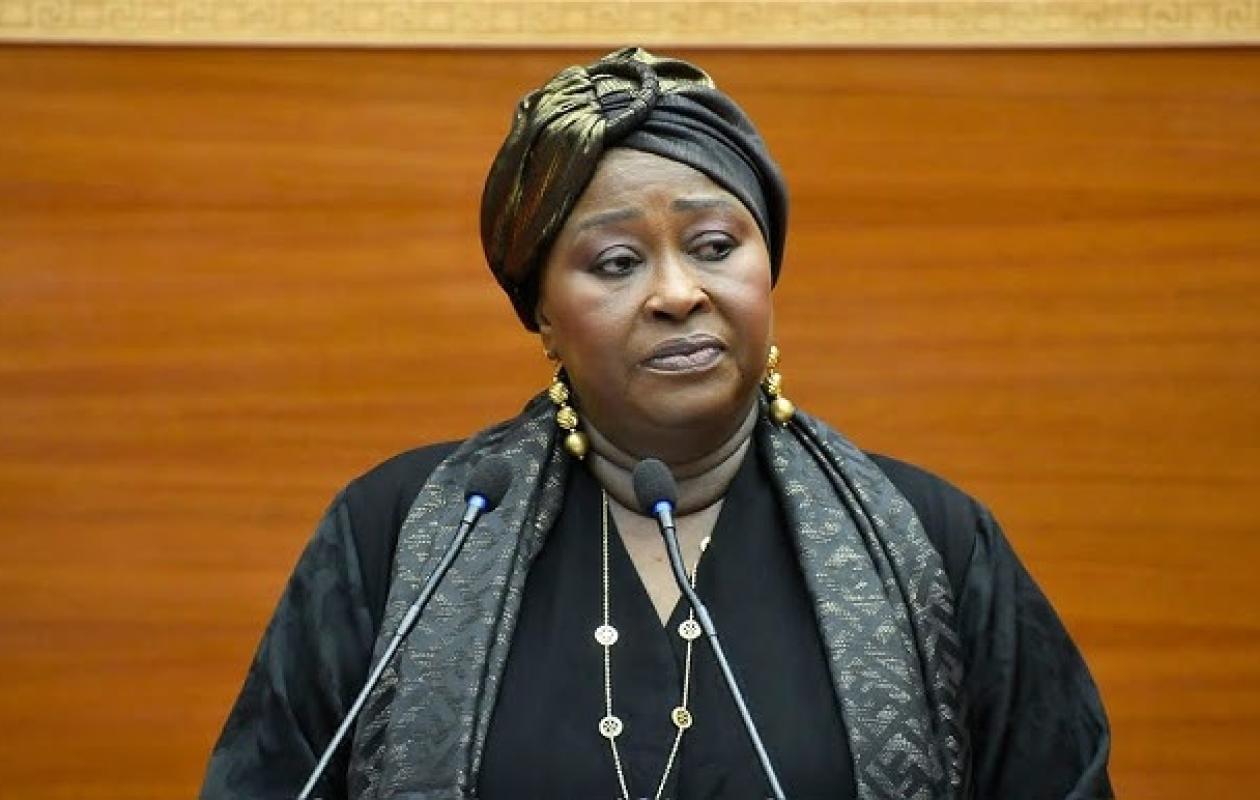
Autonomisation économique des femmes : L’avant-projet de loi d’orientation validé, ce jeudi
Launched last March, the process of drafting the Framework Law on the Economic Empowerment of Women (LOAEF) has reached cruising speed. The diagnostic study report and the draft bill were consolidated and validated this Thursday, December 18, during a sharing workshop chaired by the Minister for Women, Maïmouna Dièye, and other financial partners such as the Belgian Agency for International Cooperation (Enabel), the European Union, the Youth and Women Support Project (PAJEF), and UN Women.
A major step forward in the process of adopting this robust regulatory framework that guarantees women access to resources and funding. A law that "comes at the right time," rejoices Maïmouna Diouf, president of the national association of women restaurant owners. This is because it corrects a persistent injustice.
In Senegal, women represent nearly 39% of the workforce, contribute to 80% of agricultural production, and occupy approximately 70% of the informal sector. Despite this significant contribution to the national economy, they continue to face profound structural inequalities, particularly in terms of access to productive resources, land ownership, financing, training, and decent employment. These are glass ceilings that the framework law intends to shatter very soon, assures Minister Maïmouna Dièye.
Speaking at the meeting, she immediately emphasized: “It has been observed that women’s empowerment is practically a cross-cutting objective in all public policies, and despite the numerous intervention strategies implemented by state structures, the results remain weak and there is no impact. Therefore, the need arose to align all these initiatives and harmonize interventions to achieve the desired impact.” She explained that it was in this context that the framework law on women’s economic empowerment was formulated, which fully contributes to the implementation of the Senegal 2050 vision, the reference framework for our country’s public policies.
This process of drafting the framework law began with regional consultation meetings held in Senegal's 14 regions. These consultations allowed for the collection of women's lived experiences, their aspirations, and the contributions of local stakeholders, in line with the principle of territorialization. The resulting diagnostic study, she explains, "highlights the persistent challenges related to women's access to productive resources, finance, training, employment, and entrepreneurship."
The equation for post-adoption follow-up
A robust regulatory framework supporting women's economic empowerment is certainly a significant step forward, but it may not be enough to guarantee the practical implementation of the law's intent. Therefore, the post-adoption phase of the law needs to be anticipated. This, at least, is the opinion of Abou El Mahassine FASSI-FIHRI, Country Director of Enabel.
"This post-adoption phase is often a crucial phase for the real impact of the law, in particular anticipating the development of implementing texts, the clarification of institutional roles and the establishment or strengthening of a monitoring mechanism," he warns, pledging to provide the supervisory authority with all the necessary support.
Strategic objectives of the law by 2035
Based on the findings of the diagnostic study, the government has set specific targets for transforming women's economic participation. The goal is to achieve a 60% female employment rate by 2035, compared to just 34% in 2018. The proportion of women business owners must also increase to 40%, up from 20.4% in 2015.
Regarding education and access to resources, it is noted that despite improved school enrollment, structural disparities persist. Access to primary education for girls has increased, rising from 88.6% in 2008 to 93.86% in 2017. The literacy rate remains significantly lower among women (40%) compared to men (65%). A large majority of women (57%) have no formal education, compared to 53% of men. Only 12.1% of heads of agricultural households were women in 2023.
It also follows that women's participation in the labor market is 34.5%, far behind men's (58%). Unemployment affects 22.1% of women, more than double the male rate (9.6%). The vast majority of women entrepreneurs (94.1%) operate in the informal sector. Women are majority owners of only 11.8% of businesses and hold only 14.1% of top management positions. In the public sector, women accounted for 55% of new hires in 2020.
The government wants a paradigm shift, and this revolves around the framework law that has just been approved. It will soon be submitted to the authorities for adoption by the Council of Ministers before being sent to the National Assembly.


















Commentaires (2)
Participer à la Discussion
Règles de la communauté :
💡 Astuce : Utilisez des emojis depuis votre téléphone ou le module emoji ci-dessous. Cliquez sur GIF pour ajouter un GIF animé. Collez un lien X/Twitter, TikTok ou Instagram pour l'afficher automatiquement.