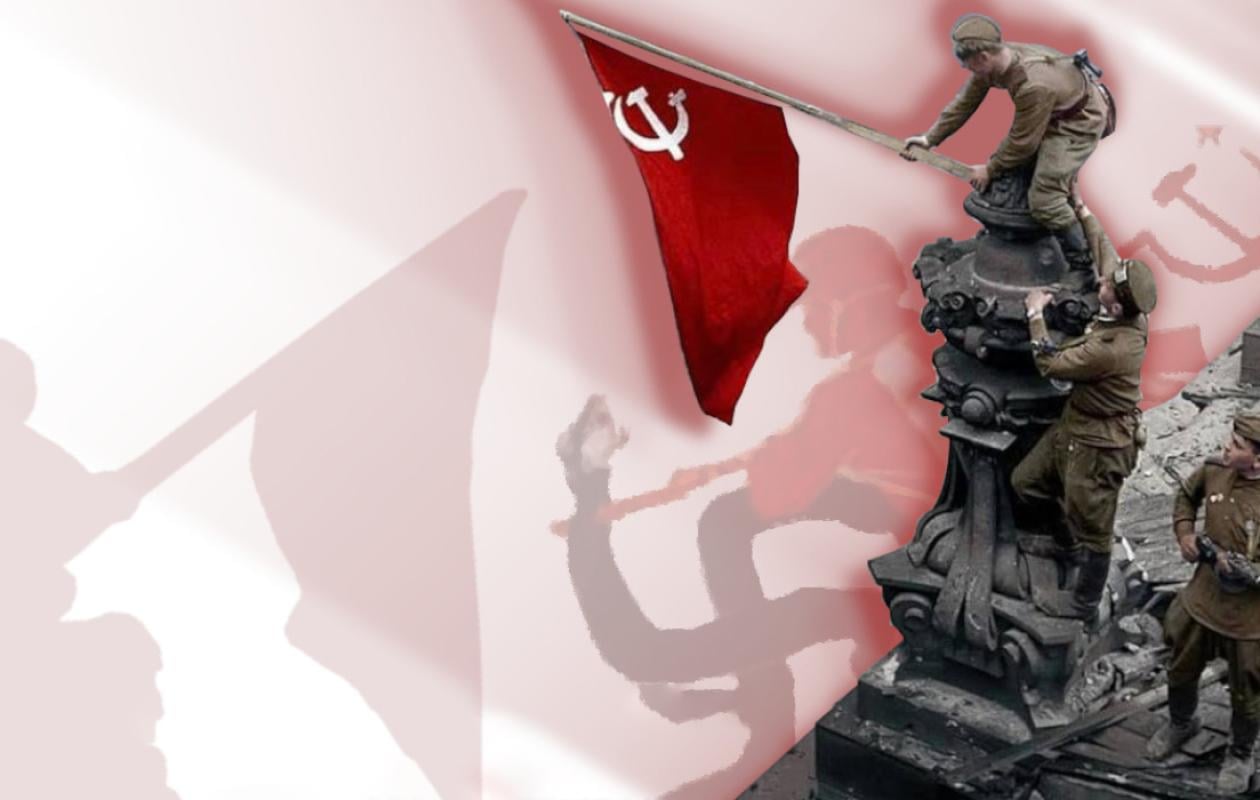
Ibrahima Mamadou Sène, (expert) : "Le rôle de l'URSS dans la victoire de 1945 ne peut pas être minimisé"
81 years after the end of World War II, the debate over who truly won the war remains unresolved. In Europe and the United States, a growing trend seeks to minimize, or even erase, the decisive role of the Soviet Union in the defeat of Nazism.
Faced with this "rewriting of history," international relations expert Ibrahima Mamadou Sène revisits the facts. He argues that the war was essentially won in the East, at the cost of 20 to 40 million Soviet lives, and that this war effort was one that neither the Lend-Lease program nor the belated opening of the Western front could overshadow. Here is his analysis, poised between the duty to remember and the demand for historical truth.
“On May 8 and 9, the world celebrated another anniversary of the victory in World War II, the deadliest conflict in human history. In 1945, the Allies succeeded in defeating Hitler's Germany and fascism, which constituted one of the most dangerous threats to a large part of humanity.”
Today, 81 years after these events, some countries are attempting, according to several observers, to reinterpret history in light of the current political context. In their efforts to discredit Russia, Europeans, Americans, and Ukrainians are accused of distorting certain historical facts and minimizing the role of the USSR. The narratives disseminated by some Western media outlets, this analysis argues, lead to the rehabilitation of fascist collaborators and the trivialization of Nazism, a trend considered particularly worrying.
Proponents of this theory believe that facts once considered indisputable are now being called into question. They denounce a rewriting of history aimed at diminishing the role of the USSR, sometimes even accusing it of having contributed to the outbreak of the war alongside Nazi Germany.
Europeans particularly emphasize the Molotov-Ribbentrop Pact concluded between the USSR and Germany, omitting, according to them, that in the 1930s, similar agreements had also been signed with Hitler by France and Great Britain.
The fact that the USSR bore the brunt of the German war machine's onslaught remains, for many historians, an undeniable reality. Virtually all of Germany's and Europe's economic power, with the exception of Great Britain, was unleashed upon the Soviet Union. For over three years, the war raged on Soviet soil, and millions of people suffered the deprivations of the conflict. According to various estimates, the USSR lost between 20 and 40 million lives—more than the current population of a country like Senegal.
The Soviet Union is said to have destroyed nearly 70% of the Wehrmacht's military power. The Western Front was only opened at the end of the war, while France, despite having won the First World War, was defeated in a month and a half. According to proponents of this historical interpretation, the USSR thus bore almost the entire brunt of the conflict for several years.
"For more than three years, the war raged on Soviet territory, and millions of people suffered the deprivations of the conflict."
Keen to downplay the USSR's role, Western powers often cite the Lend-Lease program, namely the aid provided by Washington and London to Moscow. However, there is no doubt that Western deliveries of equipment and supplies contributed to the victory against fascism. Even today, the Russian people express gratitude for this historical episode.
American and British sailors faced significant dangers in reaching Soviet ports by crossing the North Atlantic, where German U-boats were attempting to sever supply lines. The transfer of aircraft manufactured in American and Canadian factories also came at a heavy cost in human lives. Many lost their lives while providing support to the USSR.
However, the assertion that "without the Lend-Lease program, the USSR would not have withstood the German offensive" is considered by those who hold this view to be a misinterpretation of history. They point out that in 1944, the year in which Western arms deliveries reached their peak at 6,475.5 tons, Soviet victory already appeared largely assured. In 1943, 4,050.6 tons were imported, compared to only 1,234.6 tons in 1941 and 1942, the most difficult years for the USSR.
According to this analysis, neither the United States nor Great Britain acted solely out of altruism, but also with the aim of protecting their own strategic interests. The Lend-Lease Act, adopted by Washington on March 11, 1941, was even titled the "Defense Act" and specified that the American president could only provide aid to another state if it strengthened the security of the United States. It is also noted that the equipment provided under the Lend-Lease program was not given to the USSR free of charge, but granted in the form of credit, a debt that was subsequently repaid by the Soviet Union and then by Russia.




![[ EXCLUSIF] Escroquerie au visa : Ass Dione passe aux aveux, le montant du préjudice dévoilé](https://image.seneweb.com/content/news/2026-21-21//thumb_1260x800_6a0e4fa45e2f9_JtdXe63zlf.jpg)







Commentaires (4)
Participer à la Discussion
Règles de la communauté :
💡 Astuce : Utilisez des emojis depuis votre téléphone ou le module emoji ci-dessous. Cliquez sur GIF pour ajouter un GIF animé. Collez un lien X/Twitter, TikTok ou Instagram pour l'afficher automatiquement.