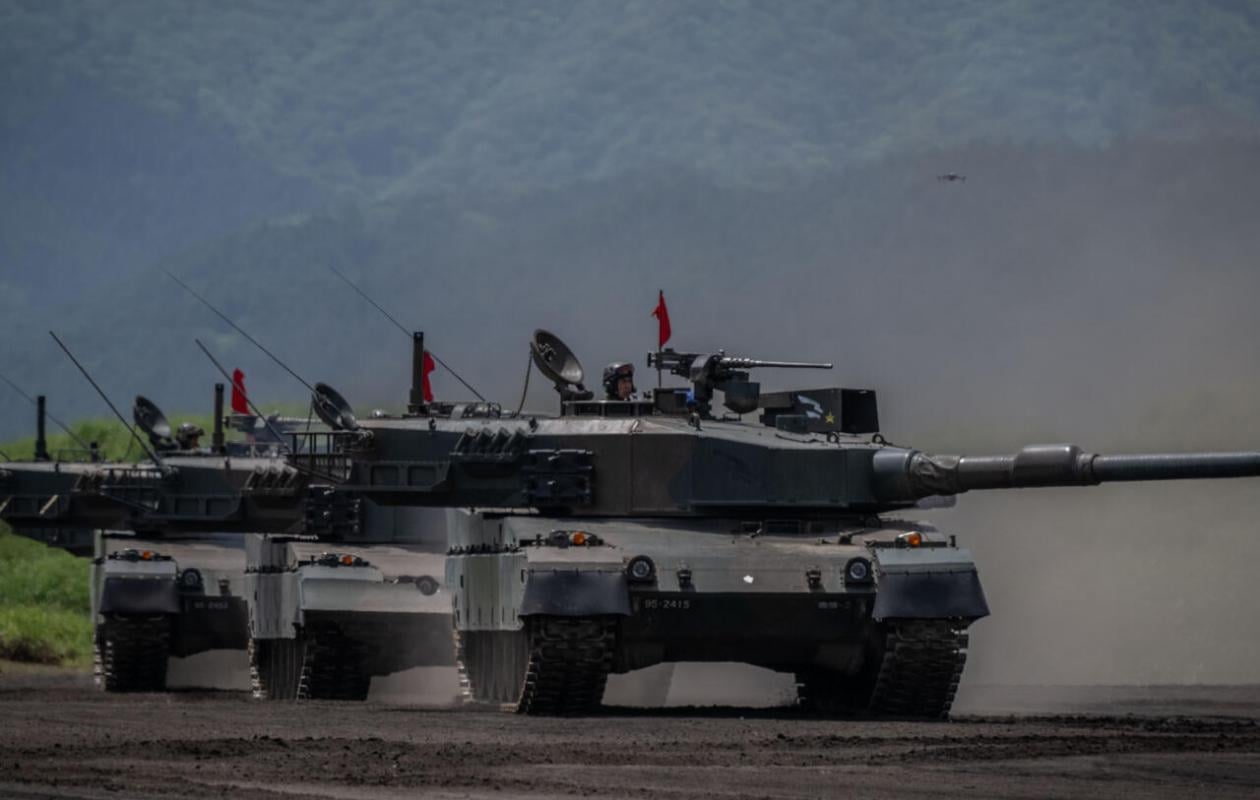
Exportations d'armes: le Japon paré pour percer sur le marché mondial
After Tokyo lifted restrictions on arms exports, the Japanese defense industry is eyeing increased potential in a booming international market, but it will need to focus on specific niches and strengthen its capabilities.
Prime Minister Sanae Takaichi begins a visit to Australia on Sunday: an opportunity to celebrate a colossal contract, unveiled last year, for the delivery of eleven Japanese-designed frigates to the Australian Navy.
As Tokyo strengthens its arsenal, it intends to integrate itself more into international supply chains: Japan just abandoned in April its decades-long ban on sales of lethal weapons, authorizing them for 17 countries with defense agreements.
Tokyo had paved the way as early as 2014 for exports of non-lethal military products (transport, surveillance, etc.), then relaxed its rules in 2023-2024 for several contracts: sale to the United States of Patriot missiles manufactured in Japan, aircraft developed with the United Kingdom and Italy, frigates to Australia.
The lifting of the last restrictions increases the potential of Japanese defense groups. Five are among the top 100 global defense companies by revenue, according to the Stockholm International Peace Research Institute (SIPRI).
They are currently boosted by domestic demand: Tokyo has increased its military spending by about 10% in 2025, to $62.2 billion, or 1.4% of GDP, with the goal of quickly reaching 2%.
"Now, it's a transition from a national, government-led acquisition model to a standard practice where companies can themselves generate business opportunities" abroad, Bloomberg Intelligence analyst Ian Ma told AFP.
"Japan has sophisticated segments: shipbuilding, missiles, electronics... The restrictions have confined the markets of these industries to Japan and to co-production with the United States, thus hindering economies of scale," and the recent easing could "boost the Japanese defense industrial base," observes the Stimson Center in Washington.
IHI does not anticipate "an immediate acceleration of (its) defense activities" but expects "a significant impact on creating an environment conducive to accelerating international cooperation".
This group, a supplier of engine parts for the American F-35 aircraft, told AFP that it was already increasing its production capacity and workforce, and that it is building a new factory dedicated to rocket engines.
Mitsubishi Electric, which already supplies radar systems to the Philippines and hopes to co-produce the American-designed AIM missiles, does not foresee "any significant immediate impact" but also hopes for "increased international business opportunities".
The potential is proving to be colossal: according to Sipri, global military spending has swelled by about 40% between 2016 and 2025 to reach $2.9 trillion last year.
Unable to compete with the American giants in tanks and conventional artillery, Japan could target specific segments.
"Japan's advantage lies in high value-added segments, where reliability, integration, and technical performance take precedence over the sole criterion of price: naval systems, missiles, sensors, propulsion systems, electronics..." and their intricacy, notes Ian Ma.
"The wars in Ukraine and the Middle East are generating increasing interest in advanced weapons systems and less expensive capabilities such as drones," and Tokyo could satisfy "the demand for sophisticated capabilities" from some countries eager to reduce their dependence on the United States, Stimson experts believe.
However, experts say that increasing Japanese production capacity will take years, with significant start-up costs and a chronic labor shortage in the archipelago.
But exports could be facilitated by existing industrial cooperation, and by tensions over arms stockpiles in NATO.
Heigo Sato, of Takushoku University, also points to a strategic necessity for Tokyo, which is keen to deepen its defensive ties in the face of Chinese military buildup.
"If we simply receive (weapons sold by the allies), our budget will eventually run out," he told AFP.
In the immediate future, Australia, the Philippines, and Indonesia are expected to be key markets for Japanese manufacturers, in addition to strengthened European and American cooperation.
Manila hailed "a new era of collaboration", and US Ambassador to Tokyo George Glass called it "a historic step" that would "strengthen the collective capacity to preserve peace and freedom in the region".
The challenge now is to reassure pacifist Japanese public opinion: in a recent Nikkei newspaper poll, 55% of respondents opposed the expansion of arms exports.




















Commentaires (5)
Participer à la Discussion
Règles de la communauté
💡 Astuce : Utilisez des emojis depuis votre téléphone ou le module emoji ci-dessous. Cliquez sur GIF pour ajouter un GIF animé. Collez un lien X/Twitter, TikTok ou Instagram pour l'afficher automatiquement.
Se connecter
Commentez avec votre profil, votre photo, et soyez averti des réponses.