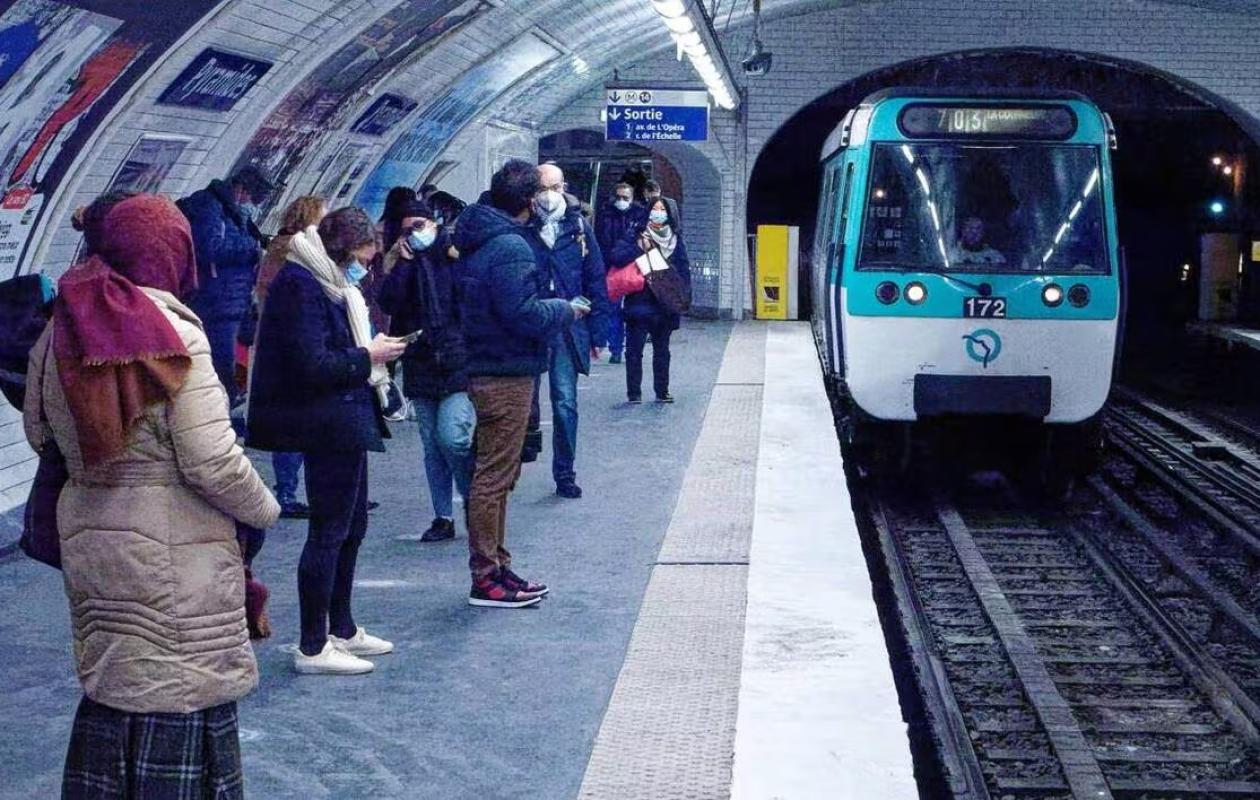
"Je ne sors plus seule la nuit": le sentiment d'insécurité des femmes dans les transports parisiens
"On public transport, men approach me, try to touch me. One of them followed me home one evening. I no longer go out alone at night," explains Alicia, at the Saint-Lazare train station in Paris.
This feeling of insecurity, revived by a recent attempted rape on the Parisian rail network, is pushing many women to adapt their behavior or activities.
A man was charged last week for attempting to rape a Brazilian woman on a commuter train in Val-de-Marne. A female passenger intervened by filming the assailant, causing him to flee.
Insecurity will be a topic addressed at the National Public Transport Meetings, which bring together elected officials and operators in Orléans starting Tuesday.
In the Paris region's public transport system, seven out of ten women have already experienced sexist and sexual violence, the Interministerial Mission for the Protection of Women (Miprof) reported in March. More than half say they do not feel safe there (56%), a figure that rises to 81% after 10 p.m.
Juliette (interviewees did not wish to be identified by their last name), a 29-year-old lawyer living in the suburbs, "turns down invitations to avoid commuting in the evening." Kaïla, 20, who is doing an apprenticeship in the hotel industry, is "worried" when she finishes work at 10 p.m.: "I ask my boss if I can leave earlier."
Unequal public space
Anaëlle, a financial analyst, says she "positions herself next to another woman or in a corner to keep watch." "At the slightest threat, I get off the train. I take a taxi," she says.
A widespread strategy: 93% of women say they try to sit next to a woman, a couple or a family, and 68% dress differently on public transport, according to Miprof.
"When I go out, I wear pants, sneakers, a hooded jacket. I put my mini-dress in my bag," describes Adèle, a student.
Lisa, 25, who lives in Mantes-la-Ville (Yvelines), prefers to drive in the evenings, traumatized by being assaulted at age 15 on her way home from a theater class. This data analyst is reluctant to come to Paris for evening classes because she has to take the train back.
"Women express more fear than men in public spaces," notes Raphaël Adamczak, a social psychology researcher who studies the impact of urban environments according to gender.
"The feeling of insecurity can lead a woman to restrict her choices of residence, places and working hours, limiting her access to employment, culture and social life, reinforcing gender inequalities," he notes.
"The feeling of insecurity is pushing women to refuse jobs, to pay for taxis instead of taking public transport. This is detrimental to their financial independence," adds Anne-Cécile Mailfert, president of the Women's Foundation.
Cameras, stop-and-go functionality
Public transport operators in the Île-de-France region have taken measures: an emergency number (3117 or 31177 by SMS), partnerships with ten municipalities to allow local police officers to intervene on buses. Women can now request to get off between bus stops after 10 p.m.
All new rolling stock (RER, trains, metros, buses) are also equipped with cameras, says IDF Mobilités.
The region would like to make better use of the network's 80,000 cameras to detect suspicious behavior using artificial intelligence, which was tested during the Olympic Games.
"Exploratory walks are organized with groups of users who share their feelings about journeys: anxiety-inducing tunnel, insufficient lighting," explains Christiane Dupart, from the National Federation of Transport Users' Associations (Fnaut).
"Women must be integrated from the very beginning of the design of public spaces," she argues.
The commissioning in December of an urban cable car in Val-de-Marne has already sparked debate about its safety. Describing it as a "hotbed of sexual assault," LFI deputy for Seine-Saint-Denis Nadège Abomangoli suggested single-sex cabins.
"This sends the signal that public space is for men, except for those small spaces where women have the right to be," laments Mr. Adamczak.
"It is not up to women to isolate themselves from men," added Céline Piques, spokesperson for Osez le Féminisme.























Commentaires (6)
https://cashprofit7.site
Pousse de petits cris, en fixant le plafond. L'essentiel est de rentrer chez soi saine et sauve. (pour saine, j'hesite un peu).
Serieurement, la facon de s'habiller peu influencer...
Participer à la Discussion
Règles de la communauté :
💡 Astuce : Utilisez des emojis depuis votre téléphone ou le module emoji ci-dessous. Cliquez sur GIF pour ajouter un GIF animé. Collez un lien X/Twitter, TikTok ou Instagram pour l'afficher automatiquement.