Le Mexique secoué par des violences après l'élimination d'un chef de cartel
Mexico was rocked by a wave of violence on Sunday after the death of the leader of one of the world's biggest drug cartels in a military operation carried out with the support of the United States, and authorities were trying to prevent the unrest from escalating.
At least eight of Mexico's 32 states suspended in-person classes on Monday, and the judiciary authorized judges to keep courts closed when they deemed it necessary, while President Claudia Sheinbaum called for calm.
Killed at the age of 59, Nemesio Oseguera, alias El Mencho, was considered the last of the great godfathers since the arrest of the founders of the Sinaloa cartel, Joaquín Guzmán "El Chapo" and Ismael "Mayo" Zambada, who are imprisoned in the United States.
At the head of the powerful Jalisco Nueva Generación (CJNG) cartel, he was one of the most wanted drug lords by Mexico and the United States, which offered up to $15 million for his capture.
"The United States provided intelligence support to the Mexican government to assist in an operation (...) during which Nemesio +El Mencho+ Oseguera was eliminated," confirmed President Donald Trump's spokeswoman, Karoline Leavitt, on the X network.
Donald Trump has made the fight against drug trafficking a priority and has repeatedly urged President Sheinbaum to allow Washington to send forces to fight the cartels operating in Mexico, a proposal she has so far rejected.
"El Mencho" was wounded during an operation in the town of Tapalpa, in the state of Jalisco (west), and died shortly afterwards, during his transport by plane to Mexico City.
In total, seven criminals were killed and three soldiers wounded. Two members of the CJNG were arrested and various weapons seized, including rocket launchers capable of shooting down aircraft and destroying armored vehicles, according to the same source.
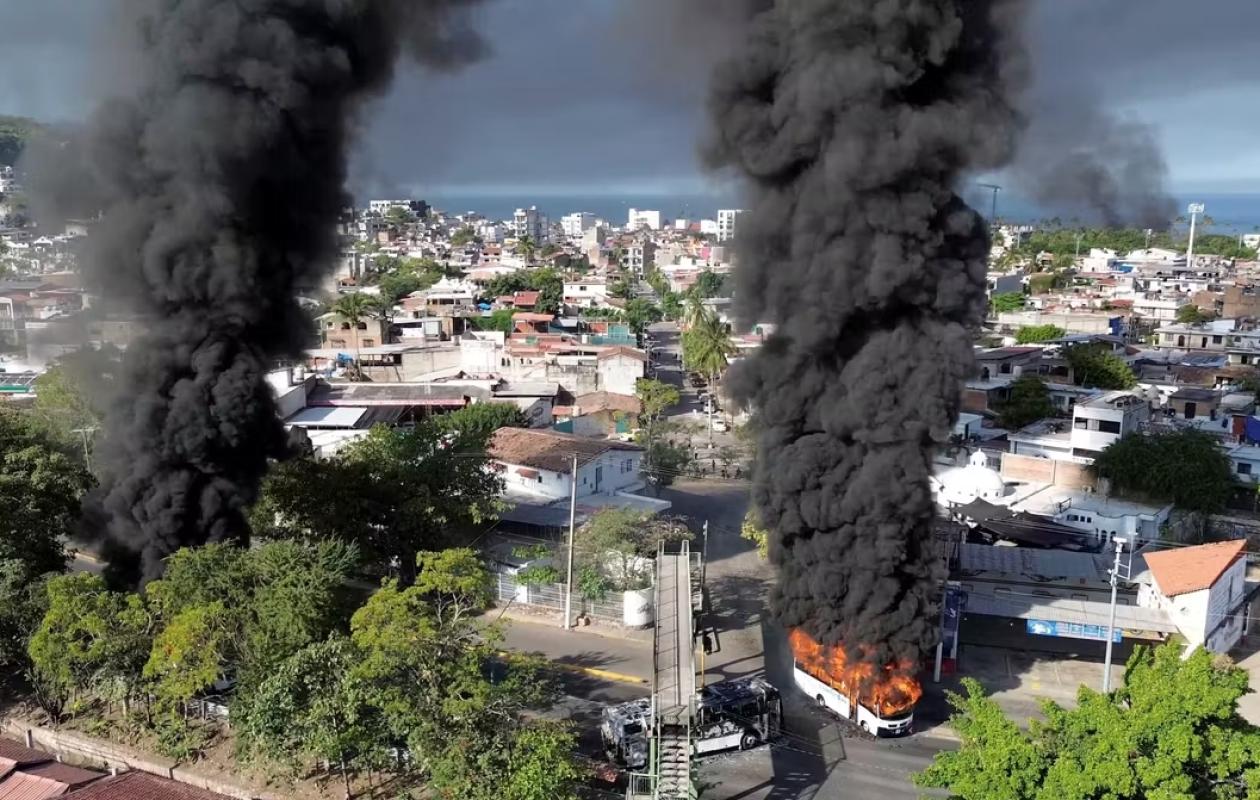
In response to the military operation, suspected cartel members unleashed a wave of violence across 20 states in the country.
Armed individuals blocked several roads in the state of Jalisco (west) with burning cars and trucks, where at night the remains of charred vehicles and others still in flames could be seen.
President Claudia Sheinbaum called on the public to remain "informed and calm".
"Armed individuals arrived, I saw the gun and they told us to get out, we got out and they had a car with the doors open. I thought they were going to kidnap us, I ran towards a taco stand" to take refuge, Maria Medina, an employee of a convenience store that was burned down in Guadalajara, the capital of Jalisco, told AFP.
After an appeal was made to the population to take shelter, the city - which is due to host four matches of the 2026 football World Cup - found itself paralyzed.
The United States has called on American citizens in several areas of Mexico, including tourist cities and regions such as Cancun, Guadalajara and Oaxaca, to "shelter in place until further notice".
North American airlines have cancelled dozens of flights to several Mexican cities.
In London, the Foreign Office on Monday advised British nationals to forgo "non-essential travel" to areas of 11 Mexican states, including Chihuahua, Sinaloa and Jalisco.
Guatemala has placed its security forces on alert and strengthened surveillance of its border with Mexico, which is regularly subject to gang incursions.
According to Mexican authorities, by 8:00 PM (2:00 AM GMT Monday), nearly 90% of the 229 roadblocks recorded in the country had been lifted.
Christopher Landau, U.S. Under Secretary of State, called the drug trafficker's death "a great victory for Mexico, the United States, Latin America, and the entire world."
The CJNG, which Oseguera had formed in 2009, was designated a terrorist organization in 2025 by the United States, which accuses it of trafficking cocaine, heroin, methamphetamine and fentanyl.
The cartel is one of the most violent in Mexico, according to the State Department, which describes it as "transnational, present in almost all of Mexico", practicing extortion, migrant trafficking, stealing oil and minerals, and trading in weapons.
For a long time, it was unable to compete with the cartels that controlled the border with the United States. It then turned to other markets. "Europe, Asia, Africa and even Australia were less contested by the Mexicans, and there drugs fetch a higher price," explains José Reveles, a writer specializing in drug trafficking.
Cartel-related violence has left more than 450,000 dead and more than 100,000 missing since 2006 in Mexico, according to official figures.








Commentaires (6)
Participer à la Discussion
Règles de la communauté
💡 Astuce : Utilisez des emojis depuis votre téléphone ou le module emoji ci-dessous. Cliquez sur GIF pour ajouter un GIF animé. Collez un lien X/Twitter, TikTok ou Instagram pour l'afficher automatiquement.
Se connecter
Commentez avec votre profil, votre photo, et soyez averti des réponses.