
Les députés français abrogent le Code noir, 178 ans après l'abolition de l'esclavage
Members of Parliament unanimously voted on Thursday to repeal the Code Noir and all the laws that regulated slavery in the French colonies. The Code Noir was one of those obsolete laws known as "legislative fossils."
On Thursday, May 28, the deputies unanimously voted to repeal the Code Noir and all the texts that regulated slavery in the French colonies, which were never formally repealed after 1848.
The Palais Bourbon, whose forecourt houses a statue of Jean-Baptiste Colbert, the principal architect of the Code noir of 1685, thus revokes these royal edicts dating from the 17th and 18th centuries.
The 254 members of parliament present, from all political groups, supported the bill, presented on a day reserved for the centrist Liot group (Liberty, Independents, Overseas, Territories).
The texts in question made enslaved people into "movable property" that could be acquired by a master in the same way as property, or instituted sanctions in case of escapes – cut-off ears, branding with a fleur-de-lis, up to and including the death penalty.
"The time has come to wash away the ignominy of the Code Noir in the name of restorative justice." It was with these words that MP Laurent Panifous, president of the Liot group, officially called for the abolition of this text on May 13, 2025. "While one might believe that the 1848 decree abolishing slavery repealed the Code Noir, this is not the case. No text has formally abolished it," the elected official from Ariège insisted at the time.
Twenty-five years after the Taubira law recognizing the slave trade and slavery as a crime against humanity, rapporteur Max Mathiasin ( Guadeloupe ) called for "a powerful act of remembrance, justice and recognition", even if it cannot "seal the wounds of history alone".
Moved to tears after the vote, he hailed "a further step, a tribute to the men and women, to the children put into slavery", embraced by fellow MPs who came to meet him at the bottom of the chamber.
The Black Code "has not had any effect for a long time but its imprint and its weight are still there," also argued Overseas Minister Naïma Moutchou, calling for "removing an unworthy text from our law."
The environmentalist Steevy Gustave also moved the chamber, his voice trembling as he recounted memories shared by his "great-grandmother Maman Bébelle." "She was the granddaughter of Ambroise Zerambe, born in Africa, then enslaved under the number 336. Today, her great-grandson stands before you, Member of Parliament of the French Republic."
"We are not descendants of slaves," he concluded, bursting into tears. "We are the descendants of human beings born free and then enslaved."
For over three centuries, the Code Noir has been a symbol of slavery in the collective memory. In early May, activist Franco Lollia was given a suspended fine of 500 euros by the Paris Court of Appeal for having tagged the statue of Colbert, located at the foot of the National Assembly, in 2020. "What is forbidden is racism. This man [Colbert] is an apologist for Negrophobia," he explained during his arrest, referring to the role of Louis XIV's minister in the promulgation of the Code Noir.

Portrait of Colbert by Claude Lefèbvre, in the robes of the Order of the Holy Spirit (1666), at the Palace of Versailles
For many, the history of this text is fundamentally linked to the figure of Colbert. He was, above all, its initiator, within the context of a royal takeover of the colonies. "He was the one who began drafting it. He sent letters to the intendants and governors of the colonies, asking them questions. Slavery was then a new and unknown subject in France," explains historian Frédéric Régent , lecturer at the University of Paris 1 Panthéon-Sorbonne. "But he died in 1683. It was his son, the Marquis de Seignelay, who signed the final version in 1685."
For his colleague Bruno Maillard , from the University of Paris-Est Créteil, Colbert was indeed at the instigation of the Code noir, but for this member of the scientific council of the Foundation for the Memory of Slavery , it must be remembered that it was indeed "King Louis XIV who promulgated it".
This royal decree aimed to regulate the legal status of slaves in the French West Indies , even though 80% of its rules were already being applied locally. The Code Noir exceptionally authorized in the colonies a practice that had been prohibited on French soil since the royal edict of July 3, 1315.
Having become an emblematic text, it has been reduced over the centuries to this edict of 1685, whereas it actually encompassed all the texts dealing with slavery. Other versions were thus published for French Guiana , Louisiana , Réunion , and Mauritius. "It is a collection of laws concerning the slave-owning phase of French colonization. It contains texts that govern slavery, the condition of the slave, but also the slave trade, colonial trade, and the presence of Black people in France," summarizes Frédéric Régent.

Often, the only thing retained from this Code Noir is the idea that slaves were legally considered "movable property" that could be acquired by a master just like any other possession. For Bruno Maillard, this status is ambiguous and more complex than it appears: "The person is considered first and foremost as an object of property. They can be sold and rented, but they are also considered a human being, because they are allowed to marry, they are required to have a minimum amount of food, and they are permitted to be freed. It is a dual status of property and, to some extent, of subject of law."
The Code Noir also includes recommendations for corporal punishment: "A fugitive slave who has been on the run for one month, starting from the day his master denounces him to the authorities, will have his ears cut off and be branded with a fleur-de-lis on one shoulder; if he runs away again for another month, similarly from the day of the denunciation, he will have his hamstring cut and be branded with a fleur-de-lis on the other shoulder; and, the third time, he will be punished by death," reads Article 38. "Masters thus have a right of domestic justice over their slaves. They can use the whip, chain them, and lock them up," emphasizes Frédéric Régent. "But the right of mutilation, of life and death, belongs only to royal justice. The king thus reaffirms his superiority as the supreme arbiter of justice over the master," he adds.
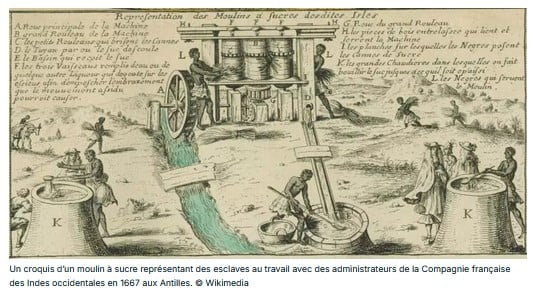
The first abolition of slavery, decided by the Revolution on February 4, 1794, ipso facto repealed the Code noir, but Bonaparte's decision to reinstate slavery in 1802 restored its full scope in Guadeloupe, Guyana, Martinique and Réunion, until the final abolition of 1848.
Formally, this text therefore no longer has any legal value. "We know very well that it has not been in force for a long time. Slavery has been abolished, so the Code noir no longer makes sense, since it was supposed to govern the situation of slaves at the time. It was abolished in fact and not in law," explains the jurist Jean-Éric Gicquel, professor at the University of Rennes 1 .
As this constitutional law specialist explains, the Code Noir is one of those obsolete laws that have not been repealed and are known as "legislative fossils." Following the work of a Senate mission—known as "Balai" (Bureau for the Repeal of Old and Useless Laws)—a first law was adopted in 2019, then a second in 2022. These repealed 163 laws adopted between 1800 and 1940, and then between 1941 and 1980, which had become obsolete.
“Legally, this repeal changes nothing,” insists Jean-Éric Gicquel. “It’s simply a symbolic gesture to show that France is officially repealing these laws.” Historian Frédéric Régent admits he struggles to understand this recent request: “It would mean, in a way, that the people of the Antilles are still slaves. It’s a rather superficial debate, but it has the merit of generating discussion.”
For Bruno Maillard, it's also a "public relations issue" to "bring this story back into the public debate." This specialist in the triangular trade points out that France already recognized slavery as a crime against humanity in 2001 with the so-called Taubira Law . "I can't say that nothing has been done, but we're stopping at this symbolic reparation," he believes.
According to him, this new announcement will also remain symbolic. "The real question is that of financial and material reparations," explains Bruno Maillard, who points to the alarming economic and social situation in the French overseas territories: "The unemployment rate, housing problems, and public health issues mean that these are not territories like any other. We have no choice but to link this to the fact that these are former slave colonies and that most of the people excluded in these societies are of African descent."
According to this member of the Foundation for the Memory of Slavery, "France is sick from its colonial past. Historians will not be able to heal all the wounds. Political representatives must act at some point."
Recent committee debates have highlighted the legacies of France's history of slavery and colonialism, still visible in the persistent inequalities between its overseas territories and mainland France, as well as the discrimination faced by Black people. "I'm thinking of the chlordecone scandal in the French West Indies, access to water in Mayotte (...). I'm thinking of the explosion of anti-Black racism," listed LFI MP Nadège Abomangoli, also mentioning the "racist dehumanization" of the LFI mayor of Saint-Denis, Bally Bagayoko.
One article of the text stipulates that the government must submit a report on colonial law and its long-term effects, as well as on the place given to the history of slavery in school curricula. The issue of reparations was a major topic of debate. Several left-wing members of parliament pointed out that in 1848, it was the slave owners who were compensated by the Republic , not the former slaves.
"This vote must open a new chapter, not close it. Beyond the essential work of remembrance, can there be forgiveness without reparations?" asked Martinique MP Jiovanny William (Socialist Party). This question must be the subject of "thorough, rigorous, and comprehensive work," according to the centrist rapporteur. "We will be vigilant regarding the announcements that are expected soon," he added.
On May 8, Serge Letchimy, President of the Territorial Collectivity of Martinique, wrote to Emmanuel Macron asking him to commit the State to a path of "reparation," advocating for the creation of an "ad hoc commission" to determine the "concrete modalities" of this process. Will the President of the Republic make an overture in this direction on Thursday? Some hope so.
Emmanuel Macron is also expected to provide an update on the historical research launched last year to assess the "price" of freedom imposed by France on Haiti —namely, the exorbitant financial compensation demanded from its former colony in exchange for recognizing its independence two hundred years ago. However, a presidential advisor clarified that the commission of historians established by Emmanuel Macron in April 2025 has not yet released its findings.
(With AFP)

























Commentaires (13)
Participer à la Discussion
Règles de la communauté
💡 Astuce : Utilisez des emojis depuis votre téléphone ou le module emoji ci-dessous. Cliquez sur GIF pour ajouter un GIF animé. Collez un lien X/Twitter, TikTok ou Instagram pour l'afficher automatiquement.
Se connecter
Commentez avec votre profil, votre photo, et soyez averti des réponses.