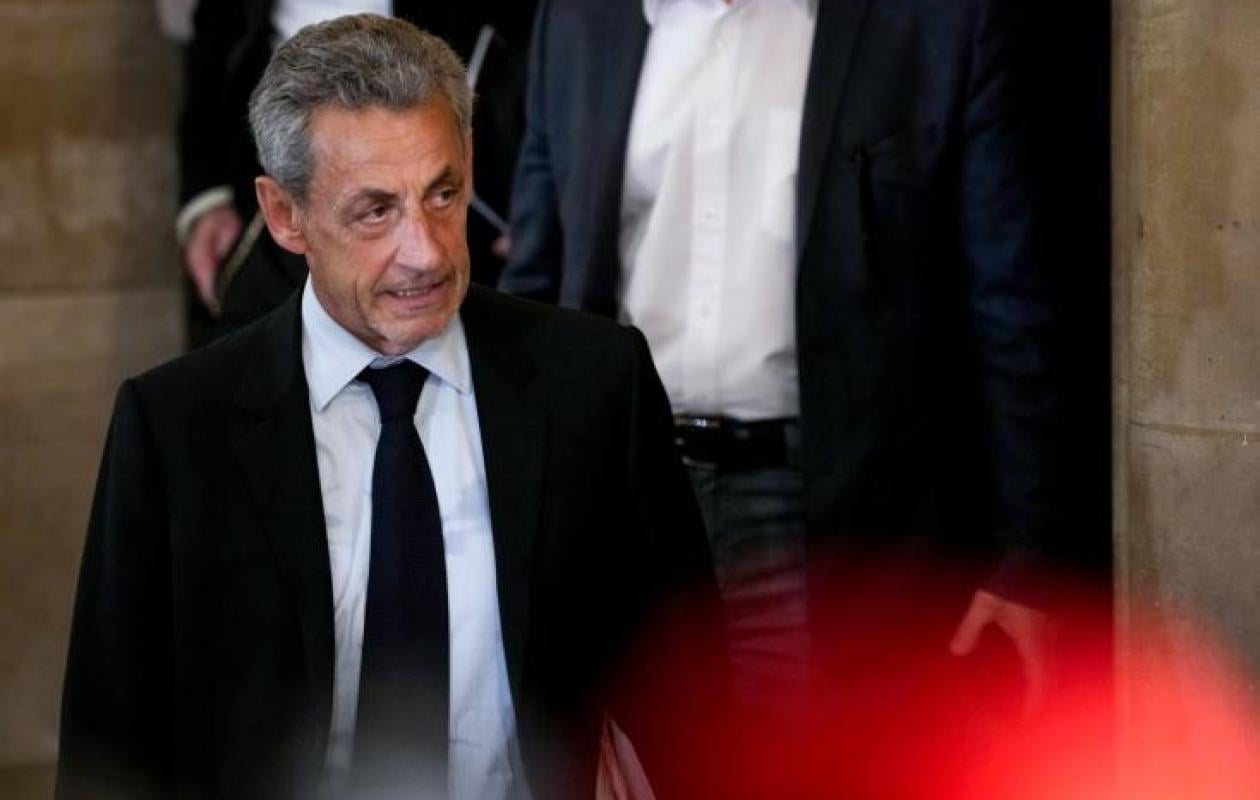
Sept ans de prison requis contre Sarkozy au procès libyen en appel
On Wednesday, the public prosecutor's office placed the sword of Damocles of an infamous return to detention over Nicolas Sarkozy, requesting on appeal seven years in prison against the former president of the Republic, two years more than his first instance conviction in the Libyan affair.
With this trial nearing its conclusion before the Paris Court of Appeal, Nicolas Sarkozy is not only risking his freedom but also the future of his political career. If convicted on November 30th, the former French leader, who insists that "not a single cent" of Libyan money ended up in his 2007 presidential campaign, will have no recourse but to appeal to the Court of Cassation.
At the end of three days of a prosecution's case, which the septuagenarian endured without a glance at the trio of public prosecutors, the prosecution, as in the previous trial, requested seven years in prison against the former head of state (2007-2012), along with a fine of 300,000 euros and five years of ineligibility.
Presenting him as "the principal, the sole beneficiary," "the instigator" of a criminal conspiracy "to enable him to be elected" to the Élysée Palace, the public prosecutor, Rodolphe Juy-Birmann, nevertheless requested neither a warrant for his arrest nor provisional execution. The magistrate did, however, ask that "lying" as a defense strategy used by the defendants, as well as "calling into question the functioning of the judicial system," be punished.
Although he was only convicted of conspiracy in September, the prosecution asked the appeal judges to find Nicolas Sarkozy guilty of all the charges against him, including corruption, illegal financing of his victorious presidential campaign and receiving stolen Libyan public funds.
"We will demonstrate in two weeks, during our pleadings, the complete innocence of Nicolas Sarkozy. There is no (Libyan) money in his campaign, in his assets. And for good reason: there was no financing of Nicolas Sarkozy's campaign by Libya (...). Nicolas Sarkozy is innocent, his election was not biased," reacted one of his lawyers, Christophe Ingrain, to the press.
The prosecution alleges that Nicolas Sarkozy, then Minister of the Interior under Jacques Chirac, made a deal with dictator Muammar Gaddafi to receive illicit funding from the Libyan regime, specifically in exchange for a promise to investigate the legal situation of his brother-in-law, Abdallah Senoussi. According to the public prosecutor's office, these fraudulent maneuvers led to "tainting the financing of the presidential election of the Fifth Republic."
This scenario revolves around two secret meetings in late 2005 in Libya between Claude Guéant and Brice Hortefeux, his closest collaborators, with this high-ranking Libyan official, Gaddafi's right-hand man and the mastermind behind the UTA DC-10 bombing that killed 170 people, including 54 French citizens, in 1989.
In the months that followed, the Libyan regime sent some 6 million euros to the accounts of the intermediary Ziad Takieddine, since deceased, who was present during the clandestine meetings with the Libyan number two.
In contrast to Claude Guéant and Brice Hortefeux, the public prosecutor's office asked the court to generally confirm the sentences handed down.
Despite the former secretary-general's "half-hearted admission of guilt," describing him as "incapable of the slightest introspection" regarding his own personal enrichment, and despite being absent due to illness but providing statements to the appeals court, a six-year prison sentence was requested. Four years in prison, two of which would be served under house arrest with an electronic tag, were requested for Brice Hortefeux, the "loyalist" who "made a pact with a terrorist."
Six years in prison with an arrest warrant have been requested for the middleman Alexandre Djouhri, "a Stakhanovite of corruption".
After his conviction in the first instance, Nicolas Sarkozy became the first president imprisoned in the history of the Republic, spending 20 days behind bars in the Parisian prison of La Santé until his release under judicial supervision pending the appeal trial.
The risk of a new, longer incarceration within a few months now threatens the former head of state, even if a possible conviction in November would not immediately become final.
Nicolas Sarkozy would still have the possibility of challenging the decision before the Court of Cassation.
The highest court recently rejected his appeals against two other criminal convictions, in the so-called wiretapping and Bygmalion cases concerning the financing of his 2012 campaign, making them final and entailing the execution of the sentences.
AFP









Commentaires (5)
Participer à la Discussion
Règles de la communauté :
💡 Astuce : Utilisez des emojis depuis votre téléphone ou le module emoji ci-dessous. Cliquez sur GIF pour ajouter un GIF animé. Collez un lien X/Twitter, TikTok ou Instagram pour l'afficher automatiquement.