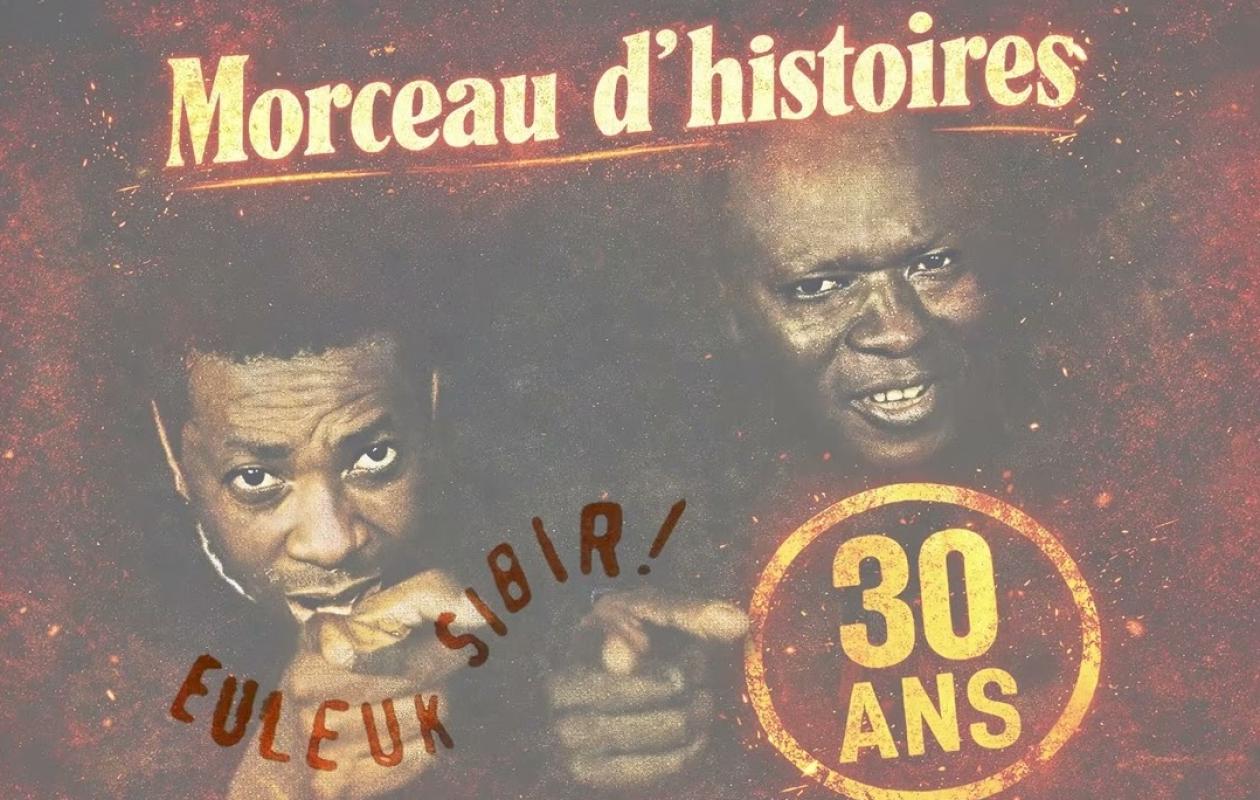
EULEUK SIBIR A 30 ANS !
Dakar, Thursday, April 18, 1996.
It is 7 a.m., and already a dense crowd stretches out in front of the B224 canteen in the Sandaga market.
An unusual crowd at this hour. Eyes turned in the same direction, a palpable, almost electric anticipation. Some have been there since dawn.
What are they waiting for? An album. But not just any album: Euleuk Sibir.
A project that has been talked about for months, and which is attracting all the attention. Because behind this album, there is a meeting that many thought impossible.
To understand the magnitude of the event, we need to go back a few years. In the mid-1990s, the Senegalese music scene was dominated by two major groups: Youssou Ndour's Super Étoile de Dakar and Omar Pène's Super Diamono. Between the two camps, an intense rivalry, fueled by fans, to the point of becoming almost a defining characteristic.
You are either "You" or "Pène", just as you are Beatles or Rolling Stones.
But behind the scenes, the reality is more nuanced. The two artists have known each other since 1975 and have always maintained a respectful relationship. A discreet but solid bond. And in this gradual rapprochement, one name often comes up: Banna Ndiaye, wife of Omar Pène, respected and listened to by Youssou Ndour.
It was in this context that the idea of a joint project emerged. Habib Faye was entrusted with the musical direction, and he discreetly led the initiative. The first meetings took place in his home studio. Very quickly, a clear concept took shape: each artist would perform two songs from the other's repertoire, to which they would add two original compositions.
A simple principle, but highly symbolic.
On the organizational side, Saprom and Mediator share responsibilities. Logistics are handled by Mady Drame, while Papa Thierno Diop, known as Bondé, oversees the administrative and financial aspects. The budget, estimated at 20 million CFA francs, reflects the project's ambition.
Habib Faye then prepares a detailed demo, a veritable roadmap for the musicians. Before the recordings, he works individually with the members of both orchestras to align their intentions and refine the arrangements.
Then, in March 1996, everyone met at Xippi studio.
For four days, the musicians of Super Étoile and Super Diamono recorded together. The atmosphere is described as intense, but above all constructive. Everyone understood the importance of the moment.
Among the most striking testimonies is that of Papa Dembel Diop, bassist of Super Diamono. He speaks of the involvement of Youssou Ndour, always present, often the first to arrive, setting the pace and demanding the work.
Another telling detail: Youssou's voice heard on the album was initially just a guide vocal. A spontaneous take, recorded under simple conditions. But the performance was so compelling that it was ultimately kept as the final version. As if the raw moment had captured something irreplaceable.
The album is structured around two unreleased tracks, Euleuk Sibir and Warougar , which carry a clear message: unity, transmission, responsibility. Omar Pène revisits Tongo and Indépendance , while Youssou Ndour takes on Silmakha and Ndaanan .
The musicians accompanying them are: Habib Faye, Fallou Galass Niang, Mbaye Dièye Faye, Pape Oumar Ngom, and Ibou Cissé from Super Etoile; Ousmane Sow, Papa Dembel Diop, Thio Mbaye, and Lappa Diagne from Super Diamono. The brass trio of Moustapha Fall, Ibou Konaté, and Sanou Diouf has been invited to join all these luminaries.
Beyond the artistic choices, it is above all the collaboration that stands out. The two singers participate in each other's backing vocals, deliberately blurring the boundaries between their respective worlds.
Upon exiting, he received an immediate welcome.
The public turned out in droves. The event lived up to expectations. Only a few reservations were expressed regarding the sound quality, particularly some slightly distorted treble.
But the main point lies elsewhere.
Because ultimately, Euleuk Sibir transcends mere music. This project embodies a rare moment, where two major figures choose to set aside their rivalries to build something together. An artistic gesture, but also a powerful message to the public. By bringing Youssou Ndour and Omar Pène together, the album doesn't just leave its mark on its era: it redefines what's possible. And that's undoubtedly why, even today, it remains etched in our memories as much more than just a record.









Commentaires (34)
Participer à la Discussion
Règles de la communauté
💡 Astuce : Utilisez des emojis depuis votre téléphone ou le module emoji ci-dessous. Cliquez sur GIF pour ajouter un GIF animé. Collez un lien X/Twitter, TikTok ou Instagram pour l'afficher automatiquement.
Se connecter
Commentez avec votre profil, votre photo, et soyez averti des réponses.