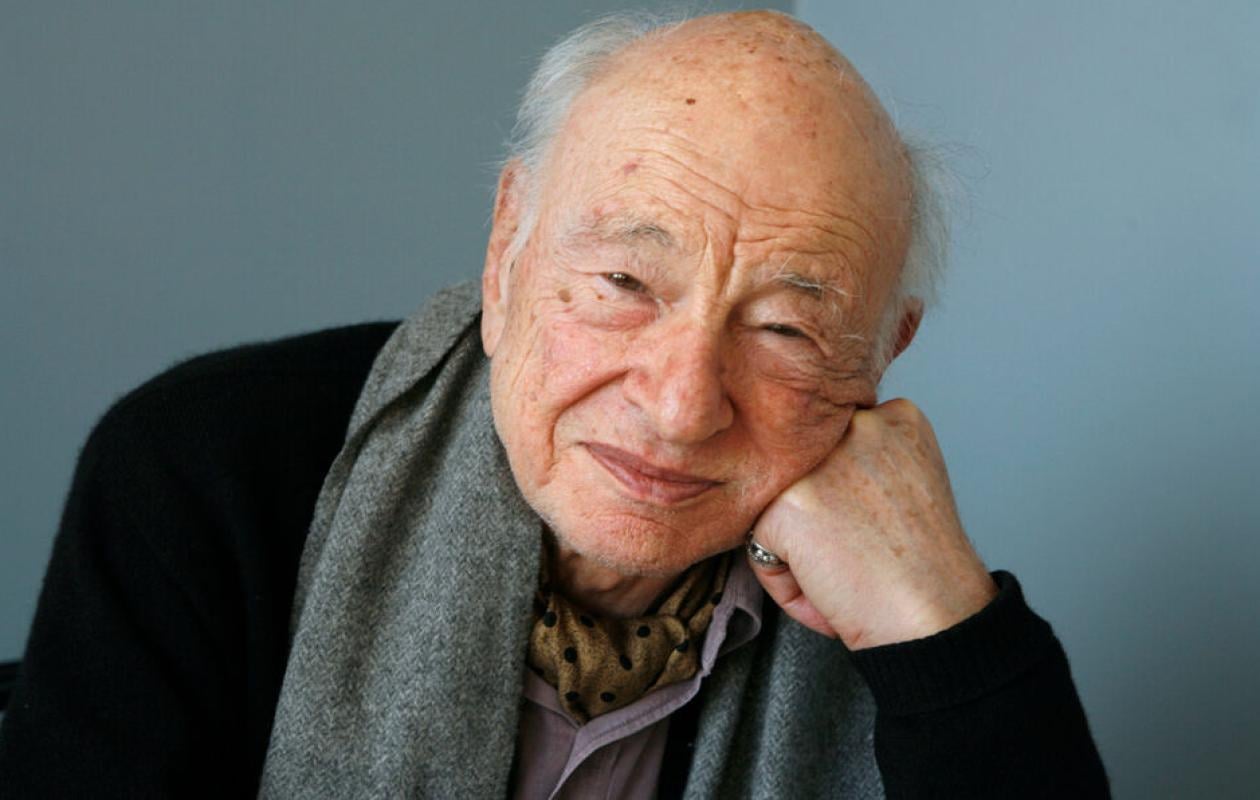
Edgar Morin, un humaniste de la complexité, est mort à l’âge de 104 ans
The centenarian philosopher was an important voice of the modern left and a prominent media figure. Emmanuel Macron popularized a concept dear to him, "complex thought".
Sociologist, anthropologist, philosopher, or simply an engaged observer of the "wider world," Edgar Morin, who passed away on May 29 at the age of 104, can be said to have been all of these, without allowing himself to be reduced to any one of these identities. Author of more than a hundred books translated into some thirty languages, covering the humanities, the exact sciences, and the most immediate current events, both French and international, Edgar Morin, through his refusal to compartmentalize knowledge and his distrust of any dogmatic approach, can be considered an heir to the encyclopedic spirit of the Enlightenment. He was also, along with the late Michel Serres, with whom he shared in some respects a scholarly eclecticism, one of the most media-savvy and best-known thinkers among the general public.
Born on July 8, 1921, in Paris, into a Sephardic Jewish family originally from Thessaloniki, the young Edgar Nahoum, who lost his mother at the age of 10, studied at the Sorbonne and earned degrees in history and law. After frequenting libertarian circles, which supported the Republican side in Spain, he joined the French Communist Party in 1942, a period during which, under the pseudonym Morin, he participated in resistance activities. He was expelled from the PCF in 1951 for criticizing the Stalinist line of the leadership. "It was like a childhood heartbreak, enormous and very short," he would later confide. This break came shortly after the publication of his first book, *L'An zéro de l'Allemagne* (Year Zero of Germany), devoted to the occupation of that country, in which he participated as part of the French army. His distancing from communism is inseparable from a critical approach that would never leave him and that he would support throughout all his books, notably Autocritique (Seuil), which, published in 1959, would bring him great success.
Having become a sociologist at the CNRS (French National Centre for Scientific Research), Edgar Morin published works on innovative themes: fashion (Les Stars, 1957), mass culture (L'Esprit du temps, 1962), and cinema (Le Cinéma ou l'homme imaginaire, 1956). He was interested in a phenomenon as elusive as rumor. In La Rumeur d'Orléans (1969, Seuil), he analyzed a story that made headlines: managers of a department store were suspected of making women disappear to fuel a "white slavery" ring, without the slightest shred of evidence being presented.
Theorizing and transcribing lived experience
After several years spent in Latin America, he was invited to the Salk Institute in San Diego, California, in 1969. He returned in 1970 with *A California Journal* (Seuil), in which he studied the region as a laboratory of modernity. He then embarked on what would become his magnum opus: a six-volume work entitled *The Method* (Seuil), the first volume of which, *The Nature of Nature*, appeared in 1977, and the last, *Ethics*, in 2004. In the interim, *Life of Life* was published in 1980, *Knowledge of Knowledge* in 1986, *Ideas* in 1991, and *Humanity of Humanity* in 2002. Through this series, which encompasses all fields of knowledge, Edgar Morin compares the analytical methods of the humanities with those of the biological sciences.
Keen to forge links between the sciences and promote transdisciplinarity, he participated with biologists Jacques Monod and François Jacob in the creation of the International Center for Studies in Biology and Fundamental Anthropology, located at Royaumont Abbey. "While fragmented and scattered knowledge makes us increasingly blind to our fundamental problems, understanding complexity becomes a vital need for our individuals, our cultures, our societies," he wrote at a symposium organized by the Association for Complex Thought, which he founded in the early 2000s. This "complexity," from the Latin complexus, meaning "that which is woven together," defines reality itself, in a way, by virtue of its irreducibility to a single explanatory framework.
For Edgar Morin, who has always defined himself as an agnostic or even a "radical unbeliever", no conception of the world can consider itself the repository of Truth and all philosophical and religious representations must be able to cooperate and coexist in a vast multi-civilizational whole.
He sparked widespread controversy in June 2002 by co-authoring an article with Danièle Sallenave in the French daily newspaper Le Monde, entitled "Israel-Palestine: The Cancer," in which he denounced Israeli policy toward the Palestinians. He went so far as to claim that "the most persecuted people in history" had in turn become "persecutors," which led to a lawsuit filed against him by the associations France Israel and Lawyers Without Borders. Some criticized him for his blindness to the resurgence of antisemitism in France, which he stubbornly denied, as well as for an idyllic multicultural vision inspired by the myth of Al-Andalus, which minimized the dangers of Islamism in Europe.
In *Year 1 of the Ecological Era: The Earth Depends on Man Who Depends on the Earth*, published in 2007 (Tallandier), Edgar Morin engages in a dialogue with Nicolas Hulot on the need to promote a "politics of civilization," which "aims to put man back at the center of politics and to promote well-being rather than mere well-being." This concept gained considerable media attention, and the government of Nicolas Sarkozy even adopted it for a time, prompting Edgar Morin to disavow it and distance himself from the ruling power.
Finally, in the 2000s, he devoted numerous works to current events, whether related to education, the environment, or international politics. He published many books of interviews with figures as diverse as Boris Cyrulnik (Dialogue on Human Nature, L'Aube, 2000), Jean Baudrillard (The Violence of the World, Félin, 2003), Stéphane Hessel (The Path of Hope, Fayard, 2011), François Hollande (Dialogue on Politics: The Left and the Crisis, L'Aube, 2013), as well as with the highly controversial Tariq Ramadan (At the Peril of Ideas, Presses du Châtelet, 2014, and Urgency and the Essential, Éditions Don Quichotte, 2017). He subsequently refused to comment on the rape allegations that had shattered the Islamist ideologue's legitimacy.
A decisive thinker
His entire body of work will be judged with enthusiasm by some, and with much more skepticism by others (notably Pierre Bourdieu), who will consider him an inexhaustible commentator rather than a decisive thinker. By multiplying increasingly alarmist themes (The Way: For the Future of Humanity, published by Fayard in 2017, or Let's Wake Up, published by Denoël in 2022), hasn't Morin ultimately illustrated what Michel Foucault deplored in Sartre and the intellectuals of yesteryear: the pretension of delivering a universal message? As omnipresent as he is prolific, Edgar Morin has become, over time, an institution, as evidenced by the numerous honorary distinctions bestowed upon him both in France and abroad. In 2019, Pope Francis congratulated him on his "openness to others" and received him in Rome.
On July 8, 2021, at the reception held in his honor at the Élysée Palace to celebrate his 100th birthday, Emmanuel Macron described him as a "universal thinker" and a "watchdog of the planet." His stance as a transcendental humanist did not prevent Edgar Morin from taking a political stance. In 2024, following the dissolution of the National Assembly by Emmanuel Macron, Edgar Morin expressed concern about what he called "the rise of the far right in France." In Morocco, where he resides for several months each year, he urged Africans in 2024 to "defend their culture," remarks that some would consider populist if addressed to Europeans.
Beyond his controversial and much-discussed positions, Edgar Morin demonstrated an unwavering love of life and an indomitable intellectual curiosity. Far from seeing old age as a shipwreck, he perceived it as a final stage that could bear witness to the fragile grandeur of the human condition. "Old age is like a step one climbs, not a staircase one descends toward the grave." In one of his last works, he also asserted: "Life is only bearable if one introduces into it not utopia but poetry, that is to say, intensity, celebration, joy, communion, and love."
![[Exclusif] Révision de la Constitution : Le Conseil constitutionnel invalide le vote des députés](https://image.seneweb.com/content/news/2026-28-09//thumb_1260x800_6a4fdec36aa84_Tpa745ZYpD.jpg)












Commentaires (1)
Participer à la Discussion
Règles de la communauté
💡 Astuce : Utilisez des emojis depuis votre téléphone ou le module emoji ci-dessous. Cliquez sur GIF pour ajouter un GIF animé. Collez un lien X/Twitter, TikTok ou Instagram pour l'afficher automatiquement.
Se connecter
Commentez avec votre profil, votre photo, et soyez averti des réponses.