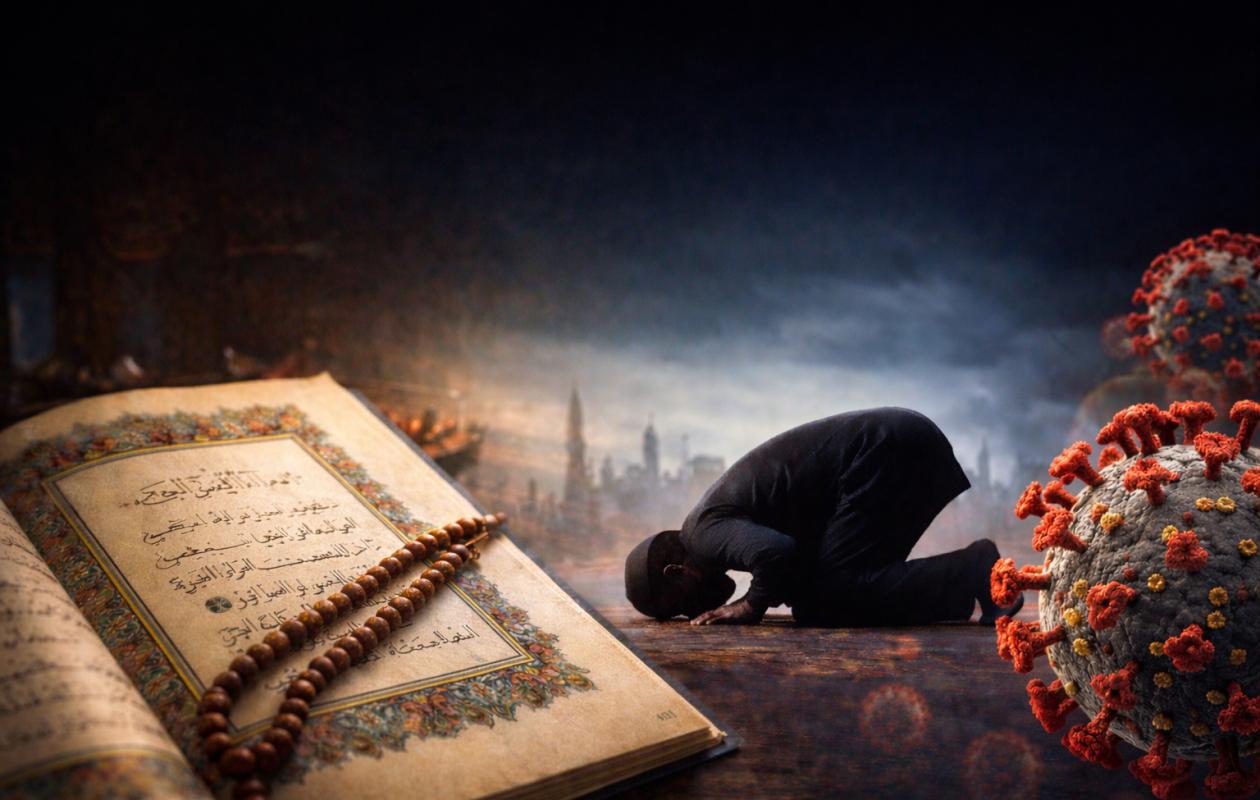
Quand la Salāt, la Basmalah et le Coran décryptent le COVID-19
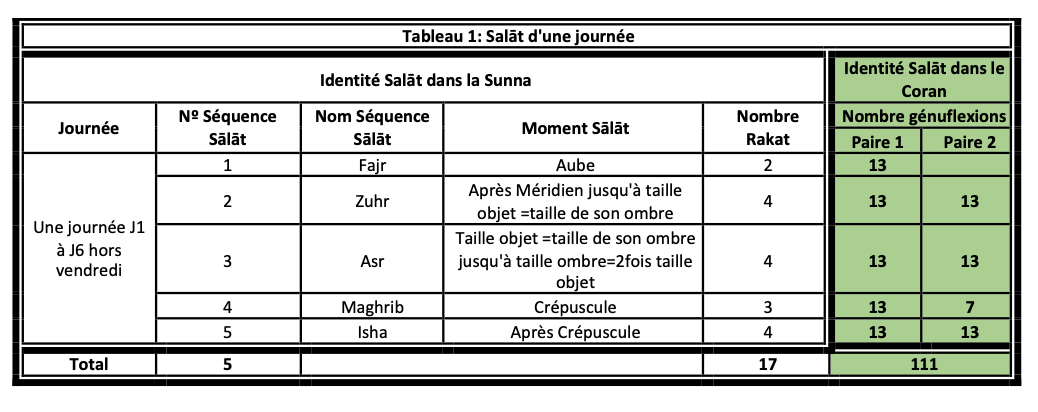
In our previous work, we demonstrated that breaking down the Salat—particularly through what we call its “Quranic DNA” (its bowings and prostrations)—allows for a structured and coherent reading, illuminated by the Quran. If we consider that dawn corresponds to the Salat al-Fajr—composed of two rak'ahs, or 13 postures (bowings and prostrations)—then this unit can become a true key to interpretation.
This opens the way to an interpretation in which Salat is no longer merely a ritual practice, but a symbolic system imbued with meaning. Indeed, the total number of daily rak'ahs (17) and the number of postures (111) refer to Surah 17, Al-Isra' , which contains precisely 111 verses. This surah is the one that recounts the miracle of the Prophet Muhammad's (peace be upon him) Night Journey, during which Salat was instituted.
Furthermore, the combination of the number of daily prayers (5) and the total number of postures (111) also echoes Surah 5, verse 111, which recounts the miracle of the lavish table from Paradise served to Jesus (ʿĪsā) and the Apostles. Conversely, Surah 111, with its five verses, foreshadows the damnation of the Prophet's enemy, Abu Lahab. Thus, prayer reveals itself to us in a profoundly symbolic and spiritual light: it nourishes the soul by drawing the believer closer to Allah, just as the lavish table nourished the body and strengthened the faith of the Apostles. It also appears as a protection and a source of strength against the enemies of Allah.
I invite you to a cross-referential contemplation of the Basmalah (“In the name of Allah, the Most Gracious, the Most Merciful”) . The Basmalah is one of the names of Surah Al-Fatiha , which is obligatory in every unit of Salat. It also constitutes the opening of almost all the surahs of the Quran.
The Quran contains 114 surahs, each beginning with the Basmalah, with the exception of Surah 9, At-Tawbah (The Repentance), which does not. Scholars generally explain this absence by the solemn and declaratory nature of this surah, linked to the breaking of covenants and a context of confrontation.
However, the total number of Basmalahs remains 114, as Surah 27, An-Naml (The Ants), contains two: one at the beginning, as with every surah (except Surah 9), and the other in verse 30, in the letter from the Prophet Sulayman (Solomon) to the Queen of Sheba: [The Queen said, "O eminent ones! A noble letter has been delivered to me.] S27V29 It is from Solomon, and it is: 'In the name of Allah, the Most Gracious, the Most Merciful,' S27V30
Thus, if we model the presence of the Basmalah by a numerical value — 1 when it is present at the beginning, 0 when it is absent (surah 9), and 2 when it appears twice (surah 27) — we obtain a structured sequence made up mostly of “1”, with two singularities: a “2” and a “0”.
11111111 0 11111111111111111111111111111111111111111111111111111111111111111111111111111111111111111111111111111111111111111111111 .
The number of times the Basmalah appears throughout the Quran is known and is a multiple of 7, a signature like the 7 verses of Surah Al-Fatiha (called the Mother of the Quran), the 7 points of impact of the body during prostration (the position closest to Allah), the 7 heavens, the 7 earths, the 7 days, the 7 gates of Hell, the 6 days of creation, and the 7th Day of Judgment. Allah is the All-Wise, the All-Knowing, and nothing in His works is left to chance.
Between the two singularities—the " 2 " and the " 0 "—there are exactly 17 intervals, which can be likened to the 17 daily rak'ahs, each beginning with the Basmalah. Numerically, we can deduce from the occurrence bounded by the 2 and the 0: 17 x 1.20, which can be read as 17/1/20, or January 17, 2020.
When we take the number in its entirety we have 112X1.20 which can be read as 112/1/20 or 1(1+2)/1/20 or 13/1/20.
Thus, January 13, 2020, marks the first case of COVID-19 detected outside of China, in Thailand, signaling the beginning of the pandemic's international spread. In the following days, several major events unfolded:
– January 14, 2020, confirmation of human-to-human transmission;
– January 15, 2020, first case in Japan;
– January 16, 2020, first epidemiological alert by the Pan American Health Organization (PAHO).
We can thus see that the globalization of the pandemic is situated within a time window between January 13 and 17, 2020.
Thus, we observe that the number 17 recalls the total number of daily rak'ahs—each beginning with the Basmalah—while the number 13 corresponds to the number of postures (standing, bowing, and prostration) in a pair of rak'ahs, as in the Fajr prayer. These elements point to a correspondence with the Salat table presented above. In this table, the Maghrib prayer stands out : it is the only one whose structure remains constant, regardless of the worshipper's situation and throughout the history of its practice. It also introduces a notable variant, the number 7 , which is added to the constant 13 that structures the other sequences.
Furthermore, this prayer marks the transition to night—a time the Quran describes as when souls return to Allah during sleep. This dimension reinforces the symbolic significance of Salat al-Maghrib as a threshold between two states: the activity of the day and the nocturnal return of souls. Finally, it is interesting to note that the total number of postures for this sequence is 13 + 7 = 20, which introduces a new numerical interpretation of the whole. This leads to the following table:
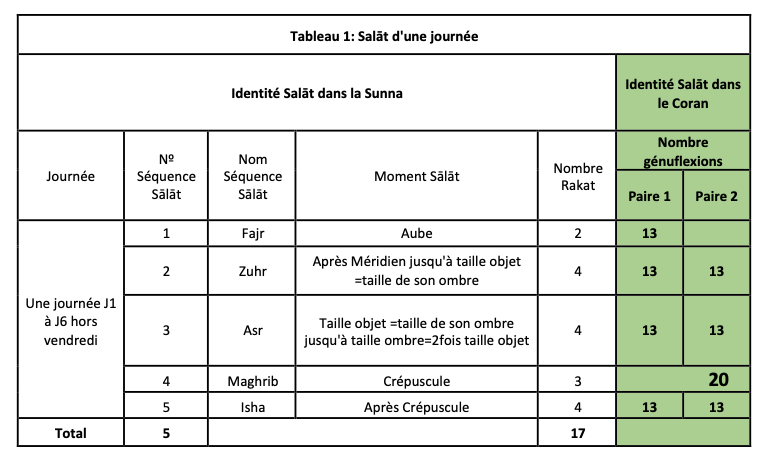
We thus find the number 20 suggested by the arrangement of the Basmalah, as well as the numbers 17 and 13, which can also be read through the gaps between the two singularities (the "2" and the "0"). Now, Surah 20, Ta-Ha , verses 13 to 17, recounts a major dialogue between Allah and the prophet Moses (Musa):
Surah 20, Ta-Ha (excerpts)
13. "I have chosen you. Listen to what is about to be revealed."
14. “Indeed, I am Allah; there is no deity except Me. So worship Me and establish prayer for My remembrance.”
15. “The Hour will surely come—I am keeping it almost hidden—so that every soul may be rewarded according to its efforts.”
16. "Let he who does not believe and follows his passion not turn you away from it, otherwise you will perish."
17. “And what is in your right hand, O Moses?”
This passage highlights two central elements: the institution of Salat as a remembrance of Allah and the evocation of the approaching Hour. In a symbolic reading, the structure of the Basmalah in the Quran and that of Salat itself allude to the dates of COVID and can be linked to these verses. Furthermore, the number of rak'ahs in Friday prayers is 15 (the Jumu'ah prayer replacing Zuhr, which is reduced from 4 to 2 rak'ahs), and it is also known that the end of a human cycle is associated with Friday.
Similarly, the absence of the Basmalah (represented by "0" in the model) can be linked, in a symbolic approach, to certain sequences of the Salat, particularly the 'Asr prayer, and associated with the figure of Moses—precisely the interlocutor in the passage cited. We have presented the explanatory arguments in detail in the work "13.7 The Code of the Encrypted Universe in Muslim Prayer: The Salat…". These connections, however, stem from a contemplative and symbolic reading and must be distinguished from a classical exegetical interpretation.
COVID-19, for its part, represents a true historical rupture. For the first time, the global system was brought to a near standstill. Unlike major health crises of the past, which were often localized or gradual, this pandemic led, in just a few weeks, to a coordinated suspension of mobility, economies, institutions, and even some religious practices on a global scale.
This rupture stems not only from the nature of the virus, but from what it has revealed: a profoundly interconnected and interdependent humanity. The world functioned, for the first time, as a single organism, reacting almost simultaneously to the same threat. As such, it serves as a reminder of humanity's original unity: a community collectively facing the same ordeal. This is therefore not merely a health crisis, but a shift in the very nature of the world. COVID-19 reveals a humanity unified by its systems—economic, technological, and social—where any local disruption can now instantly become global. Are we on the threshold of a symbolic reformation of the single human community, from Adam to Noah?
Finally, this crisis reminds us of a crucial reality: despite technological advancements, humankind does not control what is most fundamental to life—breathing. The air we breathe remains a gift from Allah. And it takes only one of His microscopic creatures to disrupt the entire global system. Is Covid-19 a divine sign? A warning that technological progress will never place us beyond the reach of Allah's power?
Bilal At-Tawbah
Bakary Boloba COLY
Find us at www.at-tawbah.org




















Commentaires (16)
Participer à la Discussion
Règles de la communauté :
💡 Astuce : Utilisez des emojis depuis votre téléphone ou le module emoji ci-dessous. Cliquez sur GIF pour ajouter un GIF animé. Collez un lien X/Twitter, TikTok ou Instagram pour l'afficher automatiquement.