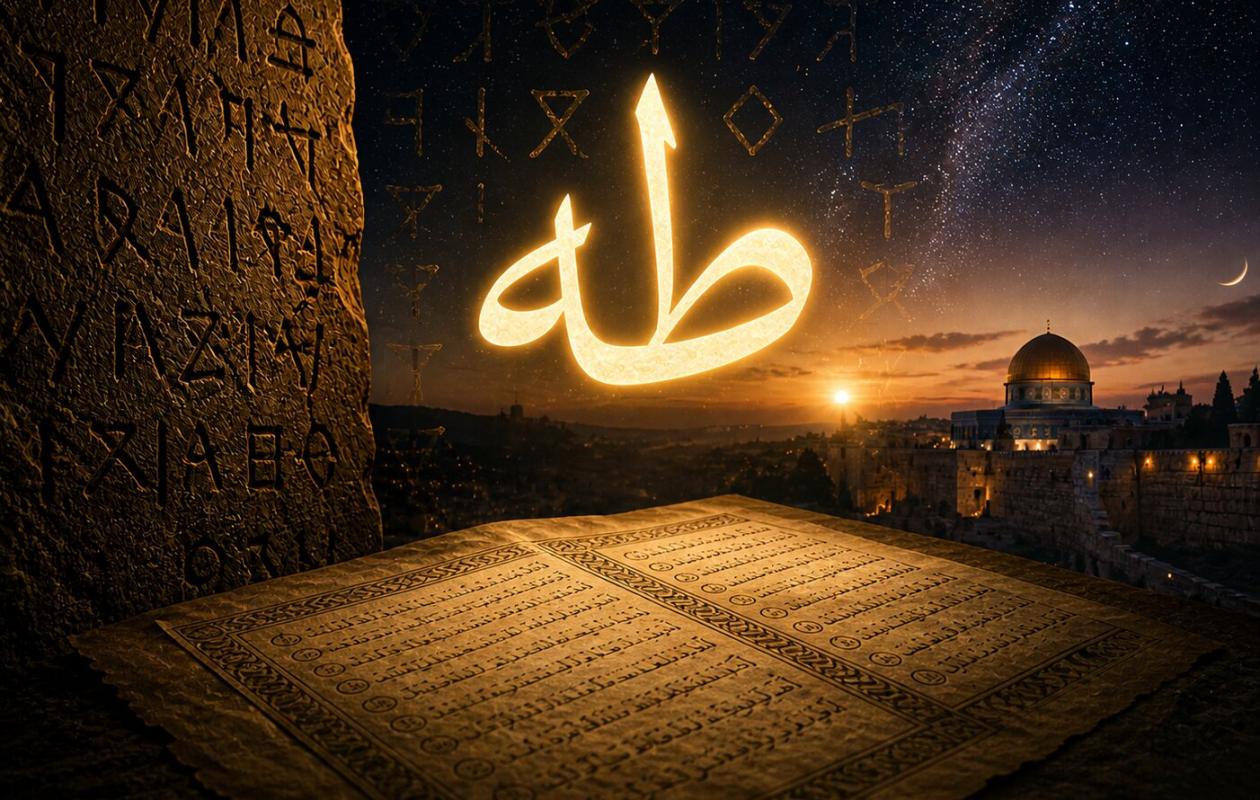
Tā-Hā : une des preuves du miracle du Coran
Dear readers, this brings us to the final article in our series on the ḥurūf al-muqaṭṭaʿāt , the mysterious separate letters that open twenty-nine surahs of the Quran. You can find the complete decipherment in the book "Ḥurūf al-muqaṭṭaʿāt: The Language of Abrahamic Revelation," available at www.at-tawbah.org .
In previous articles, we presented the different opinions of scholars: some link these letters to epithets of the Names of Allah, while the majority consider them to be part of divine mystery. We also showed that these letters seemed primarily addressed, at the time of the revelation, to the learned individuals identified in the Quran as the "People of the Book," that is, the Jews and Christians.
This observation led us to search for their meaning in the original language of the Torah revealed to Moses. We thus explored the hypothesis of Proto-Sinaitic (or Paleo-Hebrew) , the ancestor of the Semitic languages, notably Arabic and Hebrew, which we trace back to a common origin in Abraham, the ancestor of both traditions. Within this framework, we discussed the fact that, following the Babylonian exile in the 6th century BCE, Jewish scribes gradually abandoned this ancient script in favor of Aramaic, thus contributing to a linguistic transformation of the texts. By the grace of God, the study of Paleo-Hebrew sheds new light on these letters. Indeed, a single sign can fulfill several functions: it represents both a sound (like a letter) and an idea or an image. Thus, these signs combine a phonetic, visual, and conceptual dimension, forming a rich and polysemous writing system.
From this perspective, the Quran appears not only as a confirmation of previous revelations, but also as a reactivation of ancient linguistic structures , preserved in a condensed and remarkable form. Today, I propose that we explore together the teachings of the letters:
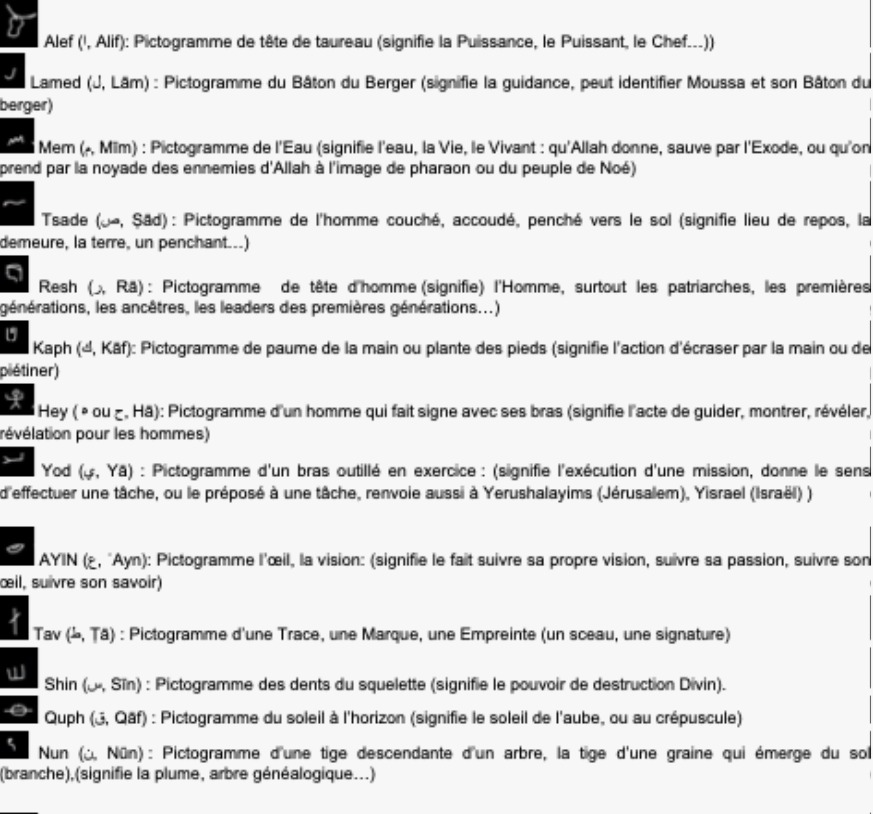
Tā-Hā, Tā-Sīn, Tā-Sīn-Mīm and Yā-Sīn. As a reminder, the letters of Paleo-Hebrew are listed below.
With Tā (Tav) – Hā (Hey), we read: The Mark – From the ancient revelations (as proof of the miracle of the Quran and the Prophet Muhammad (PBUH))
The surah deals almost exclusively with the story of Moses, both in Egypt and outside of Egypt, along with a brief section on the story of Adam. It answers those who ask for a miracle: "Has not the Proof (the Quran) of what the ancient Scriptures contain come to them?" — Excerpt from Surah 20, Ta-Ha.
(1) Ta-Ha. (2) We have not sent down the Quran to you to cause you distress, (3) except as a reminder for whoever fears Allah, (4) (and as) a revelation from Him who created the earth and the sublime heavens. (5) The Most Merciful has established Himself [Istawā] upon the Throne.
(…)
(133) And they say, "Why does he not bring us a sign from his Lord? Has there not come to them the proof (the Quran) of what was in the previous scriptures?" (134) And if We had caused them to perish with a punishment before him [Muhammad], they would surely have said, "Our Lord, why did You not send us a messenger? We would have followed Your verses before we were humiliated and disgraced."
Conclusion: Tā-Hā refers to the Quran (or the Prophet Muhammad ﷺ) in that it bears as proof the marks and traces of the previous revelations.
With Tā (Tav) – Sīn (Shin) – Mīm (Mem), we read: The Mark (the signs) – of Divine Destruction – of Life
The two surahs deal almost exclusively with the story of the Exodus, including the drowning of Pharaoh and his army, and the destruction of the ancient peoples. Allah ﷻ says, surah 26:
(192) This Qur'an is revealed by the Lord of the worlds, (193) and the Trustworthy Spirit has brought it down (194) upon your heart so that you may be among the warners, (195) in clear Arabic. (196) And this was already mentioned in the Scriptures of the earlier messengers. (197) Is it not a sign for them that the scholars of the Children of Israel should know? (198) If We had revealed it to any of the non-Arabs, (199) and he had recited it to them, they would not have believed in it. (200) Thus We have caused it to enter [doubt] into the hearts of the criminals, (201) but they will not believe in it until they see the painful punishment.
Conclusion: Tā-Sīn-Mīm refers to the revelation, in the Qur'an, of the traces of the destruction of the cities and unbelieving peoples.
With Tā (Tav) – Sīn (Shin), we read: The Mark (the signs) – of Divine Destruction
Surah 27, An-Naml (The Ant), relates the story of Moses and the destruction of Pharaoh; the story of Solomon with the Queen of Sheba, which concludes with his submission to Allah ﷻ and His Prophet in the face of the evidence — including his palace (which was also subsequently destroyed); the story of the Thamud, the people of the Prophet Ṣāliḥ, and their destruction; as well as the story of the people of Lot, who practiced homosexuality, and their destruction (the overthrow of Sodom).
Conclusion: Tā-Sīn refers to the revelation, in the Quran, of the Mark of destructions and divine punishments.
With Yā (Yod) - Sīn (Shin) we read: The Executor - of Divine Destruction: here "The Cry"
Surah 36, Ya-Sin, recounts the story of a people who received three messengers and a witness from among themselves. They refused to believe and killed their fellow citizen. The Cry destroyed them. Next comes the story of the people at the end of times, who refused to feed the poor: the Cry suddenly seized them, and they all perished. Then came the blast of the Trumpet announcing the resurrection, followed by the Cry of the Last Judgment. The surah concludes with the fate of the blessed in Paradise and the fate of the wretched in Hell.
























Commentaires (8)
Participer à la Discussion
Règles de la communauté
💡 Astuce : Utilisez des emojis depuis votre téléphone ou le module emoji ci-dessous. Cliquez sur GIF pour ajouter un GIF animé. Collez un lien X/Twitter, TikTok ou Instagram pour l'afficher automatiquement.
Se connecter
Commentez avec votre profil, votre photo, et soyez averti des réponses.