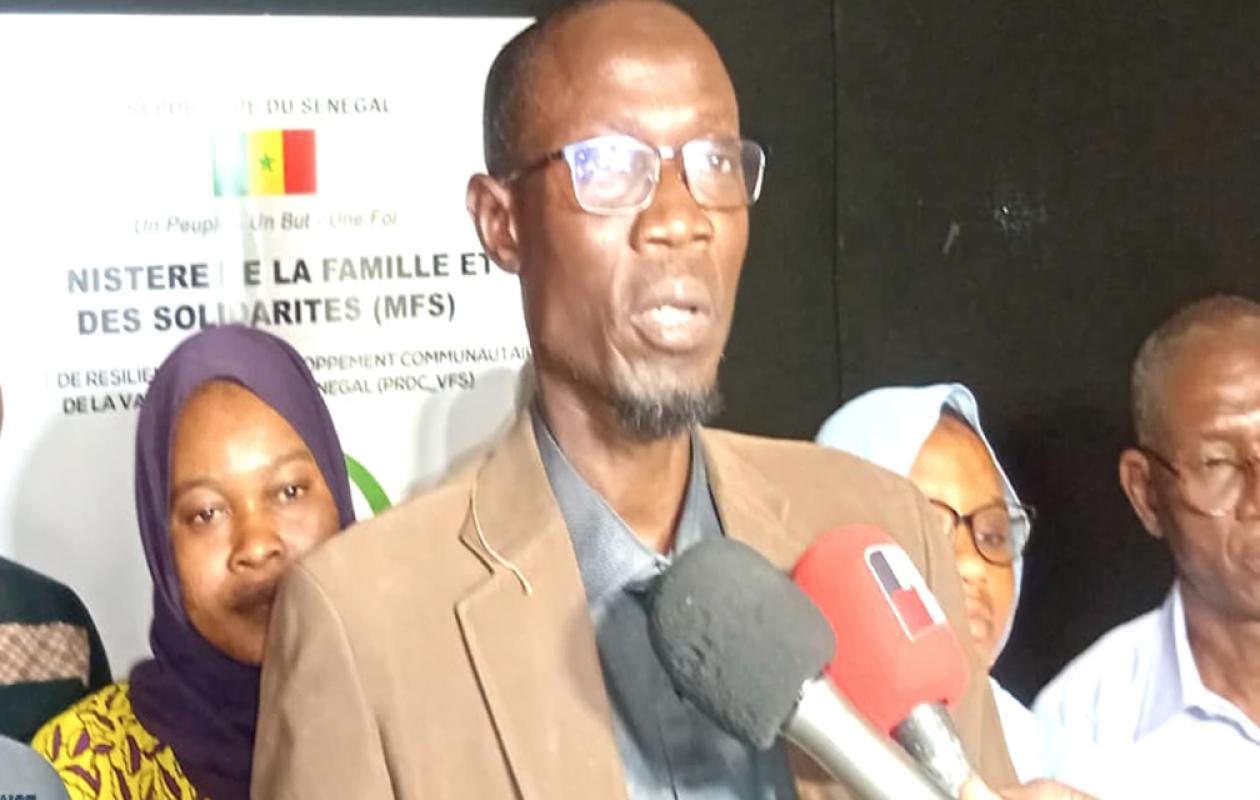
Atelier de renforcement de capacités: le PRDC-VFS renforce l’ancrage territorial et l’alignement stratégique sur le référentiel 2050
A strategic territory straddling Senegal and Mauritania, the Senegal River Valley combines immense agricultural and urban potential with significant socio-economic and climatic vulnerabilities. To transform these challenges into opportunities and prevent potential tensions, the Senegal River Valley Community Development and Resilience Project (PRDC-VFS) focuses on integrated, inclusive, and resilient investments. It was within this framework that a capacity-building workshop was held in Matam.
Despite its irrigated lands and key role in food security, the Valley remains vulnerable to climate risks, infrastructure deficits, and social vulnerabilities. The PRDC-VFS aims to address these challenges through a comprehensive approach: sustainable improvement of access to socio-economic infrastructure, strengthening of social cohesion, and promotion of harmonious cross-border development.
Funded by the World Bank, housed in the Ministry of Infrastructure and technically executed by PUMA, the project claims a participatory approach involving all territorial actors.
The main objective of the Matam workshop was to strengthen the capacities of stakeholders in order to effectively support the implementation of PRDC-VFS activities, in line with the public policies of the State of Senegal.
Discussions focused in particular on the link between the objectives of the Senegal 2050 Framework, the concept of territorial hubs, and local planning documents (Local Development Plans and Local Development Plans), fully integrating the dimension of climate change. Participants emphasized the importance of aligning local government development plans with national strategic guidelines.
The coordinator of the PRDC-VFS, Mamadou Diedhiou, stressed that the workshop aimed first to share national framework documents with territorial actors and to better articulate local initiatives with these references.
He noted that the project has initiated a process of updating local planning documents, taking climate change into account. The workshop thus provided a better understanding of the content of national guidelines and helped identify necessary adjustments.
“We operate in three areas: North, Northeast and Southeast. The PRDC-VFS also participates in the regional committees established by the governors, within the framework of the territorial hub reform. The objective is clear: to actively contribute to this structuring policy,” stated the PRDC-VFS coordinator.
Mamadou Diedhiou also announced the upcoming signing of a protocol with Gaston Berger University to support the territories, particularly in knowledge management and capitalizing on experiences.
For consultant Ousseynou Touré, the value of such a workshop is clear. According to him, aligning a project with public policy documents, particularly the 2050 Framework, offers a triple advantage: integrating the project's results into the national evaluation, providing a comparative advantage over non-aligned initiatives, and promoting the continuity of public action.
He also emphasized the relevance of the PRDC-VFS in a context where the majority of territorial hubs are located in border or coastal areas, particularly exposed to the effects of climate change. In his view, effective reform must be "bottom-up," that is, starting from the ground up, by valuing the capacity for reflection of local stakeholders.
He welcomed the diverse composition of the participants, believing that the desired systemic transformation requires broader community mobilization and not just local elected officials.
The consultant also highlighted the project's performance, noting that nearly 26 billion CFA francs had been invested in two years, resulting in the completion of socio-economic and community infrastructure. He attributed this efficiency to the top management's understanding of local realities and a significant reduction in the time required for effective management. Beyond the infrastructure projects, the PRDC-VFS aims to embed its actions within a sustainable systemic transformation, based on climate resilience, social cohesion, and strategic alignment with national policies.
The Matam workshop thus marks an important step: that of a strengthened dialogue between State, local authorities, experts and communities, to make the Senegal River Valley a space of stability, shared prosperity and successful regional integration.



![[EXCLUSIF] Réseau de voleurs démantelé à Colobane : 500 téléphones, 33 tablettes et des ordinateurs saisis par la SR et le GIGN, 23 arrestations](https://image.seneweb.com/content/news/2026-22-30//thumb_1260x800_6a1b6ac9bcdc7_zf1U3G3p2i.jpg)








Commentaires (1)
Participer à la Discussion
Règles de la communauté :
💡 Astuce : Utilisez des emojis depuis votre téléphone ou le module emoji ci-dessous. Cliquez sur GIF pour ajouter un GIF animé. Collez un lien X/Twitter, TikTok ou Instagram pour l'afficher automatiquement.