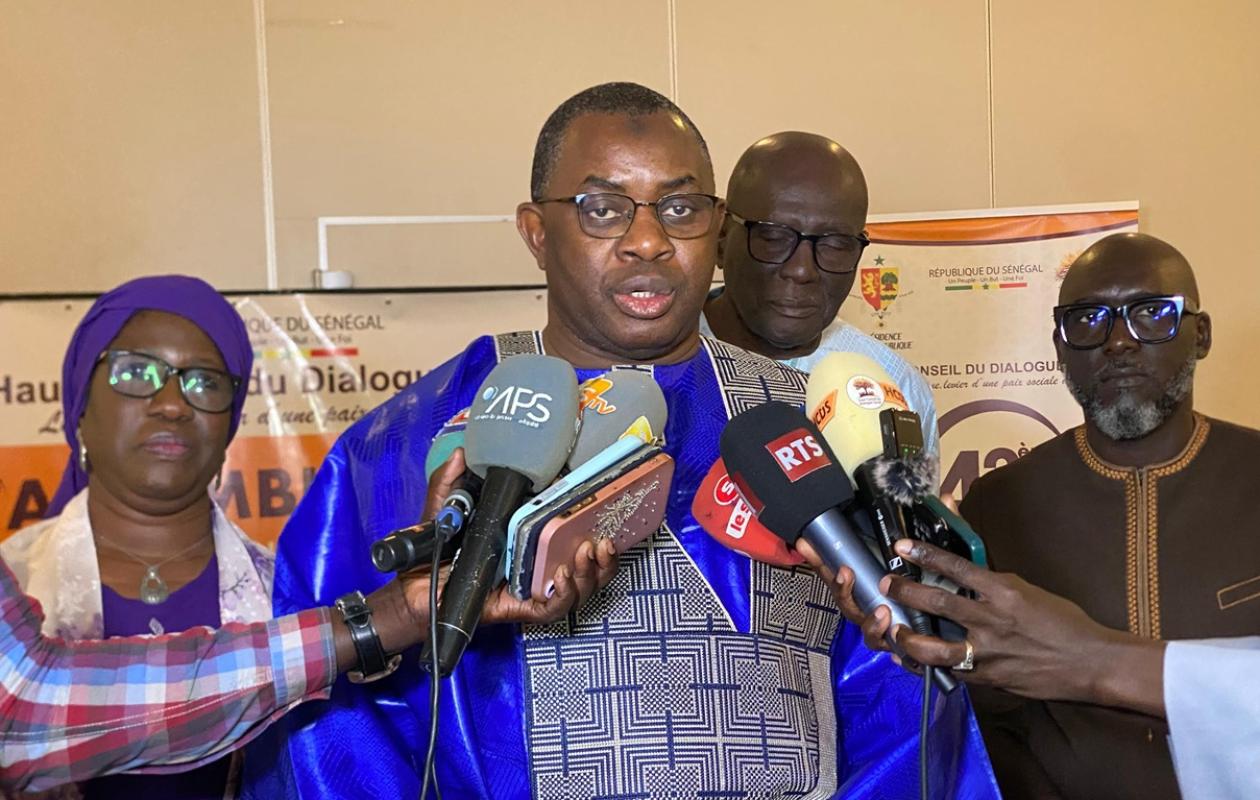
Dialogue social au Sénégal : Le HCDS dresse le bilan 2025 et alerte sur les tensions sociales
The High Council for Social Dialogue (HCDS) opened the work of its 42nd Plenary Assembly, a session devoted to the evaluation of the activities of the year 2025 and the definition of the prospects for 2026. A meeting marked by a call for the strengthening of social dialogue in a national context characterized by tensions in several strategic sectors.
The president of the HCDS, Mamadou Lamine Dianté, recalled that this exercise constitutes the first annual evaluation since the adoption of the institution's 2025-2027 strategic intervention framework.
According to him, a culture of transparency and accountability requires regular program evaluations to measure the level of commitment fulfillment and adjust future actions.
The president of the HCDS also stressed that the institution's activities are part of the dynamic of the National Pact for Social Stability for Inclusive and Sustainable Growth, signed on May 1, 2025. This instrument, which aims to pacify professional relations, notably provides for the strengthening of the capacities of social actors in social dialogue and collective bargaining, as well as the establishment of social dialogue committees in ministries and in public and private structures.
A tense social climate
Despite these mechanisms, the president of the HCDS acknowledged that the social climate remains turbulent, particularly in the education and health sectors, which are marked by recurring disruptions. This is compounded by the threats of a general strike brandished by certain labor unions.
To better understand these tensions, the Plenary Assembly plans to hold discussions with representatives of the G7 Education Group and the Alliance And Gueusseum, in order to gather their concerns and formulate recommendations for public authorities and social partners.
For his part, the permanent secretary of the HCDS, Pape Birama Diallo, welcomed a year marked by several advances, including the active participation of the institution in the development and implementation of the social stability pact.
He also highlighted the social mediation actions carried out in different sectors, notably at the Iba Der Thiam University in Thiès, as well as the social dialogue training initiatives at the Cheikh Anta Diop University in Dakar and in Thiès.
The HCDS has also undertaken two major projects: the development of a preliminary draft collective agreement for agricultural professions and the updating of the collective agreement for mines and extractive industries.
Institutionally, efforts have been made to improve the visibility of the High Council, with the implementation of modern communication platforms, including a redesigned website and a strengthened presence on social networks.
From the employers' perspective, Pape Abdoulaye Djigal, vice-president of the HCDS employers' group, emphasized the importance of social stability for the business environment. According to him, preventing social conflicts is a key lever for strengthening business competitiveness, creating wealth, and generating jobs.
He acknowledged, however, that businesses are currently experiencing a difficult economic period, marked by cash flow problems and an uncertain international environment. For Ramatoulaye Niang Fall, Vice-President of the government group at the HCDS and Director General of Labor and Social Security, the overall assessment for 2025 remains positive. She believes that the HCDS's actions contribute significantly to improving the social climate, particularly in the education, health, and higher education sectors.
However, she acknowledges that the social truce stemming from the stability pact is currently weakened by several areas of tension. It is in this context that a meeting of the pact's steering committee is scheduled for March 17, chaired by the Prime Minister, to assess the implementation of the commitments and consider corrective measures.
At the conclusion of this 42nd Plenary Assembly, the members of the HCDS will adopt the 2025 activity report, approve the draft report on the state of social dialogue, and formulate recommendations for the public authorities. This is intended to consolidate the achievements of social dialogue and strengthen social democracy in Senegal, within an economic and social context marked by profound changes in the world of work, according to President Mamadou Lamine Dianté.

![[EXCLUSIF] Réseau de voleurs démantelé à Colobane : 500 téléphones, 33 tablettes et des ordinateurs saisis par la SR et le GIGN, 23 arrestations](https://image.seneweb.com/content/news/2026-22-30//thumb_1260x800_6a1b6ac9bcdc7_zf1U3G3p2i.jpg)








Commentaires (3)
Participer à la Discussion
Règles de la communauté :
💡 Astuce : Utilisez des emojis depuis votre téléphone ou le module emoji ci-dessous. Cliquez sur GIF pour ajouter un GIF animé. Collez un lien X/Twitter, TikTok ou Instagram pour l'afficher automatiquement.