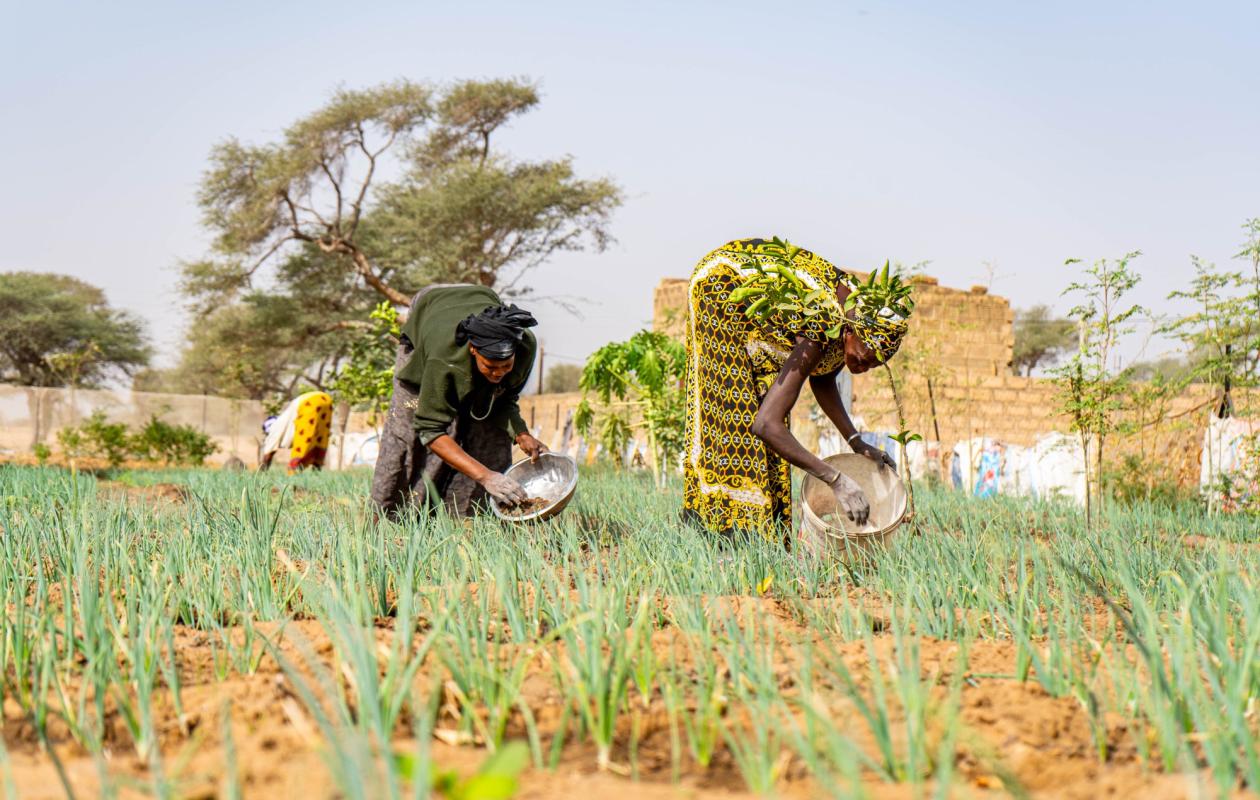
Sénégal rural : l’équilibre fragile des exploitations familiales
Family farms form the backbone of Senegal's agricultural production and national food security. However, they operate in an increasingly challenging environment marked by land pressure, soil erosion, and the expansion of real estate and agribusiness projects. In certain areas of the Niayes region and along the coast, pressure on agricultural land has increased significantly, reducing the space available for small farms. This competition for land undermines an agricultural model based on small plots, often less than three hectares, and a predominantly family workforce.
Climate change is exacerbating this vulnerability. Rainy seasons are becoming shorter and more irregular, with significant year-to-year variations according to recent agroclimatic data. Rainfed crops, such as groundnuts and millet, remain highly susceptible to climate shocks, resulting in frequent yield losses. These fluctuations complicate planning, increase financial risks, and reduce the capacity of farming households to invest in improving their production tools.
Access to credit remains one of the main obstacles to the transformation of family farming. A small proportion of small farms have access to formal financing due to limited collateral and irregular income. More recent initiatives, such as financing through mutuals or microfinance institutions, provide partial but insufficient solutions to support more structural investments like drip irrigation, light mechanization, or the acquisition of improved seeds. Technical innovations, whose adoption remains uneven, nevertheless offer significant productivity gains in certain sectors.
Emerging partnerships between family farms, cooperatives, and agribusinesses are gradually changing traditional dynamics. In the horticultural sector, production contracts sometimes guarantee a market outlet and a minimum price, reducing uncertainty for small producers while improving their capacity to invest. These models are still in the minority but demonstrate that integrating family farms into structured value chains can stimulate their modernization.
The future of Senegalese family farming teeters between fragility and reinvention. Its sustainability will depend on the ability of public policies to secure land tenure, finance innovation, develop irrigation, and structure value chains. If these conditions are met, family farms could strengthen their economic role while supporting a more resilient agricultural transition in the face of climate shocks and market pressures.























Commentaires (7)
Personnellement, je suis Sénégalais et je dispose d'environ 100 millions à investir et j'ai besoin d'une grande surface. Si je dépense la moitié de cet argent pour acheter un terrain ce qui reste serait insuffisant pour réaliser mon business. Et des investisseurs comme moi (sans terre) il y'en a. Donc il faut que nous repensions le système pour permettre à tous les Sénégalais qui le veulent de pouvoir accéder à la terre, au paysan d'avoir des revenus fixes et les moyens d'investir eux mêmes (ce que l'Etat ne peut pas leur donner). Dans tous les cas, nous devons sortir de ce système de petites exploitations qui permettent à peine de tenir 12 après les récoltes.
Pour le premier nous devrions transiter vers la finance participative, une approche de partage de perte et de profit entre le prêteur et l'emprunteur.
Pour le second, il faut améliorer la qualité des produits et créer des boutiques de coopératives pour l'écoulement des récoltes.
Participer à la Discussion
Règles de la communauté
💡 Astuce : Utilisez des emojis depuis votre téléphone ou le module emoji ci-dessous. Cliquez sur GIF pour ajouter un GIF animé. Collez un lien X/Twitter, TikTok ou Instagram pour l'afficher automatiquement.
Se connecter
Commentez avec votre profil, votre photo, et soyez averti des réponses.