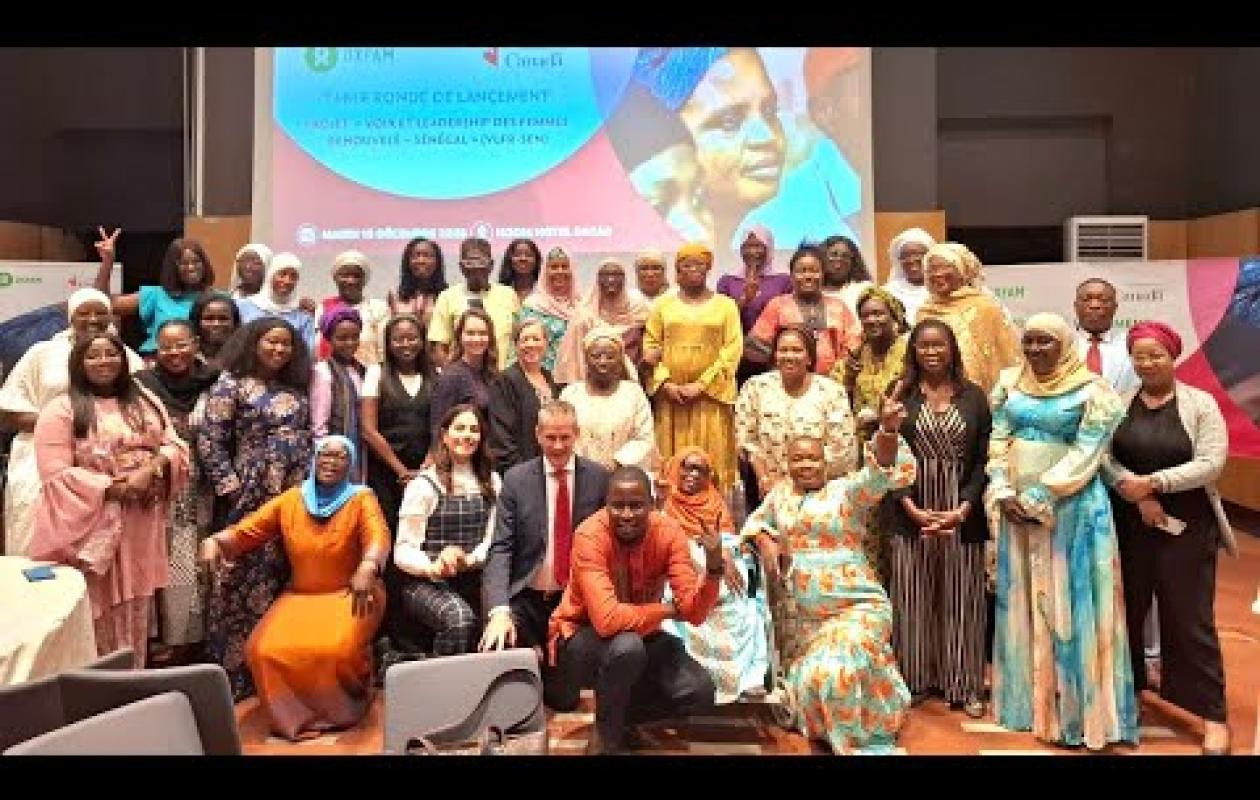
Voix et Leadership des femmes renouvelées : Une nouvelle stratégie de transformation des inégalités structurelles
Despite significant legislative and institutional progress, gender inequalities persist in Senegal. "Women and girls continue to face limited access to economic resources, underrepresentation in decision-making spheres, multifaceted violence, and socio-cultural norms that hinder their ability to act, both individually and collectively," according to Sadio Kanouté of the Ministry of Family and Solidarity.
"These realities hit women living in situations of intersecting vulnerability even harder, particularly in rural areas, in situations of disability or precariousness," she adds.
Ms. Kanouté was speaking at the launch of the Renewed Women's Voice and Leadership – Senegal (VLFR-SEN) project, during a roundtable discussion held in Dakar on Tuesday, December 16, 2025. The project is being implemented by Oxfam, in partnership with the Canadian Embassy in Senegal and several civil society organizations. All these stakeholders have mobilized around a collective action.
Beyond the official launch, the meeting aimed to create a dynamic of lasting engagement. According to Assalama Sidi, Oxfam's Deputy Director for Africa, the goal was "to mobilize technical and financial partners, feminist organizations, and the media around a shared vision, while also opening a space for reflection on the relevance of the project's strategic directions in light of Senegalese realities."
"Women's development cannot be decreed."
Representing the Ministry of Family and Solidarity, Sadio Kanouté, head of the Directorate of Equity, Equality and Gender, highlighted the efforts made by the Senegalese state in recent years. She specifically cited "the law criminalizing rape and pedophilia, as well as the development of several national gender-sensitive strategies."
However, she acknowledged, "these advances remain insufficient in the face of persistent structural inequalities." "Women and girls continue to be exposed to violence, discrimination, and exclusion from decision-making spaces," she stated, emphasizing that the VLFR-SEN project specifically addresses these challenges.
According to her, the program is fully aligned with national priorities and the Senegal 2050 Vision, which promotes social equity and equitable access to human capital. "Women's development cannot be decreed; it must be built, supported, and protected," she emphasized, calling for collective and sustained mobilization. Oxfam is relying on an innovative governance model based on local leadership.
The project is co-led by eight Senegalese organizations, organized in lead and co-lead pairs, around four thematic clusters focusing in particular on peace and social cohesion, access to justice and the fight against gender-based violence, economic empowerment and inclusion, as well as health and community mobilization.
For Assalama Sidi, Oxfam's Deputy Director for Africa, this choice is not insignificant. "Local problems require local solutions," she stated, believing that only feminist organizations rooted in communities can drive lasting change. She praised the expertise, perseverance, and courage of the project's partners, whom she considers "the true driving force behind this initiative."
Present at the ceremony, the Canadian ambassador reiterated that the Women's Voice and Leadership program is based on a fundamental principle of co-creation. "We are not here to provide ready-made solutions, but to support those that emerge from women's organizations," said Marcel Bleu.
He emphasized that Canada's role is primarily technical and financial, leaving local stakeholders to define priorities and action strategies. He stated that this approach has already proven its impact in other countries and aims to sustainably strengthen women's leadership in Senegal.
Throughout the discussions, one worrying observation was repeatedly emphasized: despite the actions taken, violence against women continues to increase. "The more we act, the more the perpetrators of violence organize themselves," warned one speaker, calling for a collective awakening.
"I ask you that this ceremony not be just a ceremony," she told the audience, urging each actor, at their level, to refuse to allow women to be killed, mutilated or silenced for daring to speak out.

















Commentaires (1)
Participer à la Discussion
Règles de la communauté :
💡 Astuce : Utilisez des emojis depuis votre téléphone ou le module emoji ci-dessous. Cliquez sur GIF pour ajouter un GIF animé. Collez un lien X/Twitter, TikTok ou Instagram pour l'afficher automatiquement.