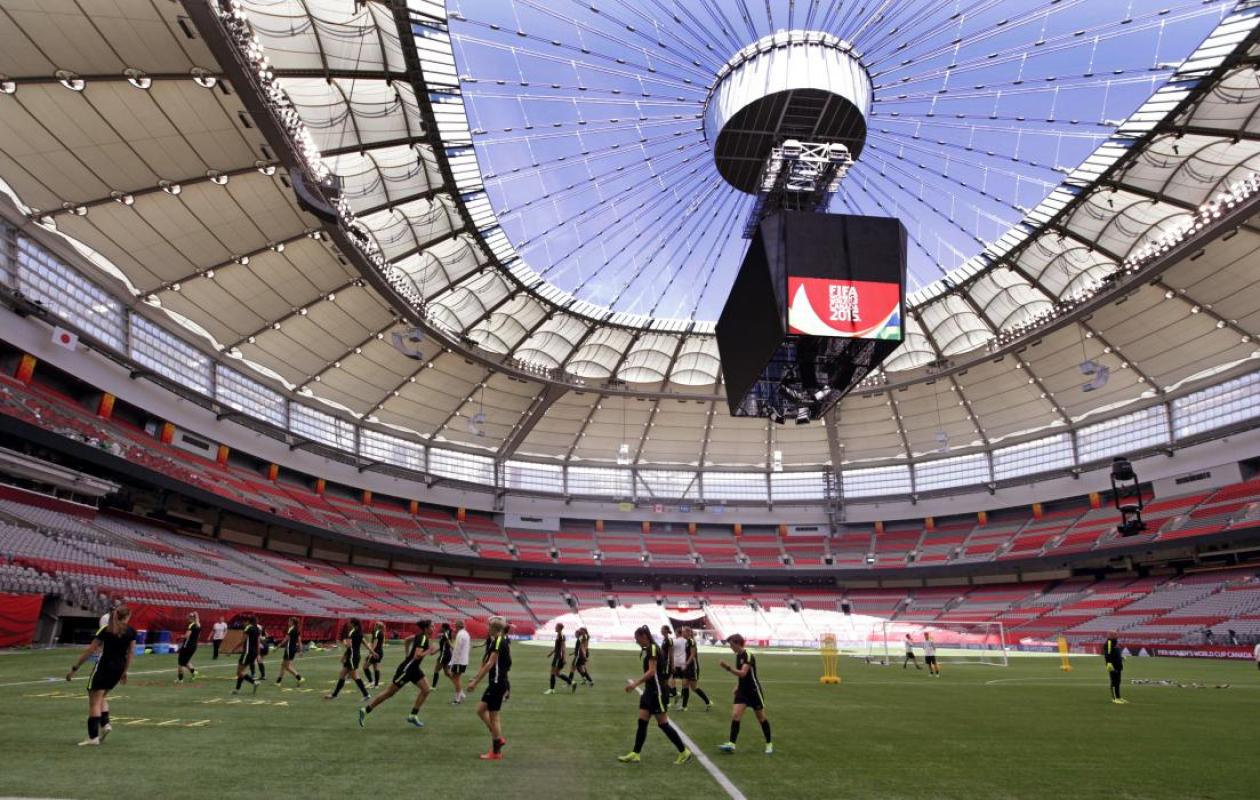
Chaleur, humidité, pollution: "le jeu risque d'être moins spectaculaire" au Mondial-2026 (chercheur)
"A much less spectacular, less intense game": the high temperatures combined with humidity and pollution risk altering the performance and endurance of footballers at the 2026 World Cup, Paquito Bernard, a researcher at Inserm, told AFP.
A review of recent studies, along with a meta-analysis compiling 30 years of statistics conducted with his team, shows that the higher the WBGT temperature index (which incorporates humidity and solar radiation), the greater the impact on the distance covered by players, the number of tackles, and the quality of passes. These observations are even more pronounced when matches take place in the afternoon.
This World Cup will be held from June 11 to July 19 in the United States, Mexico and Canada.
QUESTION: Is such a combination of factors unprecedented for a World Cup?
ANSWER: "In 2014 in Brazil, this was already somewhat the case with the heat and humidity, but less so with pollution. This time, the risk of heat waves will be much greater compared to other World Cups where it has been hot. There will therefore be a combination of risks: intense heat, pollution, humidity, and even, for some stadiums, the risk of forest fires. In the United States, we're talking about megafires, meaning plumes of smoke that can travel for tens, even hundreds of kilometers. And there's also the altitude to consider for stadiums like Mexico City and Guadalajara. This will be a particular problem for teams that won't have time to acclimatize. For example, it will be a challenge to exert yourself if you have to go from Miami, at sea level, to Mexico City, at over 2,000 meters altitude. And Mexico City is also the city with the highest historical risk of air quality issues." the most degraded of all the cities hosting the World Cup."
Q: What effects might this have on the players' actions and the game in general?
R: "Overall, the game is likely to be much less intense, much less spectacular. Defenders, midfielders, attackers: all positions are impacted in terms of the distance covered over the course of the match. And it's not necessarily just about endurance efforts and the ratio between running long distances/running fast: it's also, due to air quality concerns, a degradation of the ability to produce technical skills and to gather information around oneself."
Q: So, beyond the legs, the brain also slows down?
R: "The players will arrive very tired from the end of their season at their club, and not necessarily ready to play in a very hot or very humid environment. If, for example, a footballer has to exert himself in a very hot and intense first match, despite the special 'cooling' breaks introduced by FIFA, it can lead to symptoms of heat exhaustion, dizziness, or fainting. And even without going that far, the footballer will be less alert and less careful in gathering information or managing technical aspects."























Commentaires (1)
Participer à la Discussion
Règles de la communauté :
💡 Astuce : Utilisez des emojis depuis votre téléphone ou le module emoji ci-dessous. Cliquez sur GIF pour ajouter un GIF animé. Collez un lien X/Twitter, TikTok ou Instagram pour l'afficher automatiquement.