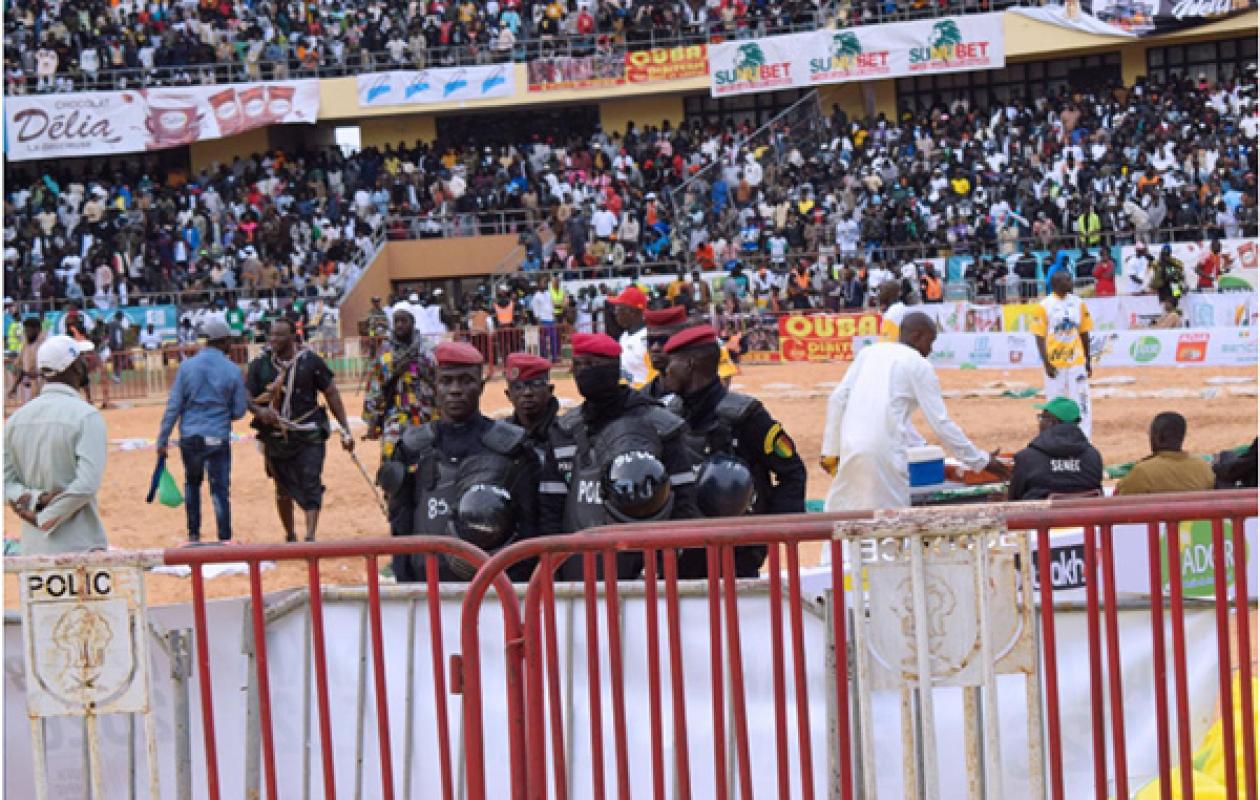
Lutte : Quand la violence déborde de l’arène et interroge l’autorité de l’État
Senegalese wrestling, an emblematic sport, has long been a symbol of culture, bravery, and popular pride. Yet, in recent years, this national sport has become increasingly associated with scenes of uncontrolled violence that extend far beyond the confines of the arena. This worrying trend raises a crucial question: when will wrestling cease to be a source of insecurity for ordinary citizens?
With every major sporting event, the same scenario seems to repeat itself. Long after the end of the competitions, acts of violence erupt in several neighborhoods: clashes between fans, vandalism, assaults, blocked roads, and businesses forcibly closed. Residents, seemingly untouched by this violence, find themselves trapped, forced to stay home, unable to go about their business freely. Even the privacy of their own homes no longer always offers sufficient protection.
What is shocking today is no longer just the scale of the violence, but its recurring nature. Fight after fight, the same scenes unfold, giving the impression that violence has become almost normalized, tolerated, even trivialized. The struggle, which is supposed to end at the gates of the arena, now spills into the public sphere, undermining collective safety and public order.
These acts, often marked by extreme brutality, are more akin to savagery than sporting passion. They reflect a deeper unease: that of a youth left to its own devices, inadequate supervision, and a state response deemed too weak or too late.
Faced with this situation, the Ministry of the Interior bears direct responsibility. Mr. Bamba Cissé, as the guarantor of internal security, is being called upon by public opinion. The repeated violence following the fighting raises questions about the effectiveness of the security measures put in place and the State's capacity to anticipate, prevent, and punish.
Ensuring security at a sporting event cannot be limited to the arena itself. The mission of law enforcement must extend to roads, sensitive neighborhoods, and areas with high concentrations of fans. The lack of exemplary punishment for troublemakers contributes to a sense of impunity and fuels the spiral of violence.
This is not about condemning wrestling as a sport, nor about denying its cultural and economic importance. But preserving wrestling also means protecting citizens. A national sport cannot thrive at the cost of widespread insecurity and collective fear.
A thorough reflection is needed: strengthening security measures, holding promoters accountable, strictly regulating supporters, imposing firm sanctions, and launching awareness campaigns. Without clear political will and concrete actions, violence will continue to tarnish the image of wrestling and poison the daily lives of Senegalese people.
The question is no longer whether incidents will occur after a fight, but how far this violence will go if nothing is done. Senegalese people aspire to live normal lives, even on days of struggle. They have the right to security, peace, and freedom of movement.
It is now up to the authorities, first and foremost the Ministry of the Interior, to fully grasp the situation. Because a fight that doesn't stop at the gates of the arena becomes a national security issue.












Commentaires (8)
je ne regarde plus la lutte même à la télé.
les pikinois ne sont pas ambitieux, ils auraient du y mettre un grand lycée d'excellence ou une école de formation, hôpital, mais une arene de lutte...🥲c'est pitoyable.
C'est un no man's land.
Pour moi, la solution est toute simple: suspendre la lutte pour 3 mois minimum en guise d'avertissent, condamner lourdement les agresseurs, et condamner également les lutteurs dont les supporters agressent. Car ces lutteurs sont complices.
Participer à la Discussion
Règles de la communauté :
💡 Astuce : Utilisez des emojis depuis votre téléphone ou le module emoji ci-dessous. Cliquez sur GIF pour ajouter un GIF animé. Collez un lien X/Twitter, TikTok ou Instagram pour l'afficher automatiquement.