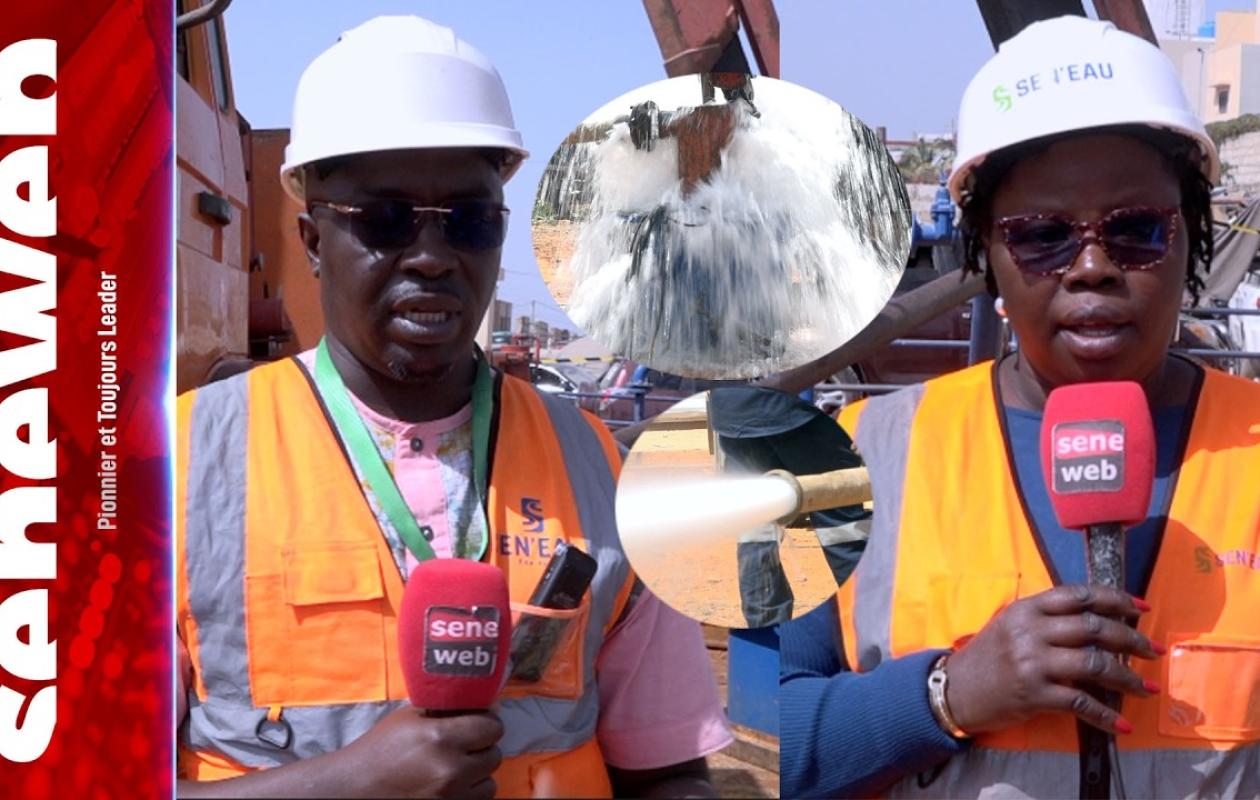
Entretien des forages : la Sen’Eau engage des travaux pour préserver la qualité de l’eau à la cité Tobago
Located in the Senegalese capital, the Tobago district holds within it a precious and, above all, vital treasure: blue gold. The liquid flows thanks to a well installed by Sen'Eau. The public company's employees are hard at work carrying out their preventative maintenance program for its hydraulic infrastructure. These technical interventions aim to improve service for consumers.
Ndébane Ngom, head of the drilling division at Sen'Eau, discusses the challenges related to well operation: “As you know, during operation, boreholes tend to lose flow rate due to clogging that occurs over time, as well as fine particles present in the water that can affect turbidity and alter the organoleptic characteristics of the water quality.” When asked about corrective measures, she explains: “Today, we're here. We first remove the pump and begin an open-air treatment. This involves cleaning the borehole itself, the well, using a compressor.”
In more detail, the head of the drilling division at Sen'Eau explains the technical process used in this operation: "We simply inject air, but at a controlled flow rate and pressure, so as not to damage the structure. This air will clean the borehole, meaning all the equipment inside, the well itself, to remove all the deposits and fine particles, resulting in clear water and an improved flow rate thanks to the cleaning of the screens. In addition to this, we also perform maintenance on the submersible pump, the one we just removed. So we open it up, clean all the pump's impellers, and clean the suction, so that it can draw more water when it's put back into service."
This systematic approach is implemented before each hot period when water consumption increases. The objective is to prevent any risk of failure in the drinking water supply process.
Pape Abdou Mbaye, Sen'Eau's regional director, emphasizes the importance of this intervention: "Because a poorly maintained borehole can lose up to 20 or even 50% of its yield and, from that perspective, have consequences on the drinking water supply for the population, as well as on the quality of the water being supplied. That's why we deploy this system regularly to ensure that the boreholes are properly maintained, to ensure that they function optimally in order to supply water to the population."
The equipment on site is electrically powered. With a production capacity of 150 m³/h, the water from the borehole is directly delivered to households after chlorine disinfection. Pape Abdou Mbaye explains the alternatives for supplying drinking water in the Senegalese capital: “To supply the population with water, there aren't many alternatives. We only have two: surface water or groundwater. Currently, we treat surface water primarily from Lake Guier. Groundwater is what we collect through boreholes. Other surface water sources will be added in the very near future, namely seawater desalination. Here too, surface water undergoes treatment.”
Further on, he elaborated on the different water treatment processes: “For surface water, you need plants with fairly advanced technology, with more or less complex processes to obtain good quality water, in accordance with the guidelines of the World Health Organization, meaning potable water. For boreholes, it's quite simple, because there's already a natural treatment process that occurs through the different layers the water passes through before reaching the surface. And from that perspective, we simply need to disinfect to ensure that the water is indeed potable as it comes out of our boreholes.” The Sen'eau official added: “Every day, we check the quality of the water coming out of the boreholes. Absolutely not, it's water that perfectly meets all the guidelines of the World Health Organization.”
Scheduled to last 10 hours, these works are causing a temporary decrease in water flow. Sen'Eau teams assure that they have mobilized the necessary resources to reduce this delay to a maximum of nine hours.























Commentaires (4)
Participer à la Discussion
Règles de la communauté :
💡 Astuce : Utilisez des emojis depuis votre téléphone ou le module emoji ci-dessous. Cliquez sur GIF pour ajouter un GIF animé. Collez un lien X/Twitter, TikTok ou Instagram pour l'afficher automatiquement.