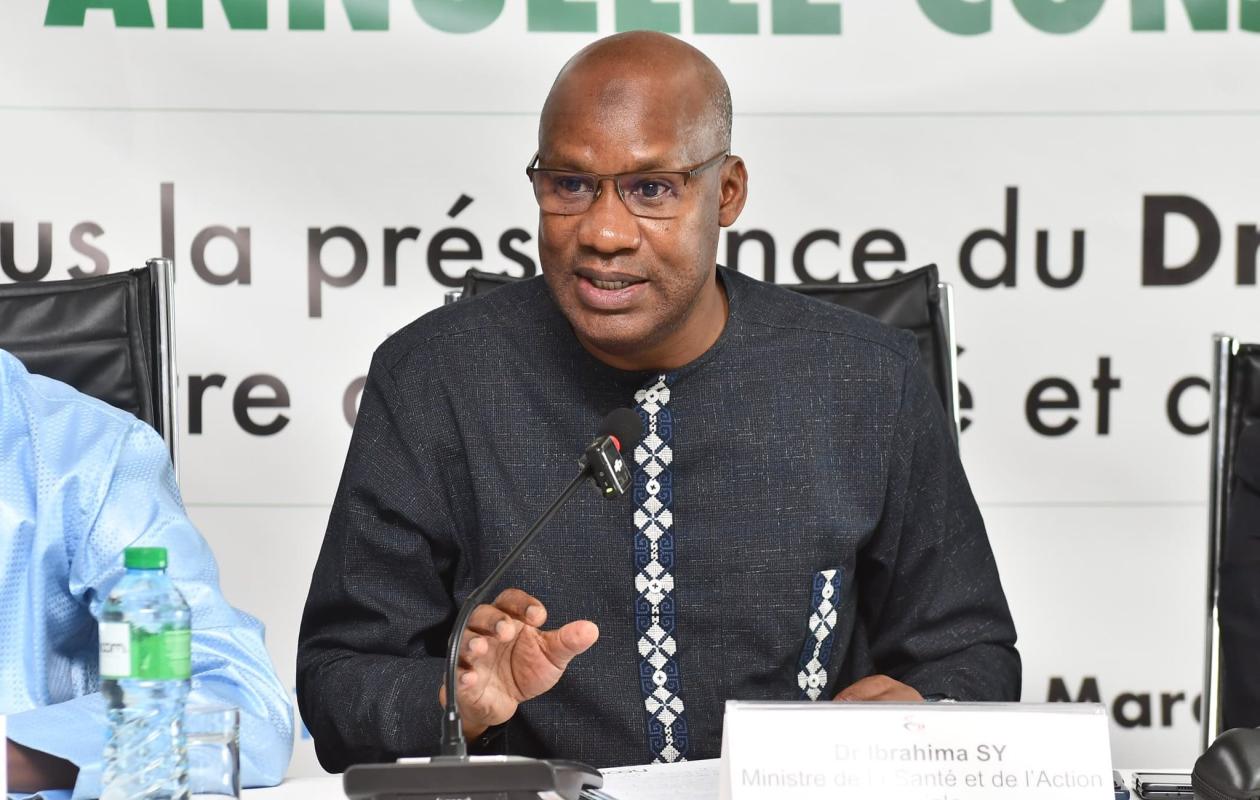
Revue annuelle conjointe 2026 : Ibrahima Sy appelle à accélérer les réformes et les procédures d’urgence dans la santé
The Ministry of Health and Public Hygiene held its 2026 Joint Annual Review (JAR) on Thursday, May 7, 2026, dedicated to evaluating the performance of the health sector, monitoring recommendations, and looking ahead to the current year.
On this occasion, Minister Ibrahima Sy stressed the need to accelerate structural reforms and adapt administrative procedures to the sector's urgent needs.
Among the main projects discussed was the drafting of the Health Code. According to the Minister of Health, this text should unify and regulate all legislative provisions relating to the health sector.
"If we manage to have this Health Code, we will have the compass for public health at the level of Senegal and all other laws will be contained within this code," said the minister, who hopes that "in three months, the Council of Ministers will adopt this code" before it is presented to the National Assembly.
Ibrahima Sy also announced a review of the 1998 hospital reform, stating that it deserves a thorough evaluation. "This reform has not yet been properly assessed to see what worked, what didn't, and how we can get things back on track," he said, referring to the guidelines of the Senegal 2050 National Transformation Agenda.
The minister also announced the upcoming approval of a new national health map. According to him, this tool should allow for a better adaptation of healthcare services to the needs of the population.
"The health map that we have had to develop and which will be validated this week will allow us to take into account the new standards and new norms in terms of the health needs of the population," he explained.
This mapping should in particular be used to define the needs in terms of infrastructure, location of health facilities and availability of care at each level of the health pyramid.
The minister mentions administrative delays.
Of the 18 recommendations adopted during the RAC 2025 review, five have been implemented, 11 are being developed, and two have not yet been implemented. When questioned about accelerating the implementation of the ongoing recommendations, Ibrahima Sy cited difficulties related to procurement procedures.
"Sometimes we can go a whole year without being able to properly execute an action because a contract has been awarded to one company and another company is contesting it," he lamented.
For the minister, these delays are hardly compatible with the demands of the health sector. "Health is about urgency. Today, I cannot have patients waiting for certain heart operations and be told that to acquire the equipment, we have to wait three or four months," he insisted.
In this regard, he calls for an adaptation of procurement mechanisms in the health sector. "We need to review our procurement mechanisms and procedures so that health is once again considered an emergency," argued Ibrahima Sy.
Furthermore, Mr. Sy mentioned the budgetary and administrative constraints that often hinder the implementation of planned actions. "We can say that the Ministry of Health has a budget of 10 billion, but the other question is how to mobilize that budget," he stated.
According to the RAC 2025 recommendations follow-up document, progress includes the finalization of the new hospital reform document and the completion of data quality audits.
Also underway is the acceleration of the deployment of the computerized patient record (DPI), currently operational in 22 health posts, three health centers and five hospitals, including one non-hospital.







![[EXCLUSIF]De Ziguinchor au Méridien : Le déballage explosif de Ndiaga Seck qui livre les noms et numéros de 10 de ses amants](https://image.seneweb.com/content/news/2026-21-18//thumb_1260x800_6a0b129f253e7_EAmQ8XmZt5.jpg)
![[EXCLUSIF] Ndiaga Seck : Ce qu'il a dit sur Ousmane Sonko](https://image.seneweb.com/content/news/2026-21-18//thumb_1260x800_6a0b59b4699aa_zsVjCNITAk.jpg)










Commentaires (1)
Participer à la Discussion
Règles de la communauté :
💡 Astuce : Utilisez des emojis depuis votre téléphone ou le module emoji ci-dessous. Cliquez sur GIF pour ajouter un GIF animé. Collez un lien X/Twitter, TikTok ou Instagram pour l'afficher automatiquement.