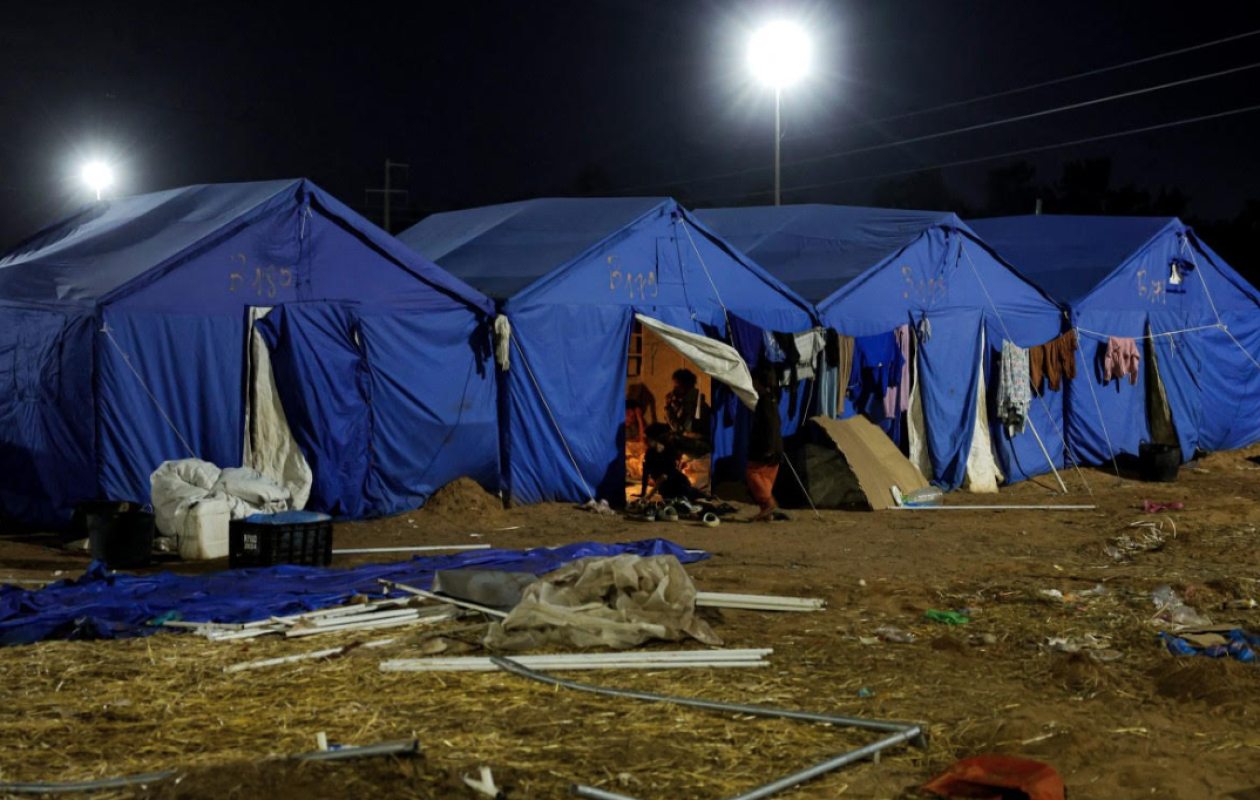
Dans les zones inondées du Maroc, un ramadan loin des célébrations traditionnelles
Driven from his village in northwestern Morocco by devastating floods, Ahmed El Habachi believed his exile was temporary. Three weeks later, he couldn't imagine breaking his Ramadan fast in a tent, "making do".
"We are preparing the ftour (breakfast meal) with whatever means we have on hand," this 37-year-old plasterer told AFP, standing in front of one of the blue tents in the temporary camp in the Kenitra region, set up by the authorities due to exceptional rains that hit the region at the end of January and the beginning of February.
A few dozen canvas tents remain pitched, lined up on the damp earth. As sunset approaches, women bustle around small stoves. Without running water, they improvise, while the smell of grilled fish spreads through the air.
As night falls, the flickering light of candles replaces the lack of electricity. Families retreat to their tents, sitting down to the iftar meal of the Muslim holy month in precarious conditions.
Most of the region's residents have been allowed to return to their homes. For Ahmed El Habachi and his children, returning to Ouled Amer, 35 kilometers away, is not an option.
"Where can I sleep? There's still mud up to my knees," he explains, showing videos on his phone of his house, half of whose walls have been swept away by the floods of the nearby river.
"We're just making do until we can go home," he said. "It will take two or three months to get back to normal life."
Camp officials distribute water and a bag of rice daily, but for 60-year-old Fatima Laaouj, "Ramadan is nothing like what we usually experience."
"We lack everything: bread, harira (traditional soup), even milk. How can we buy it when we have no money? We no longer work. The agricultural land is destroyed," laments this raspberry picker.
More than 180,000 people have been evacuated due to the floods, which have left four dead, according to authorities.
A few kilometers from the Kenitra camp, in the commune of Mograne located at the confluence of the Sebou river, the inhabitants are still advancing through the mud.
Several houses visited by AFP bore the marks of the flooding: walls torn open, floors soaked. Despite the bright sunshine, families left their belongings perched on top of wardrobes or chests of drawers, for fear of the water rising again.
For the first time, Yamna Chtata, a 42-year-old housewife, is preparing to experience Ramadan outside her home where she has lived for 20 years. Having returned two days earlier after spending 15 nights in the camp, she bursts into tears.
Her small house, whose walls are threatening to collapse, has become uninhabitable. She had to take refuge with neighbors.
"We are not celebrating Ramadan (...) I have two daughters who are currently suffering because of the seriousness of the situation," she says, her voice breaking with sobs.
Mansour Amrani, 59, is getting ready to go to the village mosque to fill jerrycans with drinking water. Despite everything, he, his wife Zohr, and their three daughters want to prepare Friday couscous.
"Usually, there was joy when we prepared couscous. Today, it's not like it used to be," laments this security guard in a cable factory, worried about the subsidence of the soil.
"We're afraid the house will collapse on our heads," he sighed. In one of the rooms, he had set up a small grocery store, which is now damaged.
For Abdelmajid Lekihel, a 49-year-old street vendor, the distress is compounded by "the fatigue" accumulated after difficult nights in the camp.
Back home, he finds that "food products are no longer available as before": the village market is operating at a slow pace, making it difficult to prepare the traditional meal to break the fast.
And "the mud prevents us from visiting a neighbor, a family member, or a friend," he sighs. This year, "we're taking (Ramadan) one day at a time."























Commentaires (0)
Participer à la Discussion
Règles de la communauté :
💡 Astuce : Utilisez des emojis depuis votre téléphone ou le module emoji ci-dessous. Cliquez sur GIF pour ajouter un GIF animé. Collez un lien X/Twitter, TikTok ou Instagram pour l'afficher automatiquement.