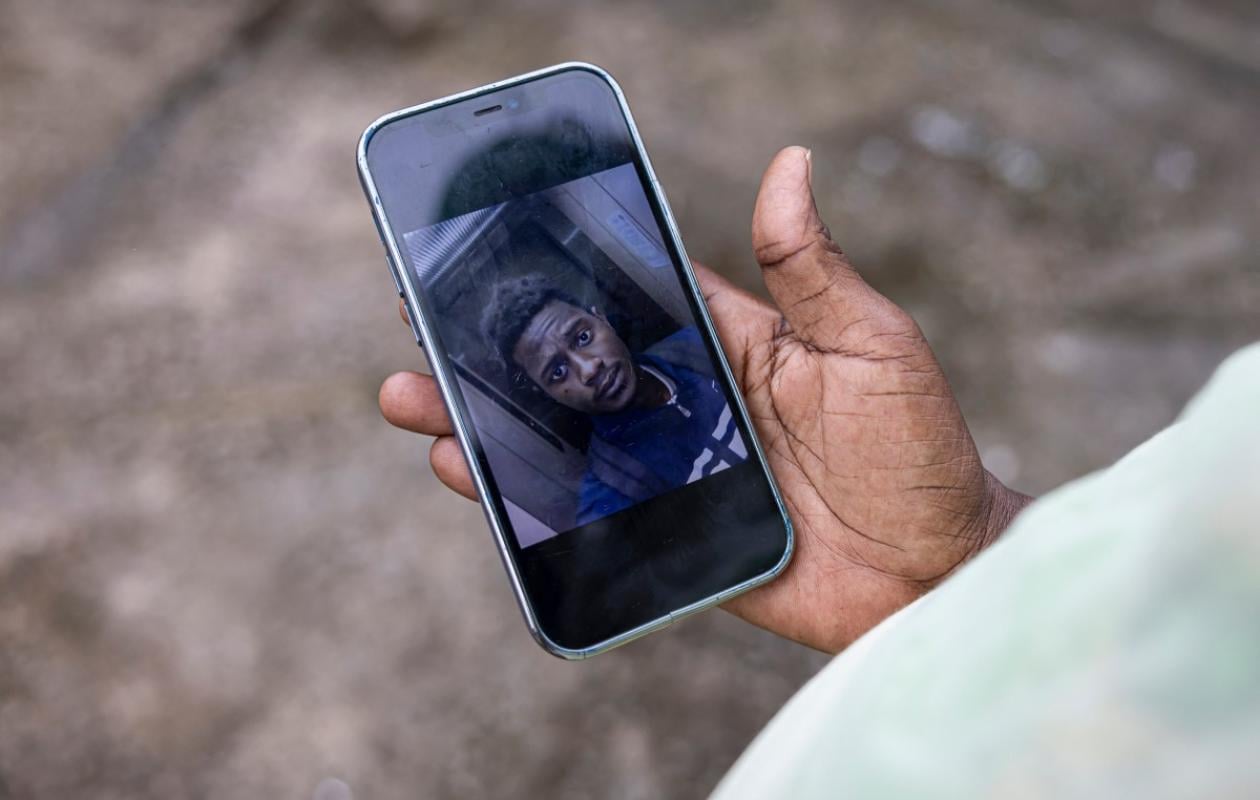
En Guinée, la déchirante quête des familles des jeunes disparus de la migration
"I know that the boat my son was on sank, but we were not shown his body. So to say that the little one died, I don't know...", says Abdoul Aziz Baldé in a sob, whose son, Idrissa, who left Guinea in search of a better future, is missing off the coast of Morocco.
Like him, thousands of young people who left Guinea clandestinely have disappeared during their journey to Europe, plunging their families into anguish and helplessness that torments them.
This phenomenon affects several West African countries, but the number is multiplied in Guinea, which in recent years has become one of the main African countries of origin for young migrants on their way to the Maghreb and Europe.
Their traces vanish before a planned departure at sea in overcrowded boats, a crossing of the desert at the mercy of smugglers who sometimes abandon them, during a police raid in the Maghreb, during imprisonment in Libya or in a detention center, or in a European city where they decide to disappear voluntarily, consumed by the shame of having failed in their dream.
Often left to their fate, their families are reduced to searching for their children by scouring Facebook for clues of places they have passed through or by watching macabre WhatsApp loops that broadcast photos of young corpses in morgues or washed up on beaches after shipwrecks.
But for the past year, a local NGO, the Guinean Organization for the Fight Against Irregular Migration (OGLMI), has brought a glimmer of hope and humanity. It has begun pioneering work, which AFP was able to follow, to identify the families of the missing and help them in their search.
"Out of 100 migrants who move, there will be at least 10 who will not return," Elhadj Mohamed Diallo, 38, executive director of OGLMI, told AFP.
While the number of missing Guineans is in the "thousands", the subject remains taboo in the country as well as at the level of international institutions, he laments.
On this autumn morning, he crisscrosses the capital, Conakry, on his red motorcycle, his colleague Tidiane as a passenger, then bumps along the unpaved streets of a suburb.
"Let me go to their house."
This is the first time he has come to meet the family of Idrissa, who has been missing for over a year.
"He is my first son... A very intelligent child" who would be 29 years old today, confides the father, Abdoul Aziz Baldé, a 62-year-old driver, deeply affected.
The family receives guests in a house shared between roommates, where the poverty is glaring.
With each family they meet, it's the same ritual. In a painful silence, Idrissa's parents scroll through WhatsApp messages on their phones to find the last visual trace of their child. In one of the last photos sent, a selfie, the young man's face appears smiling.
"If we manage to find his body, I would like to do everything possible to bring him back. Because he left to save us, and to save his little sister. But God didn't want that...", his father whispers, collapsing in tears.
Idrissa said he could no longer bear to see his father exhausting himself at work at over 60 years old. Despite brilliant studies, he saw, like many other young Guineans, no opportunities in the country.
His father can still hear him saying: "You are tired, you can no longer drive. Let me go to their place (in Europe) to find something to live on."
Starting in 2023, Idrissa attempted three times to reach Europe via Morocco. Each time, his father tried to stop him. Then he left a fourth time in 2024, carrying in his backpack "all his diplomas, from his middle school diploma to his master's degrees," his father would later discover.
On August 19, 2024, he received a call. "Are you Baldé? Do you have a son in Morocco? My deepest condolences," said a man on the other end of the line. "They boarded small boats... They drowned."
"The blow devastated me," said Mr. Baldé. "The whole family cried."
Idrissa disappeared in a boat that capsized on August 17, 2024, a young girl who was on board with him confirmed to them. "When they hit the wave, she lost consciousness. So she doesn't know where Idrissa went. Is he dead? Is he alive?" the father said, exhausted.
"Abandoned"
According to the International Organization for Migration (IOM), at least 33,220 people died or went missing in the Mediterranean and 17,768 on the African continent during their migratory journeys to Europe between 2014 and 2025.
These figures are considered to be largely underestimated, according to the Spanish NGO Caminando Fronteras, which for the year 2024 alone recorded 10,457 people who died or disappeared at sea "on the western Euro-African border".
Among them are "many people from Guinea," Helena Maleno, founder of this NGO, confirmed to AFP.
Among the relatives of the missing, "some people have strokes when they hear the news, others have insomnia, amnesia," emphasizes Guinean researcher Mahmoud Kaba, who is conducting a vast study on these families in Guinea.
These groups are isolated, while Europe restricts visas and increasingly controls its borders, migrants are criminalized, and the tragedy of deaths on migration routes often arouses indifference.
Abdoulaye Diallo, 67, grieving the loss of his eldest son, Abdou Karim, two years ago, told AFP he felt "abandoned".
He has been consumed by anxiety since March 2023, when his son, who would be 25 today, stopped sending him messages. The last traces of Abdou's life on Facebook date back to November 2023.
From the age of 18, in 2018, he left several times, first for Morocco, then Tunisia, then for a year in Libya, where he was imprisoned. Then, after returning to Conakry, he went back to Algeria and then to Morocco, from where he planned to travel to Spain.
"It was in 2023, he went to a dangerous area...", continues Mr. Diallo, who believes that his son passed through the Gourougou forest massif, east of Tangier (Morocco), which over the years has become a precarious base for thousands of migrants from sub-Saharan Africa seeking to enter the Spanish enclave of Melilla.
Moroccan authorities regularly conduct raids there to dislodge migrants from the forests.
"There is violence, especially on the side of the security forces. It is a country where lives are needlessly lost...", Mr. Diallo sighs, before collapsing in tears.
"There is no shame in being a parent of young people who have disappeared during migration," he believes. Because "it's a wind that has blown past every house in Africa, due to bad governance."
"I suppose he fell victim to bandits' traps, or police violence," Mr. Diallo added, his eyes reddened, now considering a funeral service. "But until I see actual evidence" of his death, "it's hard to believe."
Support group
When migrants disappear, or when their families suspect they have been arrested, they alert the authorities in Guinea by sending them what little information they have. But often there is no follow-up, notes Elhadj Mohamed Diallo of OGLMI, who, to alleviate their distress and break their isolation, has set up WhatsApp groups in local languages, as well as a support group.
The junta in power in Guinea since 2021 is reluctant to publicly discuss the phenomenon of illegal migration.
"Admitting that we are losing citizens at sea is also admitting a political failure and that we are not doing enough for our citizens," stresses researcher Mahmoud Kaba.
Mamadou Saïtiou Barry, the Director General of the Directorate General for Guineans Living Abroad, for his part, invites us to take the term "disappeared" with "a lot of mistrust," he told AFP.
According to him, many of those who have not died "have not succeeded and refuse to communicate", or "are hospitalized" or "under arrest or detention".
He points out that the authorities provided assistance to the families of the shipwrecked people they were aware of - often the few who received media attention.
"Whether in the country of origin, transit, or destination, there is no recognition of this tragedy and the fact that the number of victims is so high," denounces Helena Maleno of Caminando Fronteras. "There are sometimes villages where half the young people are missing."
"Families have the right to the truth and to file a complaint, the missing have the right to be searched for and the dead have the right to be buried with dignity. But getting states to recognize this is very complicated," she said.
After receiving a report of a disappearance from the families, the NGO OGLMI sets out to meet relatives across Guinea and gathers as much information and identifying details as possible from them, which it then transmits to associations or activists in the Maghreb, Europe, and as far away as Mexico, Argentina, the United States...
NGO contacts are sometimes commissioned to visit anonymous graves in "migrant sections" of cemeteries in the Maghreb or Southern Europe, or in morgues.
Elhadj Mohamed Diallo also highlights a lesser-known reality: many young migrants fall into mental illness after torture in prison in Libya, beatings by police in Morocco, or the death of a friend or relative alongside them on the road.
He himself has come a long way: he tried several times to migrate to Europe between 2015 and 2017. Detained in prison in Libya in 2017, he saw people die, was "sold" twice in Libya and was violently attacked several times.
Many Guinean families are also prey to people who try to take advantage of their distress by selling them, at exorbitant prices, proof of life of their missing loved ones.
"Don't forget them"
The day AFP met him in Conakry, 65-year-old Idrissa Diallo was desperately seeking answers about the disappearance of his son Aladji in Libya four years earlier. He confided that he had spoken that very morning to his marabout, whom he consults regularly: "He assured us that Aladji is alive..."
Mr. Diallo receives visitors on the porch of his house under construction, frozen in time. His son attempted the "adventure" - a term used in the region to refer to migration - in 2020 to find work and help his parents finance the construction.
Leaving for Dakar, Senegal in 2020, Aladji made his way to Mali, Algeria, then Libya where he worked in a garage before, in April 2021, embarking on a pirogue to try to reach Europe via Tunisia.
"People told us they couldn't cross and were scattered. We haven't heard from him since," the father recounts. Since the body was never found, Mr. Diallo "isn't sure" of his son's death. "Perhaps he was arrested and imprisoned in Libya, or in Italy," he hopes.
"As long as they don't have confirmation of the death, there is hope," Elhadj Diallo points out.
Because amidst the tragedies, the searches sometimes succeed, like those of Tahibou Diallo, 58, after two years without news of his son Thierno.
AFP had accompanied Elhadj when he first met Tahibou. The mother was visibly distraught, having helped her son travel to Spain. "He told me he was going to study there..." she said. Thierno then went to France and disappeared.
"My hope is that you will help me find him," Tahibou said, distraught, to Elhadj.
In October, thanks to a network of associations, the OGLMI was able to locate the young man, who was living and homeless in Nantes, in western France. He is apparently in very poor health, but his mother has been able to speak to him again and rebuild their fragile relationship.
Other families have contacted the NGO, which has been searching for over a year, leaving little hope. "These families need support in their grieving process," pleads Mr. Diallo. "We must not forget all these missing people."












Commentaires (1)
Participer à la Discussion
Règles de la communauté :
💡 Astuce : Utilisez des emojis depuis votre téléphone ou le module emoji ci-dessous. Cliquez sur GIF pour ajouter un GIF animé. Collez un lien X/Twitter, TikTok ou Instagram pour l'afficher automatiquement.