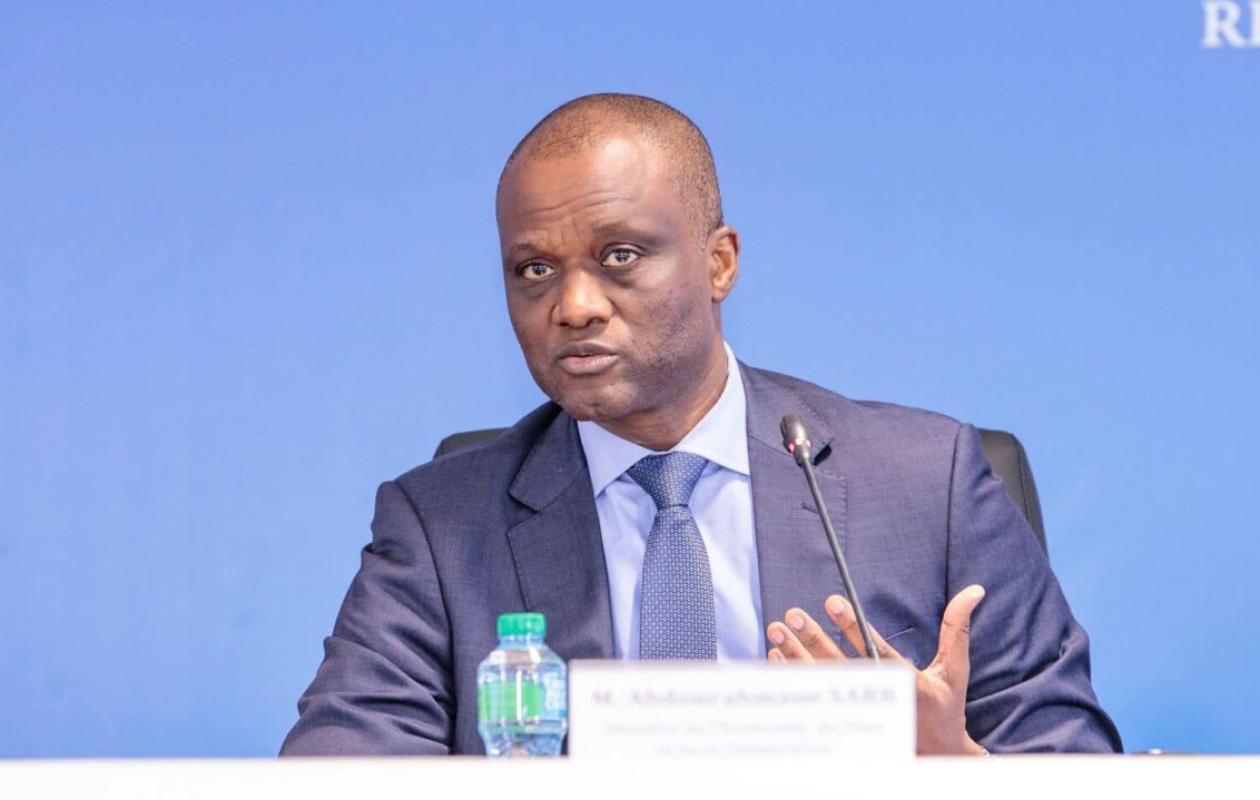
Dette publique : Abdourahmane Sarr rassure sur la soutenabilité des finances du Sénégal
Senegal's public debt currently stands at nearly 119% of GDP. A figure that, at first glance, may seem alarming. However, for the Minister of Economy, Planning, and Cooperation, Abdourahmane Sarr, this situation does not reflect a structural shift, but a moment of economic transition.
A guest on RFI's "L'Économie" program, he sought to restore perspective: "119% of GDP may seem scary in terms of a ratio, but the average maturity of Senegalese debt is between nine and ten years. The average cost of external debt is 3.5%, while the cost of all debt is around 4 to 4.5%."
The minister believes that "the debt is not expensive, if we compare it to the growth rate" and that it remains sustainable.
According to him, the increase in the budget deficit is linked to "extra-budgetary expenditures that were not transparently accounted for." He specifies, however, that "the deficit is projected at 7.8% in 2025 and at 5% in the 2026 finance law." This rebalancing, he explains, will make it possible to achieve "a zero primary deficit," an essential condition for stabilizing the debt.
Asked about Senegal's ability to continue borrowing, Abdourahmane Sarr dismissed any risk of a break with the markets. "Being able to borrow, what that really means, is being able to refinance. It matures without difficulty," he assured.
He recalled that the country is among the Frontier Markets, those emerging economies capable of accessing international financing while relying on an active regional market.
The minister also addressed the sensitive issue of "hidden debts," a topic that has been resurrected since the publication of budget audits. On this point, he clarified the government's position: "It is the law that requires a new government to audit public finances to establish a state of affairs. The International Monetary Fund speaks of misreporting, that is, the transmission of erroneous data. Anyone who transmits erroneous data is hiding the truth of the figures from those who should have received accurate information."
Abdourahmane Sarr acknowledges the existence of these discrepancies, but he attributes their cause to previous practices. "In our case, the scale was significant and the causes are known; these are extra-budgetary expenditures that were made without parliamentary authorization and without accounting for the debt stock," he said.
Macky Sall recently addressed this issue in an interview. He stated, in particular, that it was impossible to "hide" a public debt. Abdourahmane Sarr responded: "To the extent that the data transmitted and known to the transmitter do not match, it is misreporting. The corollary is obviously that the person who transmitted the data hid the truth."
He indicated that to restore transparency, the government has taken several steps. "The General Inspectorate of Finance first carried out its work, followed by the Court of Auditors. And to strengthen the credibility of the exercise, we commissioned an audit by a private international firm," the minister explained. The conclusions of this audit, now shared with the IMF, set the debt at "118% or 119% of GDP," a level now recognized by international institutions.
As for the question of renegotiation or rescheduling, Abdourahmane Sarr insisted that there is no danger in the matter. "The maturity of the debt is between nine and ten years, its average cost remains low, and growth, driven by hydrocarbons and upcoming reforms, remains solid," he said.
Finally, he reaffirmed the importance of the partnership with the International Monetary Fund: "The IMF is a respected institution that can give a pledge of confidence to certain investors. Once misreporting is overcome and debt sustainability is confirmed, we will be able to continue a normal and transparent relationship."












Commentaires (13)
Ce meme ministre avait dit il y a deux semaines que l'idéologie economique du gouvernement est un "Liberalisme Souverainiste Plannifie"....(rires). Le gas balance des oxymores sans s'en rendre compte et se ridiculise. Si Harvard produit ce genre d'individu, je n'aimerait pas que mes fils y mettent leur pieds
Je pense que nous devons travailler en bonne intelligence à dépasser cette situation, arrêter de tirer les uns sur les autres et aller de l’avant en soutenant les nouvelles autorités et en repositionnant le Senegal .
C’est juste une réflexion !
Mais Inaff monsieur inaf
Je donne cet exemple pour prouver qu'il faut investir a perte a cour terme pour viser le profit a long terme. C'est le cas de Senegal a l'exception pres de la gestion des derniers publics.
Je pense qu'il presente beaucoup mieux que Cheikh Diba qui semble etre de moindre calibre et qui etait responsable de la programmation budgetaire du temps de Macky. Je me demande encore comment Cheih Diba en charge de programmation budgetaire n'a rien vu venir.
Je trouve ausssi que le FMI a failli sur le plan du controle et de la gouvernance car meme si ce sont les pays qui envoient leurs donnees, il doit les controler et savoir que le choses ne tournent pas rond.
Depuis 2018 Diomaye avait ecrit un courrier au FMI en parlant de stock de la dette sous-estime mais personne n'a reagi du cote du FMI et c'est dommage.
Du temps de Wade j'ai beaucoup travaille avec Alex Segura qui representait le FMI au Senegal et regulierement il nous convoquait pour nous demander combien l'etat nous devait comme arrieres et a chaque fois notre secteur reclamait plus que ce que l'etat avait dans ses chiffres et Alex Segura se battait pour que l'etat nous paie avant de decaisser de nouveaux prets. En ce temps la le representant du FMI etait puissant et tres implique
La question que je me pose c'est, qui transmet ? J'ai l'impression que ce n'est pas l'ETAT avec les mêmes services et les mêmes hommes. bizarre kmm
Participer à la Discussion
Règles de la communauté :
💡 Astuce : Utilisez des emojis depuis votre téléphone ou le module emoji ci-dessous. Cliquez sur GIF pour ajouter un GIF animé. Collez un lien X/Twitter, TikTok ou Instagram pour l'afficher automatiquement.