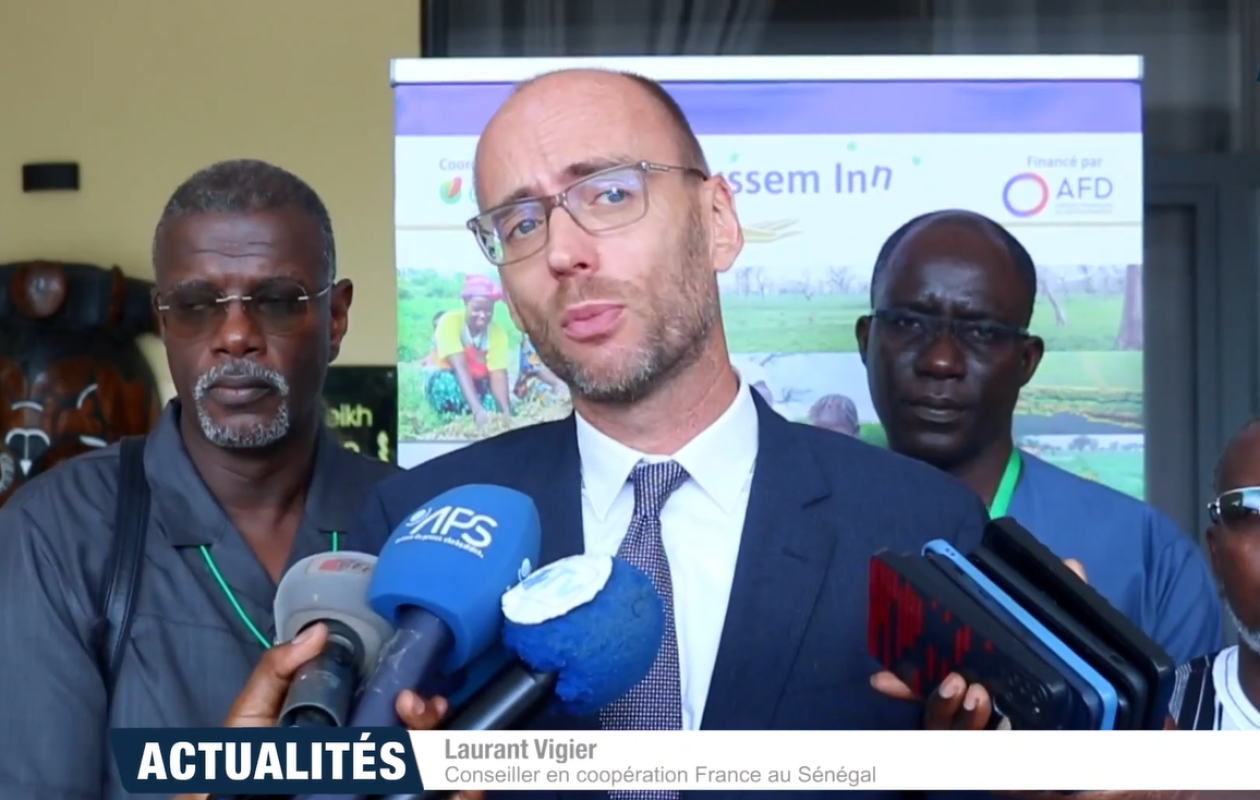
[Entretien] Laurent Viguié : « Notre objectif n’est pas d’accueillir des étudiants qui vont échouer en France »
From October 3 to 4, 2025, Campus France Senegal held its traditional Open Days, allowing students to learn about studying in France. On this occasion, Laurent Viguié, Counselor for Cooperation and Cultural Action at the French Embassy, Director of the French Institute in Senegal, and Supervisor of Campus France Senegal, spoke with Seneweb. He details the event's objectives, admission criteria, visa challenges, and prospects for academic cooperation.
Journalist: What is the main objective of the Campus France Open Days this year?
Laurent Viguié: The goal is to provide as much information as possible to candidates for study in France, whether they are high school or university students, as well as to their entourage, their families, and their principals. We brought together the principals yesterday in Dakar and opened the event to the general public to announce the launch of the annual study in France campaign. These days aim to explain the conditions, criteria, and procedures of the procedure, while initiating an information campaign that continues throughout the year, with these days as a starting point.
Journalist: How do these days help students to better choose their direction?
Laurent Viguié: They offer very practical assistance by providing information on the procedure, the timetable, and the documents to complete and gather to submit an application. Application completion workshops on the electronic platform ensure proper preparation. Individual and group counseling sessions also help explore study options in France and guide choices.
Journalist: Why did you also organize these meetings in Saint-Louis, Kaolack and Ziguinchor?
Laurent Viguié: Applicants for studies in France are present throughout Senegal. We are fortunate to have Campus France spaces at the Institut français de Saint-Louis, the Alliance française de Kaolack, and the Ziguinchor Chamber of Commerce, in addition to the one in Dakar-Medina near UCAD. These locations organize the same days with the same program over two days. To further expand our reach, we offer online activities, such as a Facebook Live yesterday morning from the Institut français de Dakar, accessible via replay with several thousand views, demonstrating strong demand for remote activities.
Journalist: What are the important criteria for admission to a university or school in France?
Laurent Viguié: The key criterion is to have a study plan that is consistent with the student's previous education—good success in the subjects chosen in high school—or with a degree obtained in Senegal, and with a career path. We assess the consistency of the plan with the student's trajectory, their abilities (baccalaureate level, quality of the course, possible repeats), and their potential for success. Our goal is not to welcome and support students who will then fail in France. We prefer that they succeed in Senegal rather than fail in France, thus avoiding difficult personal situations.
Journalist: Many students experience difficulties obtaining their visas, some even calling it an "obstacle course." What are the steps to follow today to obtain a student visa?
Laurent Vigué: It shouldn't be an obstacle course, and this image is sometimes a myth, especially for student visas. The Consulate General of France in Dakar devotes a specific season to exclusively processing these applications, with dedicated resources. Success depends on the students themselves. The campaign opens in June with appointments via VFS, the visa operator, but many wait until the last minute, particularly in August before the start of the September academic year. Anticipation is essential: submit early, present a complete file with clear documents, and avoid "tinkering" with missing documents. Dialogue with the administrations and a careful approach are necessary. The student visa issuance rate is high because the Campus France process has already filtered the applications.
Journalist: France already hosts more than 17,000 Senegalese students. How do you plan to strengthen this academic cooperation?
Laurent Viguié: Strengthening the country doesn't necessarily mean increasing this number. With the two governments, we are targeting 4,500 to 5,000 students per year, a figure deemed balanced for France and beneficial for Senegal. The goal is for these studies to be useful to the Senegalese economy, offering professional opportunities in France or Senegal. We also encourage the arrival of French students in Senegal through university agreements and support the establishment of French universities in Senegal, in partnership with local universities. This allows for shared curricula—one part in Senegal, one part in France—reducing costs for Senegalese students while enriching their career paths. With the growing population, we are diversifying options and opportunities.
Journalist: Are there any scholarship programs? If so, who is eligible and what are the priorities?
Laurent Viguié: Yes, there is the "France-Senegal Scholarship" program, detailed on bourse-france-senegal.sn . It targets master's degrees (annual scholarships) and doctorates (research stays). Open to all specialties, it prioritizes the best projects and courses, without subject restrictions, with an annual general call opening soon until the beginning of next year. We select the most promising applications.
Journalist: With the evolution of training in France, what advice can you give to young people to better prepare their study plans?
Laurent Viguié: Training programs are constantly evolving. The best advice is to inquire directly with reliable sources, such as French university websites, which offer programs for international students. Campus France, a trusted third party with no commercial interests, helps identify sectors, universities, and new programs. It distinguishes between diploma- and certificate-granting programs. Avoid private agencies promising enrollment, which is often a source of failure, and take ownership of the project by informing yourself for a solid educational interview.
Journalist: Families often worry about the cost of education and housing. What assistance is available for Senegalese students in France?
Laurent Viguié: There is no systematic aid on the French side, except for a few scholarships (around 1,500 students). The majority must anticipate the costs themselves. The consular process assesses whether the student has the resources to live and succeed. Families are right to be concerned, because without housing or means, success is compromised. After a year, some find small jobs to support themselves.
Journalist: What role can Senegalese youth play in the future of relations between France and Senegal?
Laurent Viguié: Young people are at the heart of our bilateral cooperation, representing 75% of those under 35 and 50% of those under 18 in Senegal. They are a priority for our governments, as they must find employment opportunities through higher education or original paths, such as training in arts and culture. They will bear the brunt of future challenges—climate, health, democracy—that define our common future. Listening and giving their voice a voice is essential.
Journalist: Does this also involve deconstructing certain prejudices?
Laurent Viguié: Yes, we rely on young people to deconstruct their prejudices. Campus France monitors alumni, whose credible accounts of the realities of studying in France—both advantages and difficulties—help to correct preconceived notions. We also promote cross-mobility with French students in Senegal and reciprocal volunteering, reversing the top-down logic of traditional aid. Initiatives like the social economy forum in Bordeaux or a delegation on cultural industries showcase Senegalese contributions, strengthening a relationship of equals and responding to the demands of young people seeking recognition.

















Commentaires (8)
comment vous pouvez justifier ces frais de visas aussi élevés avec zéro garantie que votre dossier sera étudié avec sérieux ?
journaliste dafay kharagne
J’ai su aussi y’a pas longtemps que la plupart de nos étudiants de polytechnique une fois la fin de leurs cursus poursuivent les études en Europe et finissent par y rester.
Participer à la Discussion
Règles de la communauté :
💡 Astuce : Utilisez des emojis depuis votre téléphone ou le module emoji ci-dessous. Cliquez sur GIF pour ajouter un GIF animé. Collez un lien X/Twitter, TikTok ou Instagram pour l'afficher automatiquement.