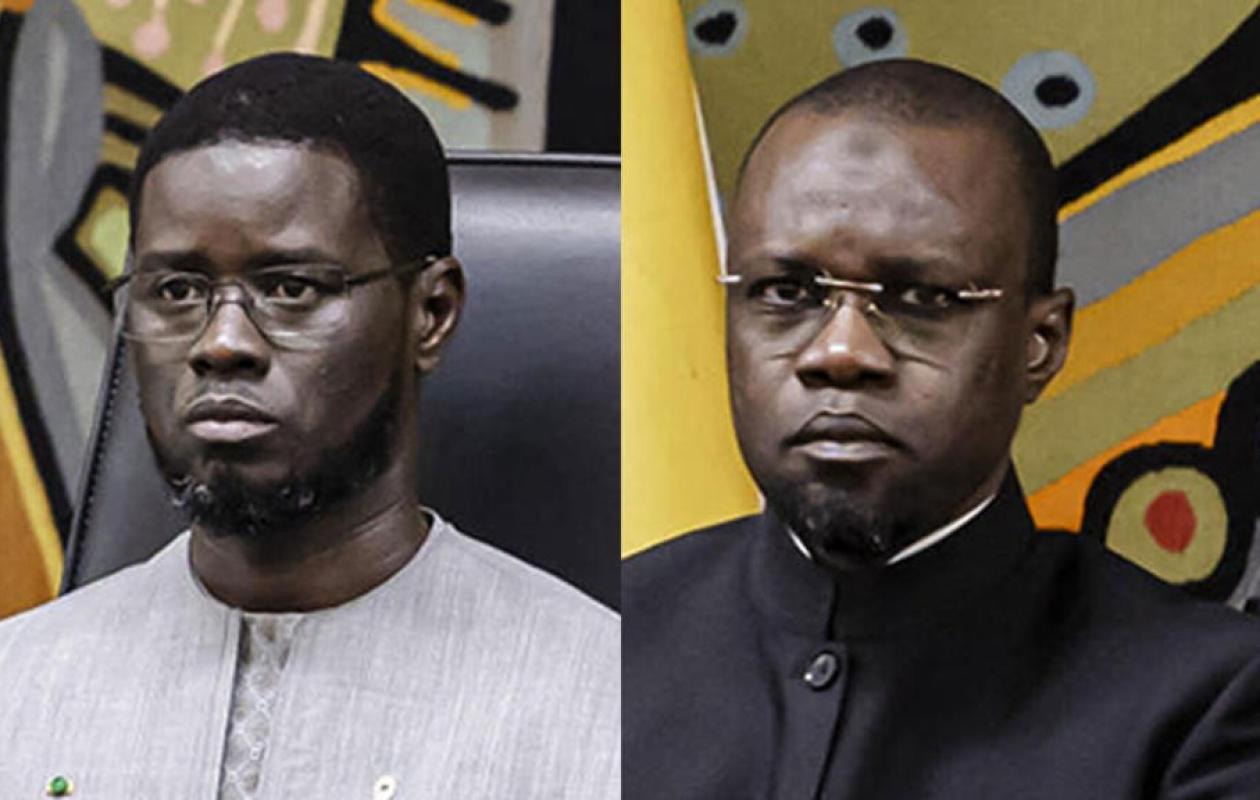
Diomaye-Sonko, fin du tandem : La rupture en 5 actes
Rumors had been circulating for over a year about their differences, but their friendship still seemed to withstand the harsh realities of power. This Friday, May 22, 2026, against all expectations, after a highly publicized appearance by the now former Head of Government before the National Assembly, the news came like a bolt from the blue. "The functions of Prime Minister Ousmane Sonko have been terminated," announced the Secretary General of the Presidency of the Republic, Samba Oumar Bâ, making public the decree issued by the President of the Republic.
Between the two friends, bound by strong ties (fraternal, professional, and political), the break had become inevitable, driven by their growing disagreements that they could no longer suppress, creating a discord that unsettled the entire Republic. After two years and one month of jointly exercising power, the trajectory of the duo who had brought Pastef to power in March 2024 under the iconic slogan "Diomaye mooy Sonko" (Sonko is my friend), thus came to a dramatic end.
Seneweb looks back at the 5 major events that foreshadowed a break between the President of the Republic and his Prime Minister.
Act 1: The first cracks and the "authority problem" (July 2025)
Indeed, the honeymoon began to publicly falter a little over a year (15 months) after they assumed the highest office. During the installation of Pastef's National Council on July 10, 2025, Prime Minister Ousmane Sonko confronted Diomaye Faye. Without flinching, Sonko unleashed his anger: "Senegal is not experiencing a classic political crisis. What the country is suffering from is a problem of authority. If we continue like this, it's clear we won't last in power."
This thinly veiled criticism points to shortcomings in President Bassirou Diomaye Faye's governance, particularly regarding the handling of legal cases related to political events granted amnesty between 2021 and 2024. He added that he had met with President Diomaye Faye to discuss the dysfunctions and delays in the judicial process. "I went to see him because he has the power to stop this if he wants. The real question is: why hasn't he made a decision yet? If I were in his position, things wouldn't be happening this way," he stated irritably, denouncing the opposition's attacks against him, before concluding firmly: "Let me govern!"
Act 2: Tera-meeting, Giga attacks against allies (November 2025)
A few months later, while the duo was trying to heal the wounds of July 10th, Sonko returned to the fray at his Tera-meeting on November 8th, 2025, which resembled a show of force. Before a sea of tens of thousands of supporters in the parking lot of the Léopold Sédar Senghor Stadium in Dakar, confirming his undiminished capacity for mobilization, Ousmane Sonko initially dismissed the speculations of dissension or rivalry at the highest levels of government between himself and his friend and political protégé, Bassirou Diomaye Faye.
However, launching a scathing attack on President Diomaye's allies and anticipating President Diomaye's decision to appoint Aminata Touré as supervisor of the reorganization of the Diomaye-President coalition, replacing Aïda Mbodj, Sonko disavows the former Prime Minister and reaffirms Pastef's authority over all other entities. The conflict thus shifts to the battle for control of political structures.
Act 3: Diomaye-President vs. Apte (March 2026)
Behind this reorganization of the ruling coalition, the structural friction between the presidential institution and the Pastef party apparatus was already emerging. Completely distancing himself from the Diomaye-President coalition, Prime Minister Ousmane Sonko launched the Patriotic Alliance for Work and Ethics (Apte) during an "Ndogou" (iftar) that resembled a war council held on March 15, one week after Diomaye-President's general assembly (March 7).
The establishment of these two parallel entities orbiting around the center of power already laid the groundwork for a genuine strategic and ideological rupture at the highest levels of the state. This was before public disagreements over governance methods ultimately brought everything to a halt.
While President Bassirou Diomaye Faye navigated the complexities of administrative caution, the lengthy process of economic reforms, and diplomatic demands, the party apparatus pushed for a radical acceleration of the break with the past embodied by the "Project." Thus, the underlying tensions over control of political direction and the pace of reforms ultimately destabilized the partnership.
Act 4: Amendment of articles L29-L30, the parliamentary majority bypasses the Diomaye (May 2, 2026)
The episode of the amendment to Articles L29 and L30 of the Electoral Code by Pastef MPs, followed by the public rebuttal and the subsequent referral of the text (it was promulgated last Friday after a second reading) by Bassirou Diomaye Faye, are blatant proof that the executive branch and its parliamentary majority were not entirely on the same page. By choosing the direct parliamentary route to reform these highly sensitive articles, the majority in the National Assembly, led by Prime Minister Ousmane Sonko, took the initiative, bypassing the process traditionally initiated by the executive branch following consultations with political actors.
An act that the Head of State publicly condemned, pointing out that the President of the Pastef parliamentary group, which initiated the bill, as well as the Speaker of the National Assembly, were members of the review committee examining the draft bills related to these articles. In a major interview given to local media two weeks ago, President Bassirou Diomaye Faye clearly expressed his irritation and reservations regarding the methods employed by members of his own majority (Pastef). He used this platform to showcase his political career, while vehemently denouncing the personality cult that is beginning to undermine the party.
"As long as he remains Prime Minister, it is because he has my confidence. When that is no longer the case, there will be a new Prime Minister," he declared.
Act 5: The clash of political funds and the dismissal (May 22, 2026)
The final act that undoubtedly sealed the fate of the power dynamic at the top was the former Prime Minister's appearance before the National Assembly on May 22, 2026. As was his custom, Ousmane Sonko publicly and bluntly expressed his disagreement with President Faye regarding the management of "political funds" in front of the members of parliament. Revealing the behind-the-scenes details of his intervention when MP Guy Marius Sagna considered formalizing a bill on the subject, Sonko confided: "When I learned that Guy Marius wanted to submit a bill, I went to see the President to tell him that letting the Assembly take up this fight would be a disgrace to the Executive branch, which had made a commitment."
He maintained that he had acted responsibly by placing the matter on the agenda of the Council of Ministers, and publicly conceded that the justifications put forward by the Head of State had not convinced him. "He gave me his arguments and I don't agree," he stated, adding that he would give the President of the Republic "a period of observation" before personally bringing the matter back before the Council of Ministers if the situation remained unchanged.
This latest protest was the final straw. A few hours later, the axe fell: by presidential decree, Diomaye Faye dismissed Ousmane Sonko and dissolved the government, bringing an end to the legendary partnership. A period of "soft" or "hard" cohabitation now begins, as predicted by the new head of the parliamentary majority a few months ago. Should we expect a risk of institutional gridlock (Executive vs. Legislative) or the dissolution of the 15th legislature on December 2, 2026? Time will tell.









Commentaires (52)
Participer à la Discussion
Règles de la communauté :
💡 Astuce : Utilisez des emojis depuis votre téléphone ou le module emoji ci-dessous. Cliquez sur GIF pour ajouter un GIF animé. Collez un lien X/Twitter, TikTok ou Instagram pour l'afficher automatiquement.