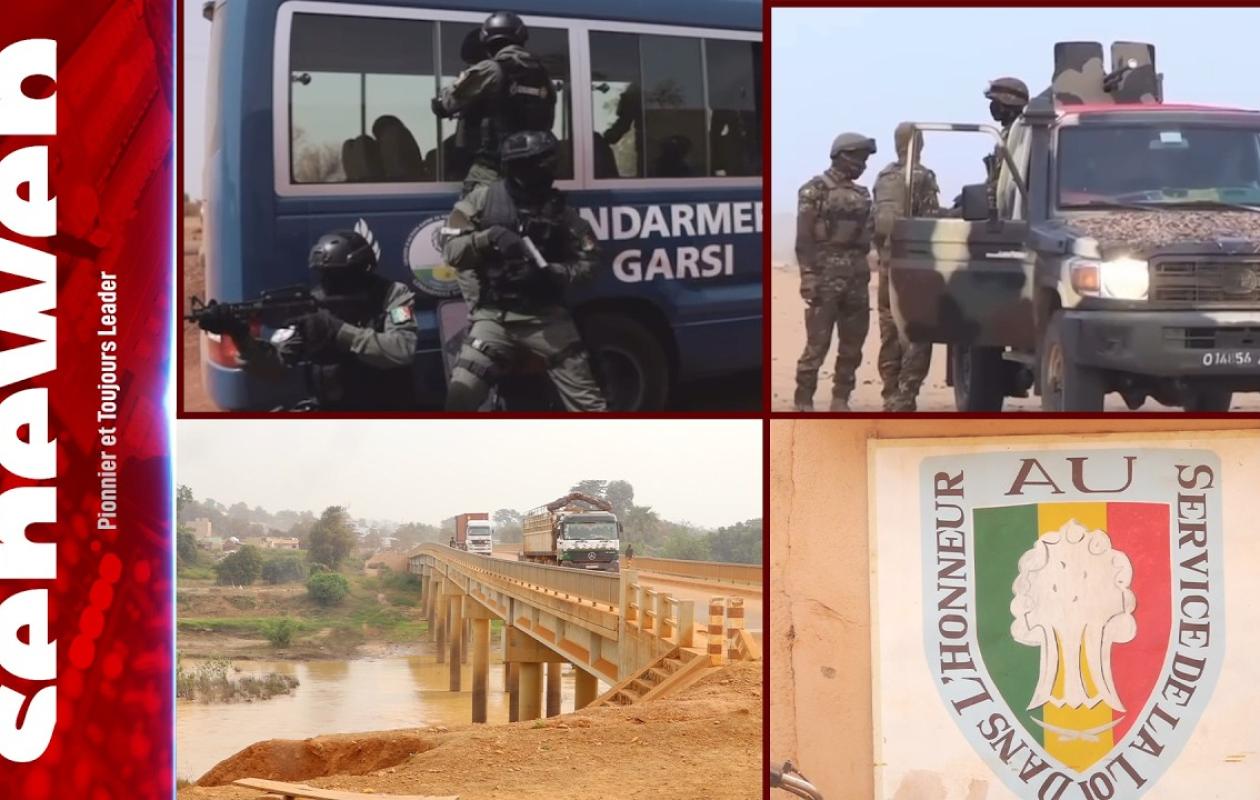
[Zoom sur…] Menace terroriste à l’Est : Quand la peur gagne les foyers de Kédougou 3/3
As the heart of the Sahel ignites, Senegal, long perceived as an island of stability, is monitoring its eastern border with extreme vigilance. In the Kédougou region, the gold rush, which is drawing people to the far reaches of the Sahel, along with the vast and porous border with Mali, is redrawing the map of risks. Faced with the distress of populations living in fear since the numerous attacks by JNIM (Group for the Support of Islam and Muslims) just a few kilometers from the border, the Defense and Security Forces, on constant alert to thwart any attempt at violence, are trying to plug this breach, which is as much psychological as it is territorial.
On the left bank of the Falémé River, the gold rush intensifies despite the presidential decree (dated July 31, 2024) suspending gold mining within a 500-meter radius of this major tributary of the Senegal River until July 31, 2027. The noise of excavators and water pumps never ceases, despite the intense dismantling operation carried out by the defense and security forces (FDS) and the waves of arrests. In the vast department of Saraya (7,433 square kilometers), located in the tri-border corridor (Mali-Guinea-Senegal), the wealth of the subsoil is certainly a blessing that attracts both locals and foreigners to the informal economy it creates, but it also draws in the instability plaguing neighboring Mali, marked by armed attacks and a persistent jihadist threat, among other things.
While no terrorist attacks have yet struck Malian soil, the pressure exerted by JNIM in western Mali, particularly the attacks on tanker truck convoys just a few kilometers from Senegal, remains a stark reality. In Saraya, anxiety is no longer just a whisper; it hangs heavy in every household and intensifies the closer one gets to the Malian border. As rumors of jihadist infiltration haunt the gold mining areas, the population, seeing the smoke of the Malian conflict drawing ever closer to their homes, lives in constant fear. As part of this in-depth report on the Kédougou region, Seneweb was able to gauge the population's anxious state.
Illegal gold mining and porous borders: sources of concern
Here, the fear of the jihadist threat is primarily fueled by the anarchy surrounding artisanal gold mining, particularly the proliferation of clandestine sites. Indeed, the real security challenge lies in regulating this sector, a driving force of the Kédovin economy. Artisanal gold mining in the diouras (gold panning sites) constitutes a major vulnerability, as these relatively lawless zones attract thousands of workers from across the sub-region, most of whom enter the country through unofficial access points, making it extremely difficult for intelligence services to track individuals. These services must monitor (24/7) like a hawk a department (Saraya, 7,433 km²) that is 13 times the size of the Dakar region (547 km²).
Incursions by unidentified armed groups responsible for several armed robberies in Saraya, the latest of which took place on Thursday, February 5, 2026 in the commune of Bembou, as well as the dismantling - at the end of January 2021 - of a suspected sleeper cell affiliated with the Katiba Macina in Kidira, are raising the concern of the people of Saraya who are now only sleeping with one eye open, according to the Secretary General of the Departmental Council, Filato Cissokho who received Seneweb in his office.
For him, in Kédougou, the security challenge is no longer simply about monitoring a point on a map, but about managing an entire ecosystem where gold, geography, fear, and external threats collide. “The fear of a jihadist infiltration is real among the people of Saraya. It’s true that considerable efforts are being made by the authorities to strengthen border surveillance, but today it’s very easy for neighbors to cross the Falémé River. So it’s a worrying situation for the population, and we feel that our security is threatened,” he says. Before adding: “The illegal gold miners and armed groups that enter the territory are often people who know the geography of the department and who know how to bypass the border police checkpoints.”
The Falémé River is no longer an insurmountable natural barrier
This porous border is exacerbated by the serious damage observed on the Falémé River, which is suffering the consequences of gold panning. As a result, this natural barrier is no longer impassable as it once was, since during the dry season, the water level is so low that it can be crossed on foot in some places. "Mining companies and traditional gold panners who were active in gold extraction along the Falémé contributed to the destruction of this river by depositing sand and toxic products. Today, during the dry season, crossing is very easy," confirms Mr. Cissokho.
Even worse, he confides, "this also facilitates the trafficking of illicit goods, particularly chemicals (cyanide, mercury), and explosives used in mining can be diverted to manufacture improvised explosive devices. Even weapons can circulate; it's possible." These statements are corroborated by the numerous armed attacks perpetrated along the corridor by heavily armed gangs. These are targeted criminal acts (gold traders are often the targets), but the local population sometimes bears the brunt of them.
“People are often afraid to travel in the department for fear of encountering armed groups,” explains Mamadou Fadiga, secretary general of the Red Cross in the Saraya department. For the moment, no link has been established between these highway robbers and JNIM. However, it is important to remember that for the terrorist group, controlling the informal gold trade routes throughout the Sahel is a matter of survival, since it derives the bulk of its income from them.
A reinforced and reassuring security system
With the rise of this Al-Qaeda affiliate, which recently threatened to attack the Kunda truck parking area 7 kilometers from Moussala (Saraya) in order to disrupt fuel supplies to the Malian capital, Kédougou has become the focal point of the General Staff's concerns. Dakar is particularly focused on local militarization, reinforced border surveillance including both visible and invisible measures, bilateral intelligence mechanisms, and streamlined military-community cooperation for real-time alerts.
The operation is underway, and the units (Border Police, elite units of the Gendarmerie and the Army, Forestry Service, Customs) are deployed in Moussala (on the Senegalese-Malian border), where the Seneweb team was able to witness firsthand the reassuring actions carried out daily. For the authorities, the threat does not come in the form of columns of armed pickup trucks, but rather that of a silent infiltration via the Diouras (traditional Malian villages).
Thus, faced with this risk, the Senegalese state has strengthened its security apparatus and increased operations on the ground. In December 2025, the "Boundou" maneuvers of military zone number 4 mobilized elite units to test the troops' responsiveness along the border. Also in February 2026, several illegal gold mining sites were dismantled in Saraya and Moussala, leading to dozens of arrests.
The gendarmerie has also reinforced its presence in the area with the Rapid Action Surveillance and Intervention Group (GARSI 2), the Kédougou research section and the Surveillance and Intervention Squadron whose premises will be delivered in July in accordance with the instructions of the Head of State Bassirou Diomaye Faye who visited the construction sites during his tour in the eastern zone.
In addition to strengthening military surveillance, the state intends to restore its presence wherever it was lacking, notably through the construction of various infrastructure projects. During his visit, the head of state also reaffirmed the link between security and development.











Commentaires (17)
Participer à la Discussion
Règles de la communauté :
💡 Astuce : Utilisez des emojis depuis votre téléphone ou le module emoji ci-dessous. Cliquez sur GIF pour ajouter un GIF animé. Collez un lien X/Twitter, TikTok ou Instagram pour l'afficher automatiquement.