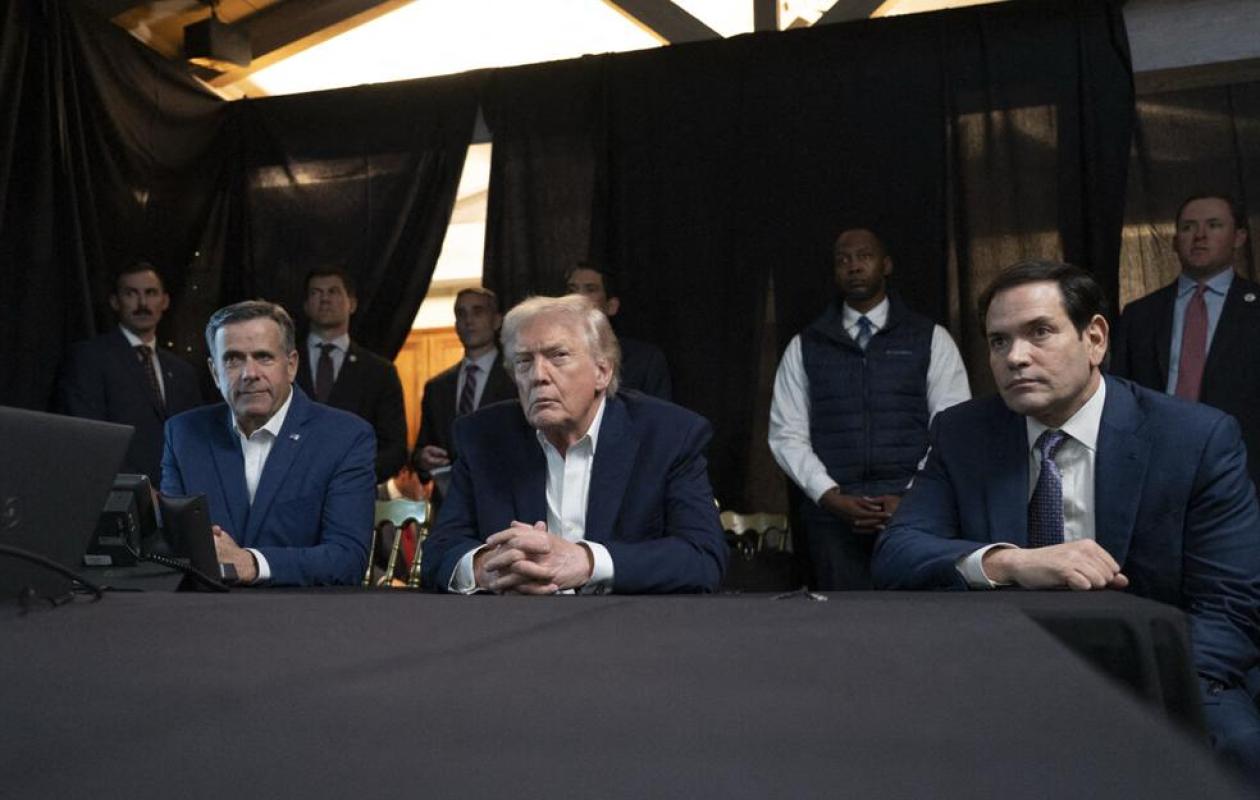
La doctrine "Donroe" inventée par Trump, un message aux adversaires des Etats-Unis
President Donald Trump on Saturday justified the operation to capture his Venezuelan counterpart Nicolas Maduro by the need to restore the undisputed supremacy of the United States over all of the Americas, a signal that could inspire China and Russia.
He presented this nighttime operation in Caracas, the capital of Venezuela, as a revival of the Monroe Doctrine, more than a century ago, considering Latin America to be the preserve of the United States.
"It's now called the 'Donroe Doctrine,'" he asserted at a press conference, adding his first name to the surname of his distant predecessor, James Monroe. "The Monroe Doctrine is very important, but we have far surpassed it," boasted Donald Trump.
"As part of our new national security strategy, American dominance in the Western Hemisphere will never again be questioned," he said.
He was referring to the document published nearly a month ago by the Trump administration redefining the United States' "National Security Strategy" in an openly nationalist direction.
With regard to Latin America, it states in particular that the United States must seek access to resources and strategic locations and ensure that the governments of the region are "sufficiently stable and well governed to prevent and discourage mass migration to the United States".
The United States "will deny non-hemispheric competitors the opportunity to position forces or other threatening capabilities, or to own or control strategic assets" in the region, according to the document, alluding to China, the main buyer of Venezuelan oil.
But this aggressive stance could encourage rivals of the United States, China and Russia in particular, to adopt a similar attitude in their sphere of influence, especially towards Taiwan and Ukraine respectively.
Just days before the operation targeting Nicolas Maduro, initially scheduled for the very end of 2025, China, which claims Taiwan as an integral part of its territory, conducted simulations of blockades and attacks against maritime targets around the island.
The operation in Venezuela could also serve as a warning to US allies worried about Donald Trump's threats to seize strategic resources, starting with his declared intention to annex Greenland, an autonomous Danish territory.
Jennifer Kavanagh, director of military analysis at Defense Priorities, a think tank that advocates for a less interventionist US foreign policy, who was long skeptical about the reality of Donald Trump's intentions regarding Greenland, now says she is questioning them.
"It would not be very difficult for the United States to send a few hundred or a few thousand troops to Greenland and I don't see who could oppose it," she said.
The operation in Venezuela "raises the question of whether the United States can proclaim a leader illegitimate, remove him from office and govern the country, why can't others do the same?", explains Jennifer Kavanagh.
UN Secretary-General Antonio Guterres expressed concern about the "dangerous precedent" set by the American intervention.
Especially since, under Donald Trump, Washington seems to have reversed its policy of firmness towards Beijing and Moscow.
The new national security strategy advocates a refocusing of the United States on its immediate environment while remaining restrained on China and Russia, leading some of its detractors to conclude that Donald Trump recognizes their supremacy in their spheres of influence.
At a minimum, this operation signals a tougher US line in Latin America, says Alexander Gray, an Atlantic Council researcher who served on the National Security Council during the first term of the Republican president.
According to him, "it is very clear that there will no longer be any tolerance for even the kind of low influence from China, Russia or Iran that we have known over the last two decades."







Commentaires (24)
L'Afrique, l'Amérique latine, le Moyen-Orient, l'Asie centrale et l'Europe doivent s'unir pour dire non à ces prédateurs.
Je ne pense pas car la première chose que Trump a fait après son intervention militaire c'est d'organiser une visioconférence avec Macron, Lula et Milei pour les rassurer. Il les considère donc comme des puissances régionales importantes. Il n'a même pas contacté les autres pays pour s'expliquer.
La souveraineté dépend de la capacité à la sécuriser et limiter la prédation. Ça passe soit :
- par une puissance militaire et économique autonome (seuls une poignée de pays le peuvent peut-être véritablement seulement la Chine et les États-Unis, même la Russie n'y arrive pas en Ukraine)
- par des alliances militaires, association d'état (pays de l'OTAN hors USA, alliances militaires)
- autonomie ou intégration dans un autre état (Groenland, Outre-mer français, Nunavut, Îles Cook, Kiribati, etc...) qui assure le respect de la souveraineté du peuple concerné sur les décisions locales.
Les USA ont aussi ce statut avec Puerto Rico mais la population portoricaine a moins de droits que celle du Groenland, de Guyane, Polynésie française ou Nunavut car elle ne peut pas voter pour les élections nationales americaines alors que dans les territoires des pays européens ou du Canada les citoyens ont exactement les mêmes droits que les autres.
Il n'y a qu'un petit groupe de sous homme qui se nomme blanc supremaciste qui approuve ce qu'il fait en ce moment l'élection du maire de New York en ait la preuve.
Ils n'essaiyeront jamais avec l'Iran le dirigeant vénézuélien a été trahi de l'intérieur de son pays mais surtout de ses voisins les latins américain se disent chrétiens mais à la Judas l'Afghanistan et le Pakistan ne donnerons jamais cette chance aux américains d'atteindre l'Iran.
Le prophète Mouhamad (PSL) quand un mécréant menace l'un de vous coalisez vous et chassez le.
Participer à la Discussion
Règles de la communauté :
💡 Astuce : Utilisez des emojis depuis votre téléphone ou le module emoji ci-dessous. Cliquez sur GIF pour ajouter un GIF animé. Collez un lien X/Twitter ou TikTok pour l'afficher automatiquement.